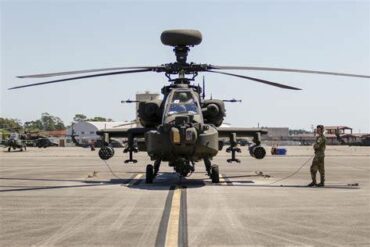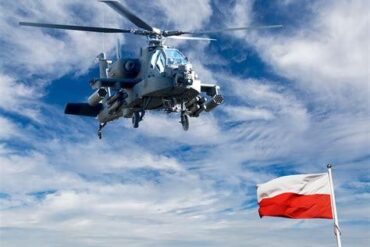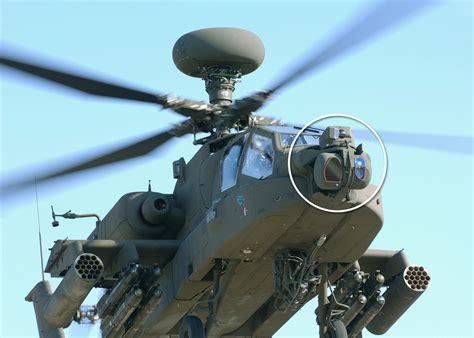
The AH-64 Apache is instantly recognizable by its heavily armed profile, tandem cockpit, and the large spherical sensor mounted prominently on its nose. At first glance, the device can look like an oversized camera, but its purpose is far more sophisticated. The prominent assembly is a critical part of the helicopter’s target acquisition, targeting, navigation, and night-vision capability, allowing Apache crews to operate effectively when visibility is poor.
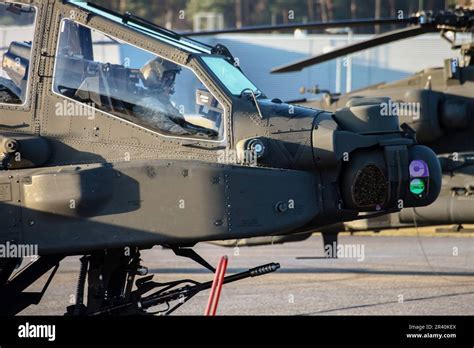
The system is known as the Target Acquisition Designation Sight/Pilot Night Vision Sensor (TADS/PNVS), with the modernized version designated MTADS/PNVS. Rather than being a single sensor, the nose assembly contains multiple optical and electronic systems designed to give the Apache crew the information needed to find, identify, track, and engage targets.
Why the Apache Has a Giant Nose Sensor
The Apache’s sensor exists because its weapons are only as useful as the crew’s ability to detect and identify targets. The helicopter may carry a powerful combination of the M230 chain gun, rockets, and precision-guided missiles, but locating a target from the cockpit can be extremely difficult at night, in darkness, or through challenging weather.
The sensor turret provides the crew with a stabilized view of the battlefield while supporting both pilotage and targeting. The system can work during the day and at night, allowing the Apache to remain operational when conventional vision becomes severely limited.
The Day Sensor Assembly incorporates technologies including a color television sensor, laser rangefinder/designator, and laser spot tracker. These components allow the crew to gather information about distant objects while also supporting the accurate employment of the helicopter’s weapons.
How TADS/PNVS Supports Apache Crews
The Apache’s nose-mounted equipment essentially gives the aircraft an electronic set of eyes. The targeting system can direct sensors toward an area of interest, helping the crew maintain awareness without relying entirely on unaided vision.
The system became particularly important during combat operations in Iraq and Afghanistan, where Apache crews frequently operated at night and in complex environments. The U.S. Army began fielding the modernized system in 2005, and it entered combat the following year. By 2013, the equipment had accumulated approximately one million flight hours, demonstrating how central the technology had become to Apache operations.
New Sensors Could Give the Apache Wider Vision
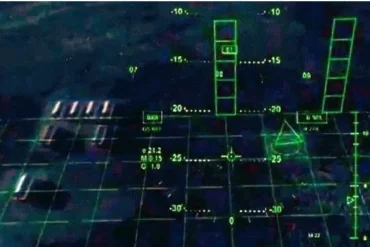
The traditional system has an important limitation: its thermal camera is mounted on a gimbal and follows the pilot’s line of sight. That provides an excellent view in the direction the pilot is looking, but it cannot simultaneously show the entire surrounding environment.
Researchers at the University of Arizona have been exploring a different approach using 21 fixed sensors mounted inside a spherical structure. The concept combines their individual images into a much wider view that can be displayed through the pilot’s helmet-mounted system.
The experimental technology could provide approximately a 210-degree horizontal field of view, potentially giving Apache pilots five to seven times more horizontal coverage than the current pilotage system. Army-supported testing is examining challenges such as motion blur and fixed-pattern noise.
The Sensor Is More Than a Camera
That giant sphere on the Apache’s nose is therefore not simply a camera. It is a sophisticated multi-sensor targeting and pilotage system that helps transform the helicopter from a heavily armed aircraft into an effective all-weather battlefield platform. Its prominent position reflects just how important seeing, tracking, measuring, and identifying targets are to the Apache’s combat effectiveness.