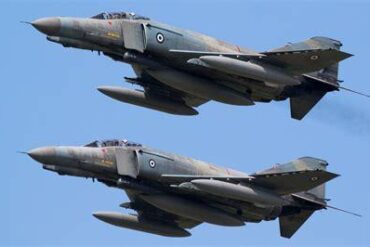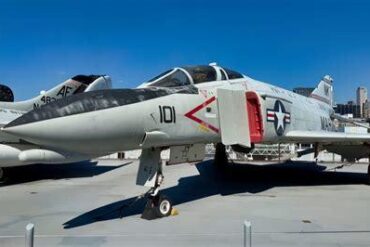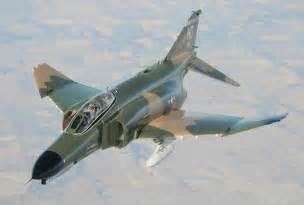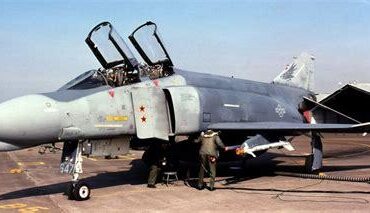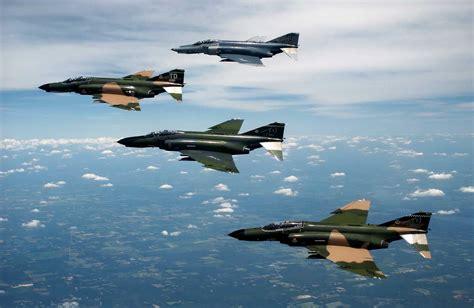
The McDonnell Douglas F-4 Phantom II belongs to a generation of combat aircraft built around a remarkably direct idea: make the airplane fast, powerful, heavily armed, and capable of carrying enough fuel and weapons to solve problems through sheer performance. It was not elegant in the modern sense, and it was never intended to be. The Phantom was a product of the Cold War, when speed, radar, missiles, altitude, range, and payload were considered the foundations of air superiority. Yet more than six decades after its first flight, its design philosophy still reveals why today’s fighters operate according to an entirely different set of rules.
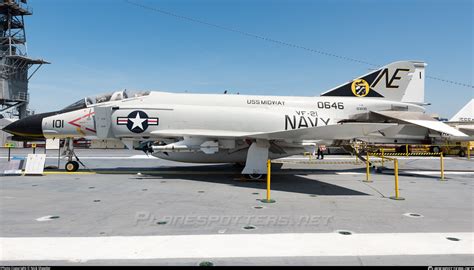
The Phantom first flew in 1958 as a carrier-based interceptor for the US Navy. Its tandem two-seat configuration, twin engines, large radar, heavy structure, and substantial weapons capacity made it look almost oversized compared with many fighters that followed. But that size provided useful advantages. The aircraft could carry enormous quantities of fuel and weapons, accommodate a powerful radar, and support two crew members without compromising its fundamental mission. It eventually became important to the US Navy, Marine Corps, and Air Force, while foreign operators adopted it in large numbers.
Few American fighters have accumulated such a broad operational history. Around 5,195 F-4s were built between 1958 and 1981, and the aircraft fought in Vietnam, the Middle East, and the Gulf War. Israel used the Phantom extensively, while countries such as South Korea, Greece, Turkey, and Iran operated their own versions. The fact that some examples remained operational more than half a century after the type entered production says something important about the underlying airframe.
The F-4 Phantom II Was Built Around Power
The most striking feature of the Phantom was not any single component. It was the way the entire aircraft was designed around raw power. Its maximum takeoff weight exceeded 60,000 pounds, while its two General Electric J79 turbojets could produce more than 34,000 pounds of combined afterburning thrust. Depending on the variant and configuration, the aircraft could reach approximately Mach 2.23, climb at more than 41,000 feet per minute, and carry as much as 18,000 pounds of external weapons and stores.
That combination created an aircraft with extraordinary flexibility for its era. The Phantom could accelerate rapidly, climb hard, fly at high altitude, carry substantial weapons, and remain useful over long distances. It was hardly a lightweight dogfighter, but dogfighting was not initially the problem its designers expected it to solve.
The F-4 was conceived during a period when military planners believed that radar-guided missiles and beyond-visual-range combat would increasingly dominate aerial warfare. The large nose-mounted radar gave the aircraft a significant detection capability for its time, while its speed and altitude allowed it to reach engagements quickly. The aircraft did not need to turn like a lightweight fighter if it could detect, engage, and destroy an opponent before entering a traditional turning fight.
That assumption explains one of the Phantom’s most famous shortcomings. Early versions were delivered without an internal cannon because designers believed missiles had made guns largely obsolete. Combat experience over Vietnam demonstrated that the assumption was too optimistic. Missile reliability, engagement rules, identification problems, and close-range encounters forced the US military to rethink the role of the gun. Later Phantom variants received an internal M61 Vulcan cannon, while external gun pods were also employed.
The lesson was not that the Phantom was badly designed. Instead, it demonstrated how quickly combat assumptions can become obsolete.
Why Pilots Called It a Flying Brick
The F-4 acquired colorful descriptions such as “flying brick” and “lead sled”, but those nicknames should not be interpreted as evidence that the aircraft was aerodynamically incompetent. It was a large, powerful supersonic aircraft carrying a considerable amount of equipment. Its designers deliberately accepted compromises in maneuverability to obtain speed, range, payload, radar performance, and structural strength.
Its engines provided the solution to many of those compromises.
A lightweight fighter can obtain maneuverability through a low wing loading and efficient aerodynamics. The Phantom took another route. It could use enormous thrust to compensate for its mass and overcome aerodynamic penalties. The result was an aircraft that could accelerate aggressively and climb rapidly, even though it was not optimized for sustained low-speed turning combat.
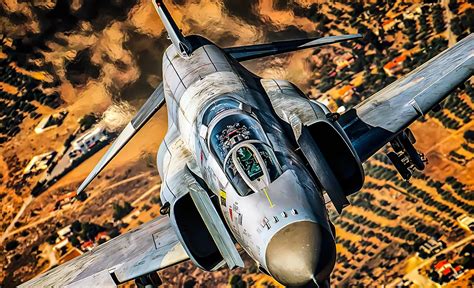
This approach worked particularly well when speed was considered life insurance. A fast aircraft could control the geometry of an engagement, disengage from unfavorable situations, reach the target quickly, and exploit altitude and energy. But the same philosophy became less attractive once air combat experience showed that fighters frequently operated at much lower speeds than their theoretical maximum.
Vietnam provided an especially important lesson. Analysis of more than 100,000 sorties over two decades of the Vietnam War showed that American fighters spent remarkably little combat time at their maximum speeds. The Phantom’s theoretical Mach 2 capability was impressive, but actual combat rarely demanded sustained Mach 2 flight.
That distinction changed fighter design permanently.
The Supersonic Speed Race Started Losing Its Meaning
For decades, fighter development seemed to follow a simple pattern: the next aircraft should be faster than the previous one. The Phantom reached approximately Mach 2.23, and the later F-15 Eagle pushed the figure to around Mach 2.5. But subsequent fighters became progressively less obsessed with maximum speed.
The F-16 Fighting Falcon can reach roughly Mach 2, while the F/A-18 Hornet is around Mach 1.8. The F-35 Lightning II is considerably slower at approximately Mach 1.6. Even advanced future fighter concepts are not necessarily being designed around extreme maximum speed.
There is a straightforward reason. High-speed flight consumes enormous quantities of fuel and dramatically reduces combat endurance. A fighter that can briefly reach Mach 2 may have little practical advantage if doing so leaves it with insufficient fuel to remain over the battlespace.
Furthermore, air combat does not normally take place at maximum speed. Aircraft maneuvering for combat generally operate at subsonic speeds, with approximately Mach 0.7 often representing a useful region for turning performance. Consequently, maximum speed became only one variable in a much larger equation involving sensors, weapons, range, fuel consumption, maneuverability, electronic warfare, and survivability.
The Phantom’s experience helped expose the limits of the old philosophy: being extremely fast is useful, but being fast is not the same as being effective.
The F-16 Changed the Fighter Design Philosophy
The next major step was the emergence of the fourth-generation fighter. The F-16, F-15, and F/A-18 represented a fundamental change from the Phantom’s philosophy.
The F-16 emerged from the Lightweight Fighter program with an emphasis on low weight, high maneuverability, and efficient aerodynamics. Its aerodynamic instability made the aircraft exceptionally responsive, but such an aircraft would be extremely difficult for a human pilot to control manually. The solution was fly-by-wire flight control technology, which allowed computers to continuously make the tiny corrections required to keep the aircraft controllable.
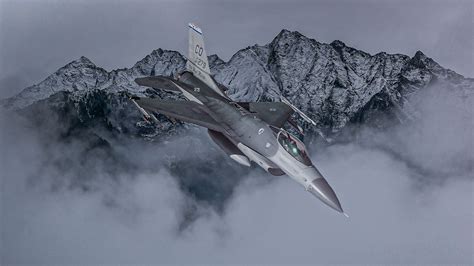
This was almost the opposite of the Phantom’s brute-force approach. Instead of adding more engine power to compensate for aerodynamic compromises, designers could use computers to exploit aerodynamically efficient and deliberately unstable configurations.
The F/A-18 followed a related philosophy. Developed from the YF-17, it combined maneuverability with carrier suitability and eventually became one of the most versatile multirole fighters ever produced.
The Phantom could perform many missions, but it generally required different variants or configurations for specialized roles. Later fourth-generation fighters were increasingly designed as true multirole platforms, able to switch between air-to-air and air-to-ground missions without requiring an entirely different aircraft.
That distinction became increasingly important as aircraft became more expensive and air forces sought greater capability from smaller fleets.
The Phantom Was Versatile, But Not Truly Multirole
One reason the F-4 remained valuable for so long was its adaptability. The basic airframe could accommodate different sensors, weapons, reconnaissance equipment, and mission systems. The aircraft was used as an interceptor, fighter-bomber, reconnaissance aircraft, and electronic warfare platform.
Yet this versatility should not be confused with the modern concept of multirole design.
The Phantom’s different missions often required specialized variants or equipment. Modern fighters are increasingly designed from the beginning to perform multiple missions through software, sensors, data links, and modular weapons integration.
This represents a profound change. The Phantom’s physical structure was the central source of its capability. Modern aircraft increasingly derive capability from electronics and software layered onto the airframe.
That difference becomes even clearer when looking at fifth-generation and emerging sixth-generation concepts.
Modern Fighters Are Designed to Avoid the Fight
The F-4 was fundamentally an aircraft intended to enter the battlespace and fight through it. Modern stealth aircraft are increasingly designed around the opposite concept: avoid detection, collect information, coordinate other assets, and attack without exposing themselves unnecessarily.
The F-35 Lightning II illustrates this transformation. Its lower top speed is only one small part of its overall design. Stealth, sensor fusion, electronic warfare, data sharing, and situational awareness are central to its combat value.
The aircraft does not need to resemble the Phantom because it is solving a different problem.
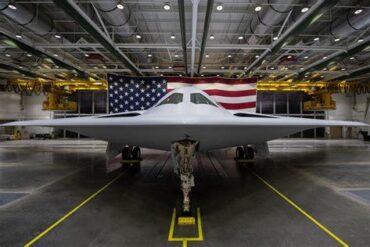
A future aircraft such as the F-47, being developed under the US Air Force’s Next Generation Air Dominance program, is expected to push this philosophy further. Publicly available information remains limited, but the broader direction of next-generation combat aviation emphasizes stealth, long range, networking, electronic warfare, advanced sensing, and crewed-uncrewed teaming.
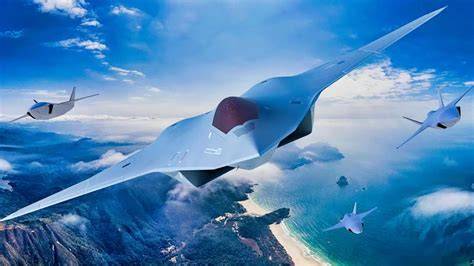
Instead of a lone fighter attempting to overpower an enemy formation, the future combat aircraft is increasingly envisioned as a node within a larger network. It may detect targets, share information, coordinate drones, suppress enemy sensors, and launch weapons while relying on other platforms to perform different parts of the mission.
In that environment, the Phantom’s brute-force formula becomes increasingly difficult to justify.
Why Brute Force Became Too Expensive
The underlying problem is not that modern engineers are incapable of building another massive, powerful fighter. They absolutely could. The problem is that modern combat environments punish the strategy.
An aircraft weighing tens of thousands of pounds can be given enormous engines, substantial armor, huge weapons loads, and powerful sensors. But if modern surface-to-air missiles can detect and engage it from considerable distances, additional engine power does not necessarily solve the survivability problem.
The same principle can be seen beyond the Phantom.
The A-10 Thunderbolt II was built around remarkable toughness, armor, and its enormous GAU-8/A cannon. The B-52 Stratofortress was designed in an era when bombers were expected to penetrate heavily defended airspace, while Soviet designs such as the Tu-160 pursued speed, range, and large weapons capacity.
Modern warfare has increasingly pushed these platforms toward stand-off operations or carefully controlled environments. The objective is no longer simply to survive enemy fire through structural strength.
The economics are equally important. Modern combat aircraft are extraordinarily expensive, while highly trained pilots represent years of investment. Losing an aircraft today can mean losing a sophisticated sensor platform, weapons carrier, network node, and trained human crew simultaneously.
That makes survivability through avoidance increasingly valuable.
The Phantom’s Real Legacy Is Its Design Philosophy
The F-4 Phantom II therefore cannot be understood simply as an obsolete fighter that modern aircraft replaced. It represents the endpoint of a particular way of thinking about air combat.
The Phantom asked: How much speed, power, radar, fuel, and weaponry can be placed into one aircraft?
Fourth-generation fighters changed the question to: How can aerodynamics, computers, maneuverability, and multirole capability make one aircraft more efficient?
Fifth-generation aircraft ask something different again: How can the aircraft detect the enemy without being detected, understand the battlespace first, and coordinate the entire force?
That progression explains why no modern fighter truly replicates the Phantom. The aircraft itself was not the problem. Its underlying assumptions belonged to a different era.
The F-4 could carry extraordinary payloads, fly above Mach 2, climb at astonishing rates, and absorb the demands of carrier and land-based operations. More than 5,000 examples were produced, and its combat history stretched from Vietnam to the Middle East and beyond. Few aircraft have demonstrated such longevity and adaptability.
But the age of sending a heavily armed crewed aircraft into hostile airspace and trusting speed, engines, missiles, and toughness to get it through is disappearing.
Today, the goal is increasingly to make the enemy struggle to find the aircraft in the first place.
That is the ultimate reason the F-4 Phantom II cannot simply be recreated. Modern air forces do not need another flying brick with bigger engines. They need aircraft that can survive a battlespace where detection, networking, electronic warfare, stealth, long-range weapons, and unmanned systems matter as much as raw aerodynamic performance.
The Phantom won by brute force because brute force was an effective answer to the military problems of its time. Modern combat aircraft are being built around the idea that the smartest way to win is not to overpower the battlefield, but to understand it first, remain difficult to detect, and strike before the opponent can respond.