The United States relies on a layered air and missile defense architecture that stretches far beyond interceptor launchers. Some installations host batteries designed to destroy incoming missiles, while others provide sensors, command networks, hardened backup centers, and training pipelines that allow those weapons to work as one system. Together, these bases illustrate how American air defense is increasingly built around integration.
The threat environment now extends beyond traditional ballistic missiles. Cruise missiles, hypersonic weapons, drones, rockets, and low-observable targets can approach from different directions and altitudes. A modern defense network therefore needs several layers, with each component contributing to detection, decision-making, interception, or recovery.
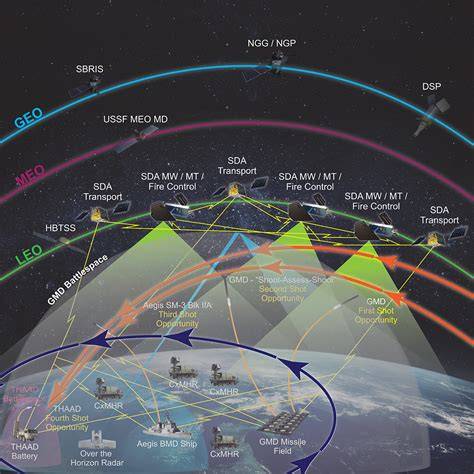
That approach is also central to the emerging Golden Dome for America initiative. Officially commenced in January 2025, the homeland missile-defense effort calls for an integrated system combining existing sensors and interceptors with new space-based capabilities. The stated goal is nationwide protection against ballistic, hypersonic, and advanced cruise-missile threats. Congress provided $24.4 billion through FY2025 reconciliation legislation, while the FY2027 budget request adds another $17.9 billion, making the program one of the largest tests of US defense integration and industrial capacity this decade.
Andersen Air Force Base: Guam’s Multilayered Missile Shield
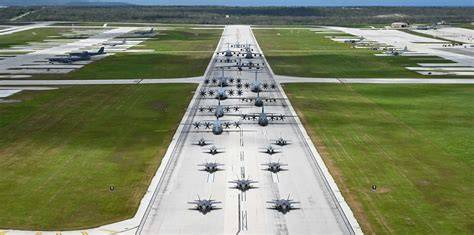
Andersen Air Force Base on Guam across the western Pacific occupies a strategically exposed position at the edge of the American defense perimeter in the western Pacific. For more than a decade, the installation was associated with Task Force Talon, the US Army’s first forward-stationed THAAD unit. The task force turned in its colors during a July 1 ceremony, transferring its mission to the reactivated 3rd Battalion, 43rd Air Defense Artillery Regiment. The battalion is building toward full activation while expanding the range of counter-missile capabilities available on the island.
Guam is the leading edge of the Enhanced Integrated Air and Missile Defense program, a Missile Defense Agency initiative valued at $1.7 billion. Its objective is a 360-degree defense architecture capable of addressing ballistic missiles, cruise missiles, and hypersonic threats. Rather than relying on one interceptor, the system layers land-based Aegis capabilities with existing Patriot and THAAD units. Another battalion is bringing Indirect Fire Protection Capability systems intended to counter rockets, artillery, mortars, and drones at closer ranges.
Patriot and THAAD serve different portions of the engagement problem. The Patriot PAC-3 Missile Segment Enhancement interceptor uses hit-to-kill technology, meaning it destroys its target through direct impact rather than an explosive warhead. An active radar seeker and dual-pulse solid rocket motor support engagements at roughly 37 miles, or 60 kilometers, and altitudes reaching about 50,000 feet. THAAD extends the defensive envelope much higher and farther during the terminal phase of an incoming ballistic missile’s flight.
The integration effort is equally important. The Missile Defense Agency has expanded a Lockheed Martin contract to $1.935 billion through 2029 to connect Navy SM-3 and SM-6 interceptors, Army THAAD and Patriot PAC-3 systems, and joint sensors through a common battle-management network. Andersen is therefore becoming a test of whether multiple defensive layers can share information and coordinate engagements across a battlespace.
Joint Base Lewis-McChord: The Command Center Behind Western Air Defense
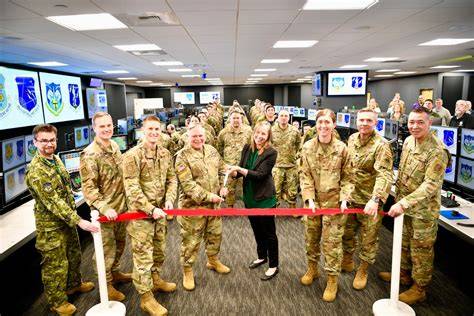
Joint Base Lewis-McChord in Washington demonstrates that a critical air-defense installation does not necessarily need interceptor launchers. The base is home to the Western Air Defense Sector, or WADS, a Washington Air National Guard organization that works with its East Coast counterpart to provide strategic air-defense operations over the continental United States. In peacetime, WADS supports NORAD’s mission of maintaining air sovereignty and identifying potential threats.
Its responsibility covers roughly 63% of the continental US landmass. A Sector Operations Control Center combines radar information, airborne data, and civil air-traffic information into a single air picture. Personnel can identify unusual activity and, when necessary, direct fighters or other assets toward unidentified or hostile aircraft. The organization is joint and binational, incorporating Washington Air National Guard personnel, US Army and Navy personnel, and a Royal Canadian Air Force detachment.
WADS recently completed a major modernization of its operations center, including ten server racks and approximately two million feet of new fiber-optic cabling. The upgrade represents its largest technology leap since the post-9/11 buildup. Such infrastructure is fundamental to modern air defense because an interceptor cannot engage a threat that the network has failed to detect, classify, track, or assign.
The same principle is visible in the relationship between Patriot and THAAD. Since 2022, Lockheed Martin has demonstrated that Patriot M903 launchers and PAC-3 MSE interceptors can receive commands through THAAD’s radar and fire-control network. This allows the systems to contribute to a broader engagement architecture without requiring every component to be physically colocated. WADS represents the command-and-control layer that makes such integration meaningful at national scale.
Cheyenne Mountain: America’s Hardened Missile Warning Backup
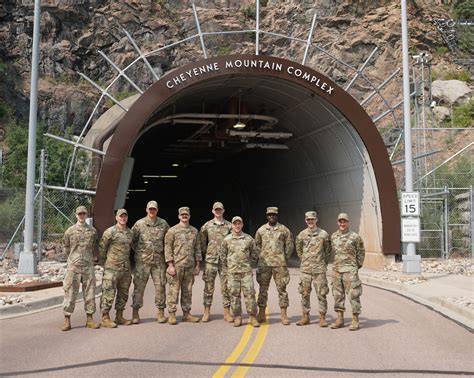
Colorado’s Cheyenne Mountain Complex represents a different kind of defense. Instead of concentrating on an interceptor battery, the mountain provides a hardened location for command, warning, and continuity-of-operations functions. Peterson Space Force Base in Colorado Springs is now the day-to-day headquarters for NORAD and US Northern Command, while many missile and space-warning responsibilities that once operated primarily from Cheyenne Mountain shifted to Peterson in 2006.
Cheyenne Mountain, however, never became irrelevant. The complex remains on warm standby as a hardened and electromagnetic-pulse-resistant alternate command center. Its design reflects a fundamental assumption of strategic defense: a command network must continue operating even if its primary node is attacked, disrupted, or otherwise unavailable. A skeleton crew maintains readiness, while the facility can be staffed when circumstances require it, including during a physical attack, cyber intrusion, or electronic-warfare event.
Inside the mountain, missile-warning functions continue to monitor ballistic missile launches and objects in space. They contribute to the wider tactical warning and attack-assessment process that has operated continuously since the Cold War. The architecture creates redundancy between an active command site and a hardened alternative.
That redundancy matters because the most sophisticated interceptor in the world has limited value if the command network directing it has been disabled. Cheyenne Mountain therefore provides a form of layered defense that is invisible in the sky. Its protective value comes from survivability, continuity, and the ability to preserve decision-making when an adversary attempts to disrupt the broader system.
Fort Bliss: Where Integrated Air and Missile Defense Is Tested
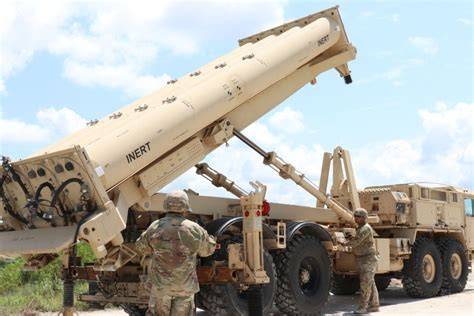
Fort Bliss in Texas is one of the most important US Army locations for operational air and missile defense development. It hosts the 32nd Army Air and Missile Defense Command, a theater-level headquarters responsible for synchronizing air-defense forces for combatant commanders worldwide. The installation also houses the 11th Air Defense Artillery Brigade, which fields Patriot battalions, THAAD units, and the Army’s Integrated Air and Missile Defense Battle Command System, known as IBCS.
The Army intends IBCS to become the common command architecture for Patriot battalions, Indirect Fire Protection Capability units, and maneuver air-defense formations. Fort Bliss was among the first locations to receive complete production-representative IBCS equipment in 2024. In October 2025, soldiers used the system in a contested electronic environment to track two missiles and destroy both during the capstone phase of its follow-on operational evaluation.
THAAD gives Fort Bliss another important capability. A complete THAAD battery includes six truck-mounted launchers, each carrying eight interceptors, for a total of 48 missiles. The system is designed to intercept threats during the terminal phase at approximately 25 to 93 miles in altitude and out to roughly 125 miles in range. A battery typically operates with about 95 soldiers, while its X-band radar provides tracking needed to support engagements.
The radar itself is a major technological asset. Each unit costs roughly $400 million to $500 million, and a 2025 gallium-nitride upgrade roughly doubled its detection range while improving its ability to identify smaller and less visible targets, including hypersonic glide vehicles. Fort Bliss is therefore not simply a place where air-defense weapons are stored. It is a proving ground for the Army’s effort to make separate sensors, launchers, interceptors, and command systems function as a unified network under demanding conditions.
Fort Sill: The Training Pipeline for America’s Air Defenders
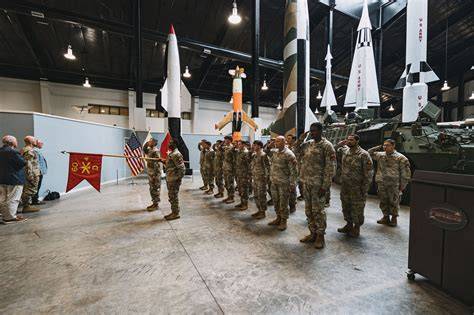
Fort Sill in Oklahoma plays a less visible but essential role. Following the 2005 Base Realignment and Closure decision, the US Army Air Defense Artillery School moved from Fort Bliss to Fort Sill’s Fires Center of Excellence. The school trains personnel who operate the Army’s air-defense systems.
Training covers the specialized jobs required to operate a modern battery, from Patriot fire-control positions to launch-station crews responsible for handling and firing PAC-3 interceptors. Fort Sill hosts the 31st Air Defense Artillery Brigade and the 30th Air Defense Artillery Brigade, reinforcing the installation’s connection to operational air-defense formations.
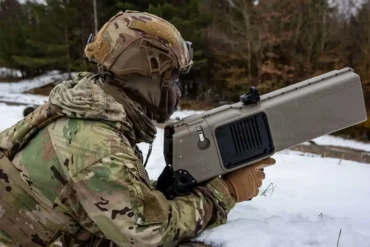
The training mission has expanded. Fort Sill now includes the Counter-small Unmanned Aircraft Systems University, which prepares planners and operators to address the expanding drone threat. Recent conflicts have demonstrated that air defense is no longer concerned only with aircraft and ballistic missiles. Drones, loitering systems, rockets, artillery, and mortars force defenders to balance detection, response time, ammunition expenditure, and cost.
How These Five Bases Fit Into a Larger Defense Network
Taken together, these installations reveal why advanced air defense cannot be measured simply by counting missiles. Andersen provides layered interception around Guam. Fort Bliss develops the Army’s integrated battle-management architecture. Fort Sill produces the personnel needed to operate it. WADS builds the continental air picture, while Cheyenne Mountain provides hardened continuity if a primary command node is compromised.
The same philosophy increasingly shapes US missile defense nationally. Golden Dome depends on connecting sensors, interceptors, command networks, and potentially space-based systems into an integrated architecture. The Missile Defense Agency has argued that much of the required technology already exists and that the central challenge is integrating it effectively.
That is a demanding engineering and organizational problem. Different services operate different weapons, sensors have different detection characteristics, and threats can arrive on trajectories that cross traditional boundaries between air defense and missile defense. The architecture must also withstand cyberattacks, electronic warfare, physical attacks, communications failures, and multiple threats at once.
The five installations show how the United States is addressing different parts of that challenge. From Guam’s expanding interceptor layers to Washington’s continental air picture, Colorado’s hardened command backup, Texas’s integrated combat testing, and Oklahoma’s training pipeline, the architecture depends on every layer working with the others. The most advanced air-defense system is not a single missile or radar. It is the network that allows them to detect, decide, and respond as one force.