The global airline industry is entering a quieter but potentially more important fleet-renewal cycle. While headlines often focus on billion-dollar widebody purchases and giant orders for the latest Airbus A350, Boeing 787, or 737 MAX, airlines are also committing billions to aircraft that operate much closer to the regional end of the market. These smaller jets are becoming essential as carriers try to serve thinner routes without sacrificing profitability.
The reason is straightforward. An A320neo or 737 MAX can be exceptionally efficient when full, but putting a 180-seat aircraft onto a route with insufficient demand can quickly destroy its economics. Modern regional aircraft such as the Embraer E2 family and Airbus A220 give airlines another option. They combine lower capacity with newer engines, improved aerodynamics, longer range, and substantially better fuel efficiency than many of the aging regional jets they are replacing.
This shift is happening across North America, Europe, Asia, and South America. Some airlines are replacing aging CRJs and first-generation E-Jets, while others are deliberately creating new fleet segments between traditional regional aircraft and larger narrowbodies. The result is a major reshaping of regional aviation, and seven airlines in particular have made commitments that reveal just how seriously carriers are taking the next generation of smaller aircraft.
American Airlines Is Buying 90 Embraer E175s for Its Regional Network
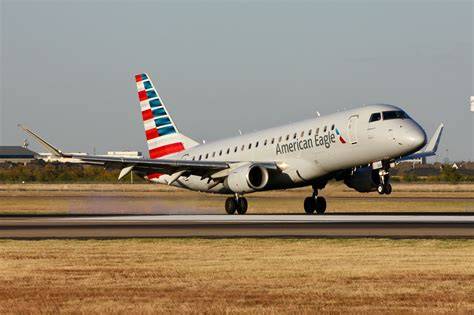
American Airlines is one of the clearest examples of how regulatory restrictions continue to influence US regional fleet decisions. The airline included 90 Embraer E175s in a much larger 260-aircraft order that also included Airbus A321neo and Boeing 737 MAX variants. Unlike the larger aircraft, the E175s will primarily be operated by American’s regional partners, including PSA Airlines, Envoy Air, and Piedmont Airlines.
The E175 remains uniquely important in the United States because it fits within the restrictions imposed by pilot union scope clauses. These agreements generally limit regional aircraft to 76 seats and a maximum takeoff weight of 86,000 pounds. That seemingly technical restriction has had an enormous impact on the US regional fleet, effectively preventing the larger and heavier E175-E2 from entering the market under current rules.
American therefore has little choice but to continue investing in the current-generation E175 if it wants to maintain a large regional network. The aircraft will replace older CRJ-200 and CRJ-700 jets that are increasingly expensive to operate and maintain. The strategy allows American to preserve connections through major hubs such as Charlotte, Dallas/Fort Worth, Chicago, and Philadelphia while matching aircraft capacity more closely with demand.
The E175 has also become remarkably dominant in US regional aviation. Republic Airways, which operates E175s for both American and Delta, became the world’s largest E-Jet operator after absorbing Mesa Air Group in 2025. American’s order therefore is not simply about adding aircraft. It reinforces an existing regional ecosystem built around the E175 and the unique economics of US scope-clause operations.
AirAsia Is Betting Big on the Airbus A220-300
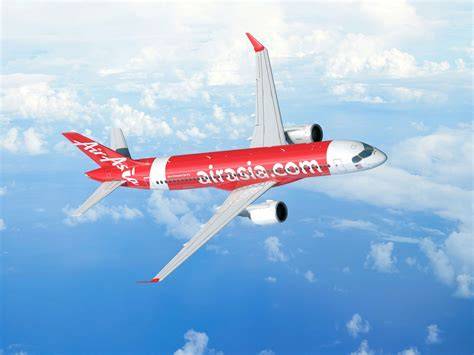
If American’s purchase demonstrates the importance of regulatory constraints, AirAsia’s 150-aircraft Airbus A220-300 order demonstrates the opposite: how a low-cost carrier can use a smaller aircraft to reshape its network. Announced in May 2026, the commitment is valued at approximately $19 billion at list prices and represents the largest single firm order for the A220 program.
AirAsia plans to begin receiving the aircraft in 2028. The airline is particularly interested in the A220 because its economics allow the carrier to pursue markets that are too small for its existing A320-family fleet. Instead of forcing an A320 into a thin market, AirAsia can deploy an aircraft with substantially fewer seats while maintaining an efficient cost structure.
The airline will also become the launch customer for a new 160-seat all-economy configuration of the A220-300. Additional overwing exits make the higher-density layout possible, giving AirAsia an aircraft that sits between a conventional regional jet and a traditional narrowbody in terms of capacity.
This is strategically important because AirAsia’s larger aircraft can then be deployed where they generate better returns. The A220s can serve shorter Southeast Asian routes, while A320-family aircraft concentrate on stronger regional markets and A330s remain available for longer-haul operations.
The deal also illustrates how fiercely Airbus and Embraer are competing for the next generation of regional flying. AirAsia reportedly considered the Embraer E2 and China’s COMAC C919 before selecting the A220. The order pushed the A220 program beyond 1,000 firm orders, giving Airbus a major boost in one of commercial aviation’s most competitive segments.
Scandinavian Airlines Is Rebuilding Its European Regional Fleet
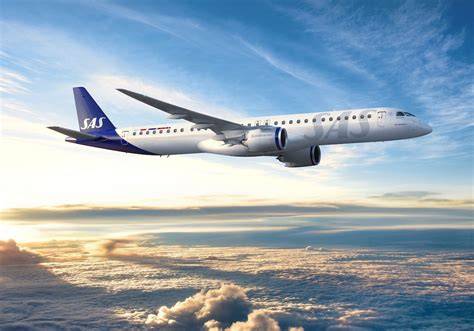
Scandinavian Airlines (SAS) is taking a different approach, using the Embraer E195-E2 to replace both aging CRJ-900s and Airbus A319s. The airline signed for 45 aircraft in 2025, with purchase rights for another 10. Deliveries are expected to begin in late 2027 and continue for roughly four years.
For SAS, the E195-E2 is particularly well suited to the geography of Northern Europe. Scandinavian markets contain many routes connecting major hubs with smaller cities where an A320neo may offer too much capacity. A smaller aircraft allows SAS to preserve frequency and connectivity without carrying hundreds of empty seats.
The E195-E2 is also expected to deliver approximately 30% lower fuel burn per seat than the aircraft it replaces. That improvement matters enormously on short-haul routes, where fuel, airport charges, and crew costs can make up a significant portion of operating expenses.
The order also forms part of SAS’s broader transformation following its emergence from Chapter 11 bankruptcy protection in 2024. With new ownership led by a consortium that includes Air France-KLM, SAS is reshaping its fleet and network while operating within the SkyTeam alliance. The E195-E2 gives the airline a modern regional aircraft capable of connecting the Scandinavian network while avoiding the capacity penalty of larger narrowbodies.
Finnair Chooses the E195-E2 Despite Its Airbus Fleet
Finnair’s 18-aircraft E195-E2 order is particularly revealing because the airline already has a substantial Airbus presence. Its fleet includes A350s and A321s, making the Airbus A220 a natural candidate for fleet commonality. Instead, Finnair selected Embraer’s larger E2 variant in March 2026.
The decision reflects an important principle in fleet planning: commonality is valuable, but it is not everything. Finnair needs an aircraft optimized for relatively short European and domestic Finnish routes, and the E195-E2 offers the capacity and economics the airline believes best fit those missions.
Finnair has highlighted a 30% reduction in CO2 emissions per passenger compared with the aircraft being replaced. The airline has also described the E195-E2 as highly versatile and among the quietest aircraft in its category.
Price was another factor. The E195-E2 has a lower list price than the A220-300, with the difference cited at approximately $22 million per aircraft. Across a meaningful fleet order, the acquisition-cost gap becomes substantial, particularly for an airline rebuilding its network after years of disruption.
Finnair expects deliveries between 2026 and 2030. It also plans to acquire up to 12 used A320 or A321 aircraft to provide additional capacity during the transition. That combination shows that fleet renewal is not always a simple replacement exercise. Airlines often use new regional aircraft, secondhand narrowbodies, and existing assets simultaneously to bridge different parts of their networks.
LATAM Airlines Is Using the E195-E2 to Reconnect South America
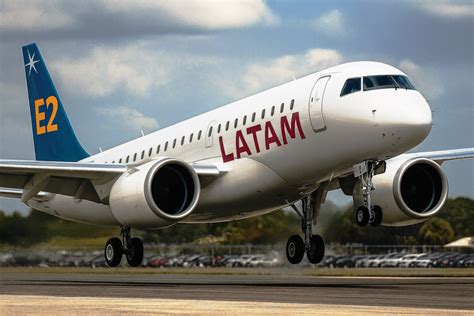
LATAM Airlines Group has committed to 24 firm Embraer E195-E2s with options for another 50. The firm aircraft are valued at approximately $2.1 billion, and deliveries began in the second half of 2026, initially focusing on LATAM Airlines Brazil.
The aircraft will be used to connect secondary Brazilian cities with major hubs such as São Paulo Guarulhos. This is precisely where smaller aircraft can create value. A route may have enough demand to justify frequent service but not enough to fill an A320-family aircraft economically throughout the year.
LATAM’s decision is especially interesting because its fleet is heavily dominated by Airbus narrowbodies. Choosing the E195-E2 therefore represents a deliberate move rather than a simple extension of existing fleet commonality.
The airline evaluated the A220 before selecting Embraer. Acquisition cost was one consideration, while Embraer’s Brazilian manufacturing presence offered another strategic advantage. For a major Brazilian carrier, having a smaller aircraft supplied by a manufacturer with deep roots in the country’s industrial base can create commercial and logistical benefits.
The E195-E2 could eventually serve other LATAM subsidiaries across Chile, Colombia, Ecuador, and Peru. That gives the airline considerable flexibility as it develops a regional network across markets where demand varies substantially between cities and seasons.
All Nippon Airways Is Bringing the E190-E2 to Japan
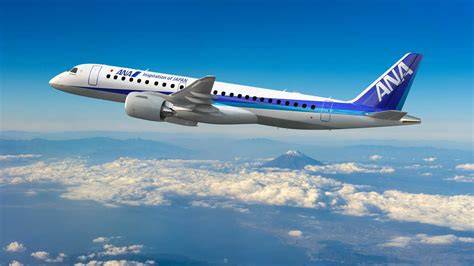
All Nippon Airways (ANA) ordered 15 Embraer E190-E2s with options for five additional aircraft, becoming the first Japanese airline to order an E2-family aircraft. Deliveries are scheduled to begin in 2028.
Japan is a particularly interesting market for a modern regional jet because domestic demand is enormous but highly concentrated around major population centers. ANA can use larger aircraft where demand is strong while deploying the E190-E2 on thinner routes feeding its major hubs at Tokyo Haneda and Tokyo Narita.
The E190-E2 typically accommodates around 97 to 114 passengers, depending on configuration. That puts it in a useful position between traditional regional aircraft and larger narrowbodies. For ANA, the aircraft can replace older regional equipment while avoiding the inefficiency of deploying a larger aircraft on every route.
Japan’s domestic aviation market handled approximately 111.47 million passengers in 2025, and air travel remains particularly competitive against rail on journeys where the Shinkansen takes three hours or more. This creates opportunities for airlines to use smaller aircraft to provide direct connectivity between secondary cities and major hubs.
ANA’s order could also have significance beyond the airline itself. If the E190-E2 performs well in Japan, other carriers could become more comfortable with Embraer’s latest generation of aircraft. That makes the country’s regional fleet market an important potential growth opportunity for the manufacturer.
Avelo Airlines Is Building a New Fleet Around the E195-E2

Avelo Airlines has made one of the boldest regional fleet commitments among US carriers, ordering 50 E195-E2s with purchase rights for another 50. Deliveries are scheduled to begin in the first half of 2027.
Avelo’s operating model makes the aircraft particularly interesting. The airline focuses heavily on secondary airports and point-to-point routes, including airports such as Hollywood Burbank and Tweed New Haven. These markets can have demand that is too inconsistent for a 737-800 but strong enough to support a smaller jet.
The E195-E2 can therefore give Avelo another tool for network expansion. Its takeoff performance can also make it attractive at airports where runway limitations or operating restrictions complicate the use of larger narrowbodies at full payload.
Avelo currently operates Boeing 737-800s, meaning the arrival of the E195-E2 will create a mixed fleet. Over time, however, the airline has indicated that the smaller aircraft could become central to its long-term strategy on routes where its operating economics outperform those of the 737.
If Avelo ultimately exercises all 50 purchase rights, its potential 100-aircraft E195-E2 commitment would make it one of the largest operators of the type worldwide.
Why Regional Fleet Renewal Is Becoming a Billion-Dollar Strategy
These seven airlines are making different fleet decisions, but the underlying trend is remarkably consistent. Airlines need a more efficient aircraft category between the traditional regional jet and the full-size narrowbody.
The E175, E190-E2, E195-E2, and A220-300 address different portions of that market. Some are constrained by regulation, some are optimized for low-cost operations, and others are designed to replace aging aircraft on European, Asian, and South American networks. Together, they represent a broader movement toward matching aircraft size more precisely with passenger demand.
The timing is also significant. Older regional aircraft are becoming increasingly difficult and expensive to keep in service, while fuel efficiency and emissions performance have become central considerations in fleet planning. Airlines cannot simply replace aircraft one-for-one. They are reassessing what size of aircraft should operate each route and whether a smaller aircraft can create new markets that larger jets cannot profitably serve.
Embraer has already passed 500 cumulative E2 orders, while the A220 program has moved beyond 1,000 firm orders. In the first half of 2026, Embraer delivered 30 commercial aircraft, including 16 E175s, five E190-E2s, and nine E195-E2s, while targeting 80 to 85 commercial deliveries for the full year.
The most important development, however, may be what these orders say about the future of airline networks. The next generation of regional flying will not simply be about replacing old aircraft with newer ones. It will be about creating a more precise relationship between aircraft capacity, route demand, fuel consumption, airport constraints, and passenger connectivity.
For airlines, that precision can translate directly into profitability. For passengers, it could mean more nonstop routes, better regional connections, and continued service to cities that might otherwise be overlooked by larger narrowbody fleets. And for manufacturers, the battle between Embraer and Airbus is becoming increasingly important as airlines discover that the aircraft sitting below the A320neo and 737 MAX may be just as strategically important as the aircraft above them.