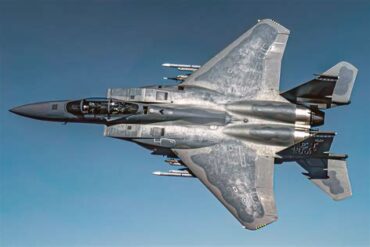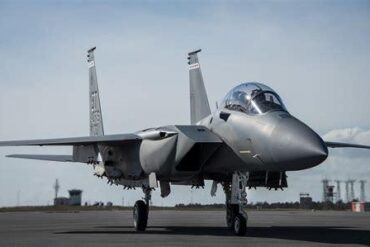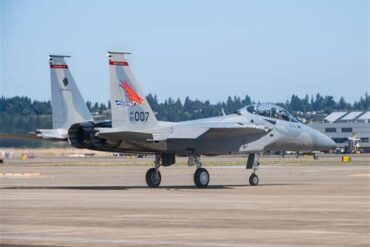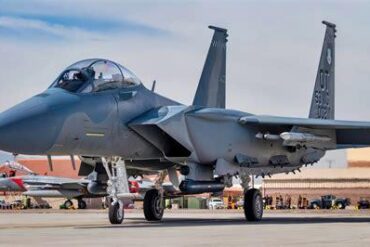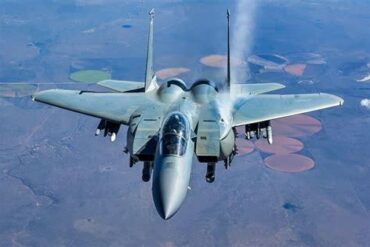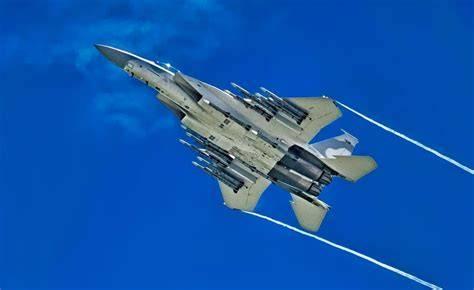
The US Air Force is preparing to spend hundreds of millions of dollars—and potentially close to $1 billion—to transform Selfridge Air National Guard Base in Michigan for a relatively small fleet of 21 F-15EX Eagle II fighters. At first glance, the investment appears difficult to justify. Dividing nearly $1 billion by 21 aircraft produces a staggering figure, especially when the aircraft themselves are only one part of a much larger modernization effort.
The reality, however, is considerably more complicated. Selfridge is not simply receiving a new squadron of fighters. The Michigan installation is undergoing a broad transformation that involves runways, taxiways, maintenance facilities, tanker infrastructure, operations buildings, training facilities, and other support systems. The planned arrival of the F-15EX is occurring alongside the introduction of the KC-46A Pegasus, effectively turning Selfridge into a substantially different combat aviation installation.
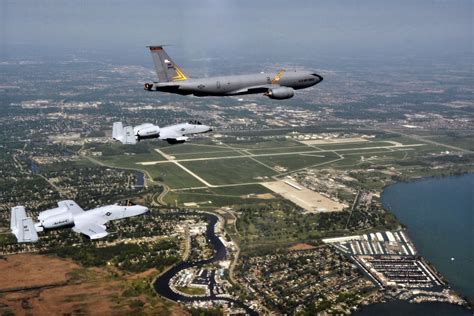
This distinction explains why the headline number can be misleading. Much of the money is not being spent directly on the 21 F-15EXs. Instead, it is being used to create the infrastructure required to operate modern combat aircraft from a base whose facilities have evolved around older aircraft such as the A-10C Thunderbolt II and KC-135 Stratotanker.
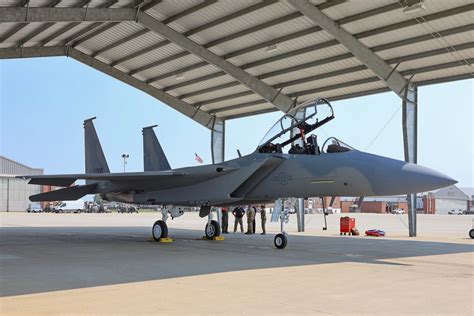
Selfridge Air National Guard Base Is Getting a New Mission
Located near Detroit and close to the Canadian border, Selfridge Air National Guard Base has long been an important component of American airpower in Michigan. The installation hosts the 127th Wing of the Michigan Air National Guard, which has historically operated both fighter and air-refueling missions.
For years, the base’s flying operations have revolved around aircraft that are now approaching the end of their useful service lives. The A-10 has been especially important to Selfridge, but the Air Force is steadily reducing the number of Thunderbolt IIs in its inventory. Under the Fiscal 2026 plan, 59 A-10s were scheduled for retirement, leaving 103 aircraft. The Fiscal 2027 request would retire another 49, reducing the remaining fleet to only 54.
That transition creates a major challenge for Selfridge. Retiring an aircraft does not automatically create the infrastructure needed for its replacement. Different aircraft have different maintenance requirements, parking arrangements, weapons-handling needs, electrical systems, security requirements, training facilities, and support equipment.
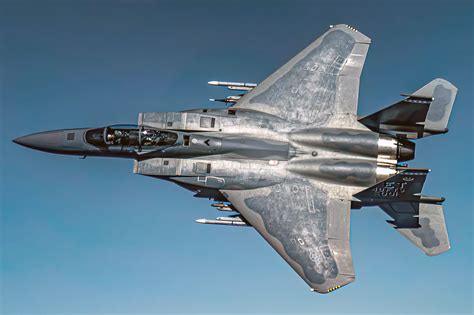
The answer for Selfridge is the F-15EX Eagle II, a heavily upgraded derivative of the F-15 family. In 2025, the Air Force announced that 21 F-15EX aircraft would be assigned to Michigan, with the first examples expected to arrive at Selfridge in 2028. For the base, that announcement represented far more than a change in aircraft type. It represented the preservation—and modernization—of a major fighter mission.
Why 21 F-15EX Jets Require So Much Construction
The central question is obvious: why does a fleet of only 21 fighters require an infrastructure program approaching $1 billion?
The answer lies in the difference between buying an aircraft and establishing an operational combat capability. A fighter cannot generate sorties simply because it arrives at the gate. It needs hardened or appropriately protected parking, maintenance capacity, spare-parts storage, weapons support, fuel systems, electrical infrastructure, communications, crew facilities, simulators, security systems, rescue services, and a functioning airfield capable of handling sustained operations.
At Selfridge, much of that infrastructure must be modernized at the same time. The federal government is expected to provide approximately $792 million to $1 billion for the broader modernization program. The spending includes facilities for both the F-15EX and KC-46A, meaning the headline figure should not be interpreted as a $1 billion bill for 21 fighters alone.
One particularly important component is an approximately $190 million eight-bay F-15EX maintenance complex. That works out to roughly $9 million in infrastructure per planned fighter, but that calculation does not mean each aircraft literally costs $9 million to house. The facility represents a permanent capability designed to support aircraft maintenance and operations for years.
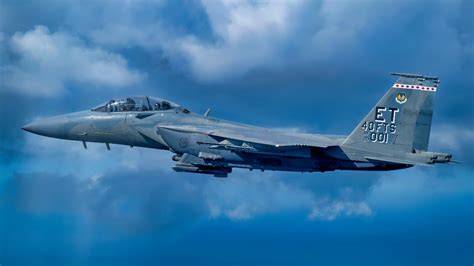
The KC-46A Makes the Investment Much Larger
The F-15EX is only half of the story.
Selfridge is also scheduled to receive 12 KC-46A Pegasus tankers, with deliveries expected to begin in 2029. This is a major modernization of the base’s air-refueling mission and adds another substantial infrastructure requirement.
Approximately $280 million in federal funding is associated with KC-46 infrastructure. That includes a dual-base hangar complex, an aircrew training complex, and a squadron operations building. The tanker investment means Selfridge is effectively becoming a modern fighter-and-refueling hub rather than simply a replacement location for an aging A-10 fleet.
The KC-46 is significantly different from the venerable KC-135 that it replaces. The Pegasus incorporates modern communications, advanced sensors, a remote vision system for aerial refueling operations, and extensive digital architecture. Supporting such an aircraft requires facilities designed around a very different generation of aviation technology.
This is why the overall modernization figure needs context. Selfridge is receiving 21 F-15EXs and 12 KC-46As, but the construction program is creating the physical ecosystem required to operate both fleets.
Michigan Is Also Spending Heavily on Selfridge
The federal government is not carrying the entire burden.
Michigan has committed significant state funding to improve the airfield itself. A $152 million spending bill for a new runway received strong support in 2026, while the state has also approved approximately $162 million for runway improvements, along with funding for Taxiway Bravo and Taxiway Alpha.
These investments are particularly important because runways and taxiways are shared infrastructure. They are not facilities that belong exclusively to the F-15EX fleet. Improving them can benefit tankers, fighters, emergency operations, training flights, maintenance movements, and potentially future aircraft missions.
The modernization therefore has a broader strategic value for Michigan. State officials and regional business organizations have described Selfridge as having the potential to become a “super base”, reflecting the economic and military significance of keeping a major flying installation active in southeastern Michigan.
For the state, investing in Selfridge also helps protect a long-term military presence. Air bases generate jobs, support local businesses, attract defense-related investment, and provide a strategic aviation capability that cannot easily be recreated elsewhere.
The F-15EX Demands a Different Kind of Infrastructure
The F-15EX Eagle II is not merely a newer version of the A-10. It belongs to a fundamentally different class of combat aircraft.
The A-10 was designed around close air support, with a relatively simple philosophy centered on ruggedness, low-altitude operations, and heavy cannon firepower. The F-15EX, by contrast, is a high-performance air-superiority and multirole fighter built around advanced sensors, networking, long-range weapons, and substantial weapons-carrying capacity.
That difference affects everything around the aircraft.
Maintenance personnel need new equipment and training. Pilots require conversion training. Weapons crews must become familiar with different loading procedures and munitions. Communications and mission-planning systems need to support modern networked operations. Simulators and training facilities must reflect the F-15EX’s advanced avionics and weapons.
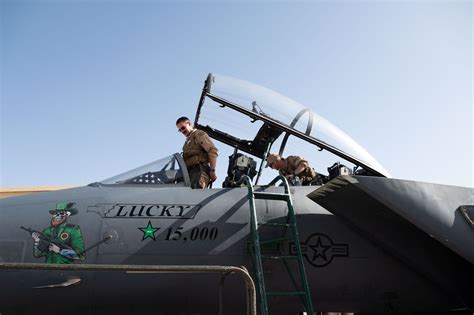
Even the personnel structure is somewhat different. The F-15EX is a two-seat aircraft, accommodating a pilot and a Weapon Systems Officer. That introduces additional training and staffing considerations compared with operating a single-seat combat aircraft.
Consequently, the cost of introducing the F-15EX extends far beyond the aircraft’s purchase price.
Training Is Another Hidden Cost
One of the easiest mistakes in defense spending discussions is to focus only on the flyaway price of an aircraft.
A fighter fleet is an ecosystem. The aircraft is the visible part, but the supporting ecosystem includes pilots, maintainers, weapons specialists, spare engines, spare parts, simulators, software, communications, facilities, fuel, ammunition, security, and continuous modernization.
For Selfridge, the transition also means that personnel familiar with the A-10 will need to adapt to the F-15EX. Some pilots may require extensive conversion training before they can operate the new aircraft operationally. Maintenance crews will similarly need to qualify on a completely different platform.
The Air Force does not publicly disclose a single universal F-15EX conversion-training price that can simply be multiplied across every pilot. Training costs vary according to the individual, aircraft type, simulator availability, instructor requirements, and broader training pipeline.
Nevertheless, aircrew conversion is a substantial part of the transition cost, and it demonstrates why an aircraft’s advertised acquisition price never tells the whole story.
The Base’s Age Is Part of the Problem
Another major reason for the enormous construction bill is that Selfridge is not a blank sheet of concrete waiting for modern aircraft.
Like many American military installations, it contains infrastructure accumulated over decades. Buildings, utilities, airfield surfaces, maintenance areas, electrical systems, and other facilities eventually require expensive modernization even when the aircraft operating from them have not changed.
The arrival of new aircraft simply accelerates that requirement.
This is an important point because some of the money being spent at Selfridge would likely have been necessary even without the F-15EX decision. A runway that requires rehabilitation does not become obsolete simply because a different fighter is selected. An aging utility network still needs improvement. Old support buildings still require replacement or renovation.
The F-15EX program therefore acts as a catalyst for broader infrastructure investment.
Selfridge Reflects a Much Larger Air Force Problem
The scale of the Selfridge project becomes easier to understand when viewed against the broader infrastructure demands facing the Department of the Air Force.
For Fiscal 2027, the Department of the Air Force requested approximately $26.75 billion for military construction, family housing, and facilities sustainment, restoration, and modernization. That was more than double the $13.06 billion enacted for Fiscal 2026.
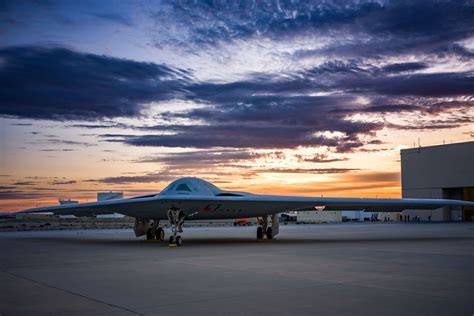
The dramatic increase reflects an increasingly urgent need to prepare installations for new generations of aircraft and weapons. The Air Force is simultaneously introducing the B-21 Raider, developing the F-47, modernizing nuclear forces, expanding Space Force infrastructure, and preparing bases for a potential conflict against sophisticated peer competitors.
Some individual projects are even more expensive than Selfridge’s transformation. Ellsworth Air Force Base in South Dakota requires roughly $1.3 billion to $1.5 billion in modernization associated with the B-21, while Dyess Air Force Base in Texas also faces a major infrastructure program. Nellis Air Force Base in Nevada has projects exceeding $1.6 billion.
The lesson is clear: modern airpower requires modern bases.
Dispersal Is Becoming More Important
There is also a strategic reason the United States is investing heavily in airfield infrastructure.
For decades, American airpower benefited from a relatively small number of exceptionally capable bases. Those installations could support large fleets with extensive infrastructure. In a major conflict against a peer adversary, however, concentrating aircraft at a limited number of bases creates vulnerabilities.
Long-range missiles, cyberattacks, drones, and other weapons could threaten large fixed installations.
The Air Force is therefore increasingly interested in agile combat employment, dispersal, rapid movement, and the ability to operate from a wider network of locations. That requires investment in runways, fuel systems, maintenance facilities, communications, and support infrastructure at locations that can provide alternative operating capacity.
Selfridge is not an austere Pacific airstrip, but its modernization fits into this larger philosophy. A modernized base in Michigan provides another capable location for fighter and tanker operations while preserving strategic depth within the continental United States.
The F-15EX Fleet Is Also Growing
The significance of Selfridge becomes even greater when considering the Air Force’s evolving F-15EX procurement plans.
Earlier expectations centered on a relatively limited fleet, but Fiscal 2027 documents indicated that the service was moving toward a much larger procurement target of approximately 267 F-15EX aircraft. The Air Force is also investing in Boeing’s production capability to increase output.
That matters because Selfridge will not be an isolated experiment. It will become one node in a broader F-15EX operating network.
The aircraft is attractive to the Air Force because it can provide substantial weapons capacity, modern avionics, long-range capabilities, and advanced networking without requiring the service to wait for every aspect of its next-generation fighter fleet to mature. It can also complement stealth aircraft rather than simply replacing them.
For Selfridge, becoming an F-15EX base therefore positions the installation within a wider modernization strategy rather than giving it a niche mission with only 21 aircraft.
Why Nearly $1 Billion Can Make Strategic Sense
The headline figure is undeniably large. Nearly $1 billion for a base receiving only 21 F-15EX fighters sounds excessive until the entire modernization package is considered.
The spending covers much more than fighter parking spaces. It includes a major maintenance complex, tanker facilities, squadron operations infrastructure, training facilities, runway improvements, taxiways, support buildings, and other systems required to turn Selfridge into a modern combat aviation installation.
The state and federal governments are also investing in infrastructure with useful lives measured in decades rather than years. A runway or maintenance facility built for today’s aircraft can potentially support future platforms as missions evolve.
There is another important consideration: abandoning or substantially reducing an established air base can also be expensive. Once specialized aviation infrastructure, skilled personnel, local partnerships, and military missions disappear, rebuilding that capability later can cost considerably more.
By investing now, the Air Force and Michigan are effectively paying to preserve a strategic aviation ecosystem.
Selfridge Is More Than an F-15EX Base
The most revealing aspect of the Selfridge project is that the 21 F-15EX aircraft are only the visible centerpiece of a much larger transformation.
The installation is moving from an aging combination of A-10 and KC-135 operations toward a modern force built around the F-15EX and KC-46A. That transition requires new infrastructure because the aircraft, missions, technology, and operational concepts are different.
The result will be a significantly more capable installation near one of America’s major industrial regions. The investment will support fighters, tankers, personnel, maintenance operations, training, and future modernization.
In that context, the nearly $1 billion figure becomes less about the price of 21 aircraft and more about the cost of maintaining a credible airpower base in the modern era. The F-15EX may be the reason the construction schedule accelerated, but the infrastructure being created at Selfridge is intended to serve the United States far beyond the arrival of the first Eagle II in 2028.