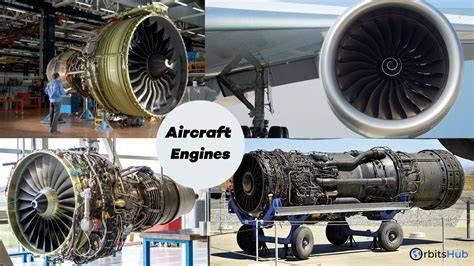
Walk the ramp at almost any commercial airport today and the scene is dominated by twin-engine airliners. Four-engine icons like the Boeing 747 and Airbus A380 have been largely displaced by fuel-sipping twinjets, and generous ETOPS ratings now let two-engine jets fly up to 330 minutes from the nearest diversion field. Yet aviation’s history is crowded with machines that needed six, eight, ten, or even twelve turning propellers and burning jets just to stagger into the air. The aircraft below share one distinction: every one of them was crewed, genuinely flew at least once, and could not leave the ground on fewer than five working engines. Experimental dead ends, one-off engine test beds, and designs that crashed before a successful flight are excluded.
Dornier Do X: Twelve Engines Over the Atlantic
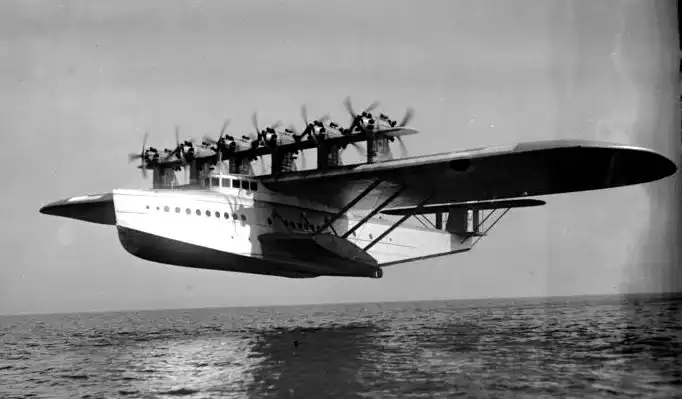
The Dornier Do X remains the most engine-laden aircraft ever to fly successfully, a colossal German flying boat driven by twelve engines arranged in six push-pull pairs along the leading edge of its wing. Designed and built by Dornier at Friedrichshafen, it first took to the air in 1929, when engine technology was still far too weak to lift an airframe of that scale on four powerplants. The Do X carried a maximum gross weight of roughly 114,400 pounds, a figure that sits almost exactly at the 114,199-pound maximum take-off weight of a modern Embraer E190 — yet it needed three times as many engines to do so. In its cabin it could seat 169 people, a passenger record it held for around two decades.
The aircraft’s finest hour came in 1931, when it departed Friedrichshafen for Natal, Brazil, via Lisbon and the Cape Verde islands, completing a transatlantic crossing that captured global attention. An earlier, even more celebrated voyage had taken it across the Caribbean to New York, where it landed at what is now LaGuardia Airport on August 27, 1930. Those flights were triumphs of endurance and publicity rather than commercial sense. The Do X was a commercial failure: it lacked sufficient power to carry a profitable payload, and its twelve engines demanded constant attention and maintenance. Only three examples were ever built. The first was eventually dismantled and displayed in Berlin before Allied bombing destroyed it during World War II, while the other two, re-engined with Fiat powerplants, went to Italy. By 1935 they were mothballed, and a couple of years later they were broken up for scrap.
Convair B-36 Peacemaker: Six Turning, Four Burning
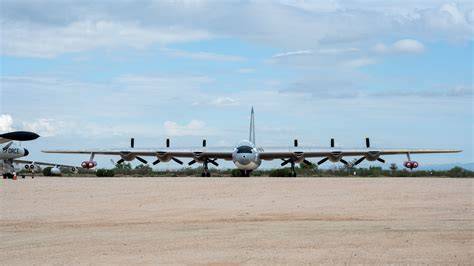
No aircraft better illustrates the awkward transition from pistons to jets than the Convair B-36 Peacemaker, a hybrid bomber carrying ten engines in two entirely different technologies. Six Pratt & Whitney R-4360 Wasp Major radial piston engines, mounted in pusher configuration, were paired with four General Electric J47 turbojets hung beneath the outer wing. Development began in 1941, but the bomber did not make its maiden flight until August 1946, roughly a year after Japan’s surrender. It entered USAF service in 1949 and retired a decade later, in 1959, and it remains one of the largest bombers the service ever flew.
The B-36’s engineering was as demanding as its size suggests. Each piston engine carried 56 spark plugs, meaning every aircraft needed 336 of them, a maintenance burden that consumed enormous amounts of labor. The pusher layout also disrupted and reduced the airflow feeding the air-cooled engines, causing chronic overheating and in-flight engine fires. Crews turned the famous “Six Turning, Four Burning” slogan into a grim joke of their own: “Two turning, two burning, two smoking, two choking, and two more unaccounted for.” For all its flaws — and it is often ranked among the worst bombers ever built — the Peacemaker gave the United States a genuine intercontinental nuclear reach at a moment when no other aircraft could.
Hughes H-4 Hercules “Spruce Goose”: Eight Engines, One Flight
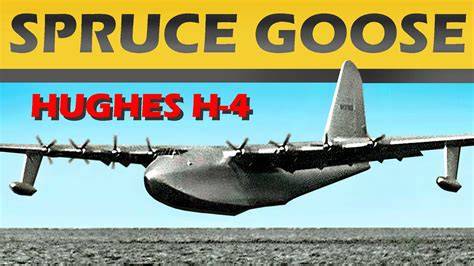
The Hughes H-4 Hercules, forever known as the Spruce Goose, was born from the carnage of the U-boat campaign in the Atlantic. Henry Kaiser, who had mass-produced nearly 1,500 Liberty Ships in record time, proposed sidestepping the submarine threat entirely by flying cargo across the ocean. The result was an eight-engined transport intended to lift a battalion of 750 soldiers or two 33-ton M4 Sherman tanks. Its eight Pratt & Whitney R-4360 Wasp Major engines produced 3,000 horsepower each, for a combined 24,000 hp, power deemed necessary to hoist an empty weight of roughly 300,000 pounds plus its planned payload.
Its 3,500-mile range was enough to cross the Atlantic, and its planned cruising speed of 150 mph betrayed the drag of its enormous airframe. With a wingspan of 319 feet, 11 inches, the Hercules stood as the widest aircraft ever flown until the Stratolaunch jet took off in 2019. Despite its metallic appearance from a distance, the machine was built from thin sheets of wood bonded with glue, a deliberate choice to conserve aluminum, which was considered critical to the war effort. The war ended before the first H-4 was finished, yet the aircraft still flew — once. On November 2, 1947, during what was supposed to be a mere taxi test, Howard Hughes pushed the throttles to 100 knots on the third run, lifted off, and climbed to about 70 feet before settling back onto the water.
Boeing B-52 Stratofortress: Eight Engines That Refuse to Retire
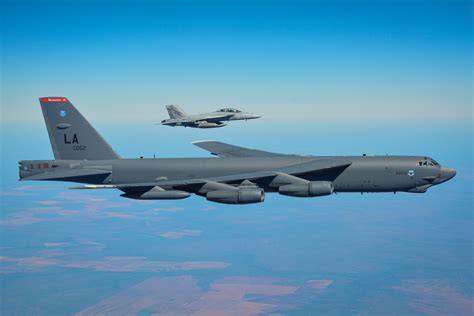
The Boeing B-52 Stratofortress is the oldest American military jet still in service, first deployed in 1955, with more than 744 units built across eight versions. Its eight engines were not excess in the 1950s: the original Pratt & Whitney J57 turbojets produced only about 10,000 pounds of thrust apiece, so eight were needed simply to get the bomber airborne with a full load. The current B-52H carries eight Pratt & Whitney TF33-P-3/103 turbofans rated at 17,000 pounds of thrust each, a 70 percent increase in total output — and yet each one still delivers only a fraction of the 134,000 pounds produced by the GE9X, the most powerful commercial jet engine flying today.
Re-engining the fleet has become a study in why eight engines persist. The USAF selected Rolls-Royce to replace the aging TF33s with new F130 engines, but the bomber will keep eight powerplants rather than consolidating to four. Cutting the count would trigger extensive and expensive engineering work — redesigning and replacing the wings, engine pylons, cockpit, throttle controls, and much more. Such a program would cost taxpayers far more and could introduce stresses that the decades-old airframes were never designed to withstand.
Antonov An-225 Mriya: Six Engines for a Space Shuttle
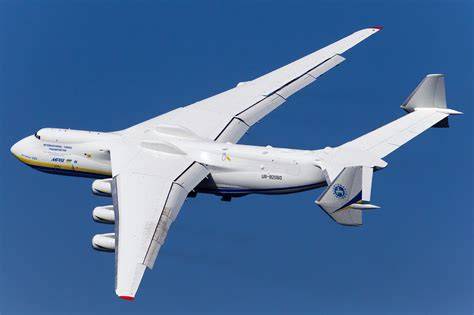
The Antonov An-225 Mriya grew out of the smaller Antonov An-124 Ruslan. Where the Ruslan carried four engines, the An-225 needed six ZMKB Progress D-18 turbofans to haul Buran, the Soviet answer to the American Space Shuttle. The super-heavy transport first flew in 1988, but the collapse of the Soviet Union and the cancellation of the Buran program stripped it of its original mission. It reinvented itself as a specialized freighter capable of carrying outsized cargo that no other aircraft on Earth could accommodate, becoming an indispensable tool for moving generators, turbines, and satellites through the 2000s.
Construction of two airframes began, but only one was ever completed. That sole aircraft was destroyed in February 2022 when Russia invaded Ukraine. It was undergoing maintenance at Antonov Airport in Hostomel, with one of its engines disassembled, meaning it was not even airworthy when Russian paratroopers attempted to seize the airfield. The Mriya was caught in the crossfire between the attackers and Ukrainian defenders. Antonov has since announced plans to rebuild it, reportedly using the unfinished second airframe as a base and salvaging parts from the wreckage; even with work beginning immediately, estimates suggest the project would take at least five years.
Blohm und Voss Bv 222 Wiking: Six Diesels Over the Sea
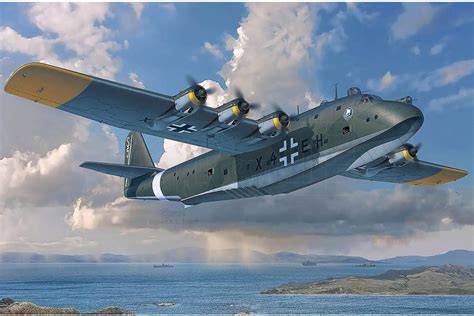
In 1937, just a few years after the Do X was scrapped, Lufthansa opened a tender for a long-range flying boat. Three manufacturers submitted prototypes, and Blohm und Voss was chosen to build three Bv 222 units. The aircraft was powered by six 1,000-horsepower inline diesel engines, and the choice of diesel fuel made it far easier to refuel at sea, an elegant solution for a machine expected to operate far from prepared airfields. Construction began in 1938, but the Bv 222 did not take its first flight until September 7, 1940, a little over a year after Britain and France had declared war on Germany.
Combat overtook the project, and the Luftwaffe gradually absorbed it for military transport, flying missions between Hamburg and Kirkenes in Norway. Later in its service life it gained defensive armament, including nose and fuselage machine guns and turrets on the upper fuselage. Its assignment to Luft-Transport-Staffel 222 (LTS 222), which adopted a Viking longship as its squadron emblem, gave the Bv 222 the nickname “Wiking.” The Luftwaffe built 13 examples: four were shot down or lost to enemy action, one crashed in an accident, and four fell into Allied hands — two flown to the United States by American forces and two captured by the British. Given how few were ever built, no Bv 222 survives today.
Boeing B-47 Stratojet: Six Engines and Swept Wings
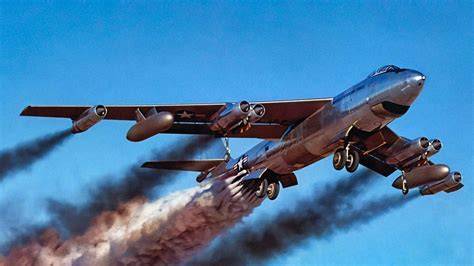
While the Convair B-36 served as the USAF’s primary intercontinental strategic nuclear bomber, it was built in relatively small numbers — fewer than 400 units. The Boeing B-47 Stratojet became the numerical backbone of that force, with more than 2,000 aircraft delivered. It was powered by six General Electric J47 turbojets, mounted in pods beneath the wings, giving it a top speed of Mach 0.84 — a dramatic leap over the piston-driven bombers it accompanied. Like the Peacemaker, the Stratojet was designed to drop nuclear weapons from high altitude, but low-level “bomb toss” techniques were later developed, allowing it to release its weapon like a fighter rather than through the carpet-bombing methods of traditional strategic bombers.
The B-47 served with Strategic Air Command from 1953 to 1963, and some units were converted into weather reconnaissance platforms after their bomber careers ended. By 1969 the Air Force had retired every B-47 in favor of the newer, more capable Boeing B-52 Stratofortress. Its most enduring legacy, however, is its swept wing, a configuration that now appears on virtually every modern jet aircraft in the sky.
Convair XC-99: Six Engines and Two Decks
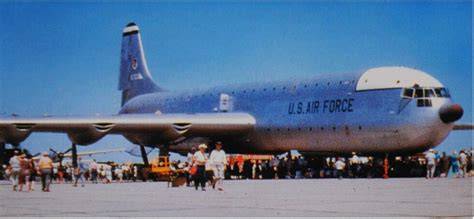
The Convair XC-99 was the B-36’s cargo-minded sibling. It reused the bomber’s wings, tail, landing gear, and engine configuration — minus the four turbojets — and paired them with a vast double-deck fuselage. Those six Pratt & Whitney R-4360 piston engines gave it a payload of 100,000 pounds of cargo or up to 400 soldiers spread across two decks, making it the largest aircraft in the air at the time. It made its first flight in 1947 and began carrying loads for the USAF, but it never entered serial production.
Only one prototype was built, and it was retired in 1957 after structural fatigue was discovered in its wings and fuselage bulkheads. That same year, the turboprop Douglas C-133 Cargomaster entered service with a larger 110,000-pound payload on just four Pratt & Whitney T34-P-9W turboprops — a stark illustration of how quickly engine power was catching up with airframe ambition. The sole XC-99 now sits disassembled at the 309th Aerospace Maintenance and Regeneration Group (AMARG) at Davis-Monthan AFB, the facility better known as the “boneyard.” Years of exposure to the elements have made restoring it to flyable condition prohibitively expensive, and it still awaits funding to be displayed in a museum.
Scaled Composites Stratolaunch Roc: Six Engines, World’s Widest Wingspan
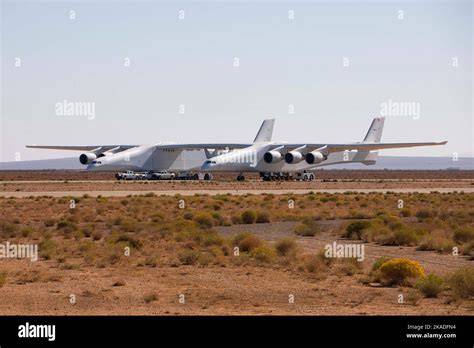
Modern engines are so powerful and reliable that almost every commercial jetliner flies on two to four of them. One niche application, however, still calls for six: the Scaled Composites Model 351 Stratolaunch “Roc.” With a wingspan of 385 feet, the Roc holds the world record for the widest aircraft ever built, and it is powered by six Pratt & Whitney PW4056 turbofans — the same engines that pull the Boeing 747-400 through the sky.
Unlike everything else on this list, the Roc was not designed to carry cargo or people. It was built to carry rockets aloft and launch them into space, freeing missions from fixed launch pads so that a launch could happen wherever the Roc could fly, provided the weather and flight parameters cooperated. That mission explains the unusual engine count: six turbofans were needed to lift a maximum take-off weight of 1.3 million pounds to a launch altitude of 27,000 feet. Stratolaunch ceased operations soon after its founder died, but the private equity firm Cerberus Capital Management bought the company and gave the Roc a second life as a hypersonic weapons launch platform.
Why Multi-Engine Giants Still Matter
The arc traced by these aircraft runs from brute-force engineering to precision power. In the late 1920s and through the 1940s, designers piled on engines because each individual unit simply could not produce enough thrust or horsepower to lift enormous airframes — twelve for the Do X, ten for the B-36, eight for the Spruce Goose and the B-52. Maintenance crews paid the price in spark plugs, overheating pusher engines, and marginal payload economics that doomed the Do X commercially. Today, a single GE9X delivers more thrust than eight early B-52 turbojets combined, which is why the skies belong to twinjets and why the B-52’s proposed four-engine conversion is deemed more trouble than it is worth.
What survives is legacy and curiosity. The B-52 and the Stratolaunch Roc are the only aircraft here still flying, and each exists in its current form because re-engineering decades of design is harder than keeping the engine count high. Eight, ten, twelve — those numbers will likely never be matched by a production airliner again, which makes these machines the clearest record we have of a time when sheer quantity was the only path to altitude.