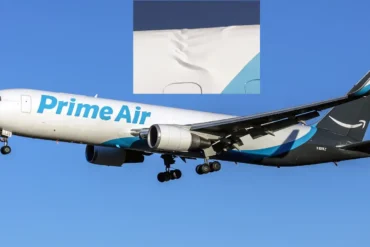
A nearly 36-year-old Amerijet International Boeing 767-300F has been grounded in Guatemala after suffering significant fuselage damage during a hard landing at La Aurora International Airport in Guatemala City. The aircraft, registered N373CM, was operating flight 8743 from Miami International Airport to Luis Muñoz Marín International Airport in San Juan when it diverted to Guatemala on September 6. The subsequent landing left a visible crease and buckle across the upper forward section of the fuselage.
The incident adds another damaged Boeing 767-300F to a growing record of freighter airframes affected by hard-landing events. While the aircraft did not suffer the kind of dramatic structural failure associated with some aviation accidents, the visible deformation on N373CM is significant because fuselage buckling can indicate that substantial loads were transmitted through the airframe during touchdown. The aircraft remains at La Aurora International Airport (GUA) while its operator and maintenance specialists determine the extent of the damage and what repairs will be required.

Amerijet Flight 8743 Diverted to Guatemala City
Flight tracking data indicates that Amerijet flight 8743 departed Miami on the evening of September 6, considerably later than scheduled. The Boeing 767 left Miami International Airport at approximately 11:19 PM, more than two hours after its planned 9:00 PM departure. The service was scheduled to reach San Juan at 11:35 PM, with a planned flight time of roughly three hours and 10 minutes.
Instead, the aircraft spent about two hours and 11 minutes in flight before diverting toward Guatemala City. The reason for the diversion has not been publicly established in the available information. What is known is that N373CM subsequently landed on La Aurora’s sole runway, Runway 02/20, where the hard touchdown caused the structural damage now visible on the forward fuselage.
La Aurora International Airport is situated approximately 16 miles (25 kilometers) from downtown Guatemala City and is Guatemala’s busiest airport. Its single runway measures about 9,800 feet (2,987 meters), providing substantial length for large commercial and cargo aircraft. The airport handled approximately 4.9 million passengers in 2024, making it an important regional aviation gateway despite its single-runway configuration.
Nose-Forward Landing Likely Caused Fuselage Buckling
Initial reports indicate that N373CM may have touched down nose wheel first, rather than allowing the main landing gear to absorb the initial impact. Such a landing can place unusually high forces on components that are not designed to take the aircraft’s full landing load.
During a normal landing, the main landing gear is designed to absorb the majority of the aircraft’s vertical energy before loads are distributed through the airframe. If the nose gear contacts the runway prematurely or with excessive force, the resulting impact can transmit significant stresses into the forward fuselage. In severe cases, the nose gear itself can buckle or fail, while surrounding structural components may also deform.
The reported damage on N373CM has been described as “buckle damage” involving the upper fuselage around STA 650, between S14L and S14R. That location and the visible crease suggest that the landing imposed forces capable of distorting the aircraft’s structural skin and supporting framework. Engineers will therefore need to establish whether the damage is confined to the outer fuselage or extends into frames, stringers, pressure structures, or other critical components.
N373CM Has a Long History With Qantas and Amerijet
The aircraft involved is not a new freighter. N373CM first flew on November 27, 1990, and was delivered to Qantas in December that year as a passenger aircraft. The Boeing 767-338ERBDSF originally carried the nickname “City of Rockhampton” and spent nearly 25 years serving the Australian airline before entering the cargo market.
Amerijet acquired the aircraft on December 4, 2015, after which it was converted into a freighter and incorporated into the carrier’s Boeing 767 fleet. The aircraft has since operated exclusively for Amerijet, supporting the airline’s network of cargo services from its Miami base and other destinations.
N373CM is powered by two General Electric CF6-80C2B6 engines, a widely used engine family associated with the Boeing 767 and other large commercial aircraft. Its age is notable, but age alone does not determine whether an aircraft remains structurally sound. Freighters routinely operate aircraft for decades, provided inspections, maintenance and structural programs keep the airframe within approved limits.
Amerijet’s Boeing 767 Freighter Fleet Faces Another Inspection
N373CM is one of 11 Boeing 767-300F freighters operated by Amerijet, making the type central to the airline’s cargo operation. Amerijet maintains its primary base in Miami and also has a hub at Piarco International Airport in Trinidad and Tobago, with services reaching more than 48 destinations worldwide.
For now, the immediate question is whether N373CM can be economically and technically repaired. A hard landing does not automatically mean an aircraft is beyond recovery, but structural damage to an older freighter can require extensive inspection, specialized repairs and potentially lengthy downtime. Engineers will need to determine the full extent of the deformation before the aircraft can return to service.
The incident also demonstrates why a seemingly routine landing can become a major maintenance event. A Boeing 767-300F carries substantial structural loads even under normal operating conditions, and an abnormal touchdown can concentrate those forces in vulnerable areas. Until the inspection is completed, N373CM’s future remains uncertain, leaving another veteran Boeing 767 freighter temporarily stranded after an unexpectedly hard arrival in Guatemala.