If you’re planning to become a commercial drone pilot, getting your FAA Part 107 drone license is a must. It’s the official certification needed to fly drones for business in the U.S.
Drones—technically called unmanned aerial systems (UAVs)—are reshaping industries like media, agriculture, and real estate. They’ve quickly become essential tools for many types of work.
With a drone pilot license, you’ll unlock career opportunities across sectors that are hungry for aerial imagery, inspection data, and efficient remote sensing. But while the Part 107 exam has a high pass rate, it’s not a walk in the park. You’ll need a solid grasp of drone rules, flight safety, and good judgment in real-world conditions.
That’s where certification comes into play. If you’re serious about taking your drone skills to the next level, this license is your gateway.
Quick Overview: FAA Part 107 Drone License
The FAA’s Part 107 license, officially named the Remote Pilot Certificate, is mandatory if you’re flying drones commercially in the United States.
Here’s a quick breakdown:
- Commercial Use: Required for anything business-related—like real estate photography, structural inspections, or survey mapping.
- Certification Process: You’ll need to pass the Part 107 exam to earn your Remote Pilot Certificate.
- Exam Details: A multiple-choice test that covers regulations, airspace, weather, and emergency procedures. It must be taken at an FAA-authorized center.
- Eligibility: You must be 16+, fluent in English, and physically and mentally fit to fly.
- Recurrent Training: You’ll need to update your aeronautical knowledge every 24 months.
- Remote ID Requirement: Your drone must broadcast its ID info as part of FAA’s safety compliance.
- Cost: Around $175, not including optional training materials or prep courses.
Now, let’s talk about why this license is so important—and what it means once you have it.
Why Get the FAA Part 107 License?
According to Precedence Research, the drone service industry could grow to $87.02 billion by 2032. That’s huge.
As more companies discover how efficient drones can be, the demand for certified pilots keeps rising. Opportunities range from mapping and inspection to security and 3D modeling. And yes, plenty of cool jobs are out there.
But there’s a serious side, too. Drones are used for disaster response, search and rescue, and risk assessment. These missions require skilled, certified pilots.
Your first step into this growing field? Earning your Part 107 license.
What Is Drone Certification?
Drone certification—formally called the Remote Pilot Certificate or Part 107 license—is issued by the FAA. To earn it, you’ll need to pass the Part 107 exam.
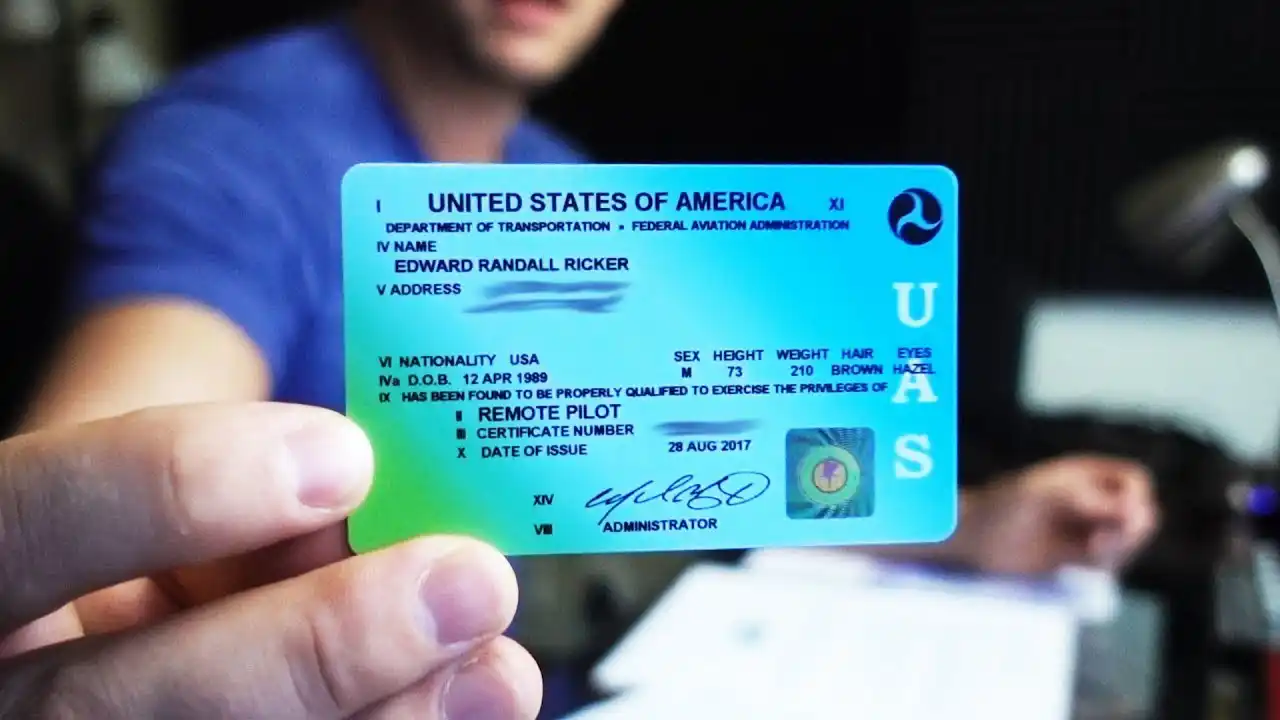
Once certified, you’re legally allowed to fly drones commercially in the U.S. The exam tests your understanding of airspace, rules, and flight safety. Passing it shows you’re prepared to fly responsibly under FAA guidelines.
Understanding Terms from 14 CFR Part 107
Here are some important definitions you should know:
- Control Station: The equipment used by the remote pilot to manage the drone’s flight.
- Corrective Lenses: Refers to glasses or contact lenses used during drone operations.
- Small Unmanned Aircraft (sUA): A drone weighing under 55 lbs. at takeoff, including all attachments.
- Small Unmanned Aircraft System (sUAS): The drone plus everything needed to operate it safely.
- Unmanned Aircraft: A flying machine operated remotely, without a pilot on board.
- Visual Observer: A person who helps the Remote Pilot in Command by keeping an eye out for other aircraft or hazards.
- Person Manipulating the Controls: Someone flying the drone under supervision of the certified pilot.
- Remote Pilot in Command (RPIC): A certified pilot responsible for the entire drone operation under Part 107.
How to Get an FAA Part 107 License: Step-by-Step
Getting your Part 107 license isn’t too complicated if you follow the steps. Here’s the path:
Step 1: Check If You’re Eligible
To apply for a commercial drone pilot license, you must:
If You’re a First-Time Pilot:
- Be 16 years or older
- Read, write, and understand English
- Be physically and mentally fit to operate a drone
- Pass the Unmanned Aircraft General – Small (UAG) knowledge test
If You Already Hold a Part 61 Certificate:
- Hold a valid Part 61 pilot certificate
- Have completed a flight review in the past 24 months
Step 2: Know the Basic Requirements
For First-Time Pilots:
- Your Remote Pilot Certificate must be with you during drone operations
- Recurrent online training must be completed every 24 months to stay current
For Existing Part 61 Certificate Holders:
- Same rules apply—carry your certificate and complete recurrent training every two years
Step 3: Understand the Exam Topics
The Part 107 exam is all multiple-choice and covers a variety of subjects.
For First-Time Pilots, expect questions on:
- FAA rules for small drone operations
- Types of airspace and flight restrictions
- Radio communication protocols
- Drone performance and load limits
- Weather sources and its impact on drone performance
- Emergency response procedures
- Crew coordination and resource management
- Drug and alcohol effects on decision-making
- Airport procedures
- Preflight inspections and maintenance
- Night flying rules
If You’re a Part 61 Certificate Holder Taking the Online Course, topics will include:
- Emergency procedures and crew coordination
- Preflight checks and safe maintenance
- Night operations
- FAA regulations for small drone privileges and restrictions
- Weather and performance impacts on drones
- Drone performance metrics and loading
By following this guide and putting in the study time, you’ll be well on your way to earning your Part 107 certification and starting your journey as a professional drone pilot.
Step 4: Drone Certification Application Process
If you’re aiming to fly drones commercially in the U.S., you’ll need to be certified by the Federal Aviation Administration (FAA). Here’s how to go through the application process to get your commercial drone pilot certificate.
A. Prepare Your Documents and Forms
Before applying, gather all necessary documents. These may include:
- FAA Form 8710-13: This is the official Remote Pilot Certificate Application Form.
- Proof of Identity: A valid government-issued photo ID is required.
- Flight Review Evidence: If you already hold a Part 61 certificate, you need proof of a current flight review.
- Training Course Certificate: Also for Part 61 certificate holders, you must provide a completion certificate from the online course.
B. Apply for the FAA Part 107 License
For First-Time Pilots:
- Create an IACRA Profile
Go to the IACRA website and register to get your FAA Tracking Number (FTN). You’ll need this before scheduling your knowledge test.
- Schedule Your Test
Book an appointment with an FAA-authorized Knowledge Testing Center. Bring your government-issued photo ID to the test.
- Pass the UAG Test
Take and pass the Unmanned Aircraft General – Small (UAG) knowledge test.
- Submit Your Application via IACRA
After passing the test, log in to IACRA with your credentials and start a new application:
- Select “Start New Application”.
- Application Type: Pilot
- Certifications: Remote Pilot
- Fill out the Other Path Information and begin the application.
Then complete and submit your application:
- Enter your 17-digit Knowledge Test Exam ID (note: it may take up to 48 hours after your test for the score to appear).
- Electronically sign and submit your application for review.
For Existing Part 61 Certificate Holders:
- Access FAA Safety Team Site
Sign in or create an account on the FAASTeam website.
- Complete the Online Training
Take the Part 107 Small UAS Initial (ALC-451) online training course.
- Log in to IACRA
Either create an IACRA account or sign into your existing one.
- Submit Form 8710-13 in IACRA
- Use the same application process as described above for first-time pilots.
- Electronically sign and submit Form 8710-13.
- Validate Your Identity In Person
Schedule an appointment with one of the following:
- FAA Flight Standards District Office (FSDO)
- FAA-Designated Pilot Examiner (DPE)
- Airman Certification Representative (ACR)
- FAA-Certified Flight Instructor (CFI)
Note: CFIs can’t issue temporary certificates but can process your application.
Bring with you:
- Your completed Form 8710-13
- Government-issued photo ID
- Proof of flight review
- Online course certificate
C. Processing Time and Certificate Issuance
After submitting your application as a first-time pilot, you’ll receive an email when your TSA background check is complete. This email includes instructions for printing your temporary remote pilot certificate from IACRA.
- The temporary certificate usually arrives within a week.
- Your permanent certificate will be mailed once the internal FAA process finishes, which may take about 6–10 weeks.
If you’re a Part 61 certificate holder, your validating representative can sign your application and issue a temporary certificate. The permanent one will follow by mail in a few weeks.
Always keep your Remote Pilot Certificate with you whenever flying a drone commercially.
Flying With Responsibility: Guidelines for Part 107 Operators
Getting your certificate is just the beginning. As a certified drone pilot, it’s your responsibility to operate your drone in a safe and lawful manner, following all relevant rules.
Here are the key FAA Part 107 regulations you must follow:
- Fly only during daylight or in twilight (30 minutes before sunrise to 30 minutes after sunset) if your drone has anti-collision lighting.
- You must have at least 3 miles of visibility from your control station.
- Do not operate from a moving vehicle, unless in a sparsely populated area and not carrying items for compensation.
- Avoid all manned aircraft at all times.
- Never fly carelessly or recklessly.
- Always keep your drone within visual line of sight. If you use First Person View (FPV) gear, you must have a visual observer who maintains unaided sight of the drone.
- You can only be a pilot or observer for one drone at a time.
- Never fly over people, unless they’re directly involved in the operation.
- Operating a drone from a moving aircraft is not allowed.
If you’re flying for fun (recreational use), don’t forget—you need to pass the Recreational UAS Safety Test (TRUST).
Essential Considerations for Commercial Drone Pilots
Operating a drone commercially isn’t just about flying—it’s about following rules, staying safe, and understanding the environment you’re flying in. From special FAA waivers to knowing your airspace, there’s a lot to keep in mind. Let’s break down the key factors that every commercial drone pilot needs to be aware of.
1. Understanding Part 107 Waivers and Exemptions
If you’re flying within the standard Part 107 rules, you won’t need a waiver. But as soon as you plan to go outside of those boundaries—say, flying at night or above the normal height limits—you’ll need a waiver from the FAA. Each type of non-standard operation has a corresponding section in the rules that requires permission.
Here are some examples:
- Flying from a moving vehicle in populated areas: You’ll need a waiver under § 107.25.
- Flying at night without anti-collision lights: This falls under § 107.29(a)(2).
- Flying during civil twilight without proper lighting: That’s § 107.29(b).
- Flying without line-of-sight visibility: You’ll need a waiver under § 107.31.
- Using a visual observer improperly: Covered by § 107.33.
- Controlling multiple drones with one pilot: See § 107.35.
- Flying over people without meeting safety standards: That’s § 107.39.
- Exceeding limits like 100 mph, 400 feet AGL, poor visibility, or flying near clouds: All of these require waivers under § 107.51.
- Flying over moving vehicles unsafely: Regulated by § 107.145.
When applying, only request a waiver for what you specifically need. For help, the FAA provides a detailed PDF called Part 107 Waiver – Section Specific Evaluation Information.
2. Airspace Authorizations: What You Need to Know
You can operate freely in Class G airspace without special permission. But for Class B, C, D, and E airspace, you’ll need approval from Air Traffic Control (ATC).
The good news? The Low Altitude Authorization and Notification Capability (LAANC) system helps speed this up. Using apps on your phone or computer, LAANC lets drone pilots request and receive ATC authorization within seconds.
- LAANC is available at over 530 FAA facilities.
- It covers 726+ airports across the U.S.
- Authorizations are typically granted almost instantly.
Note: LAANC only applies to FAA ATC facilities. It doesn’t currently support Department of Defense or contract ATC facilities.
3. FAADroneZone: Your Online Hub
FAADroneZone is the official FAA portal where drone pilots can:
- Register their drones
- Submit waiver requests
- Apply for airspace authorizations when LAANC isn’t available
It’s an essential tool for staying compliant and managing your documents in one place.
4. The B4UFLY App: Situational Awareness in Your Pocket
B4UFLY is another helpful app that gives you up-to-date information on where you can and can’t fly. It’s great for both recreational and commercial drone users.
- Offers interactive maps
- Available on iOS and Android
- Also has a desktop version for preflight planning
Download it for free from the App Store or Google Play. The desktop version is perfect for researching flying locations in advance.
Frequently Asked Questions
1. Do I need a drone pilot license in the U.S.?
Yes—if you want to fly under Part 107, you must get a Remote Pilot Certificate from the FAA. For recreational use, passing The Recreational UAS Safety Test (TRUST) is required instead.
2. How do I get FAA approval for drone operations?
To legally fly under Part 107, follow these three steps:
- Learn the rules – Understand the FAA guidelines.
- Pass the Knowledge Test – This certifies you as an FAA-certified drone pilot.
- Register your drone – Every drone must be registered through the FAA.
3. How long is the Remote Pilot Certificate valid?
The certificate is valid for two years. After that, you’ll need to complete a recurrent training course and pass a knowledge test to renew it.
4. What should I study for the Part 107 aeronautical knowledge test?
Several resources are available online to help you prepare:
- Airman Certification Standards (ACS) for UAS (PDF)
- Remote Pilot Study Guide (PDF)
- Sample Questions (PDF)
All of these can be found on the FAA website, and they’re free to access.