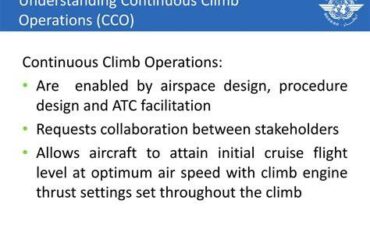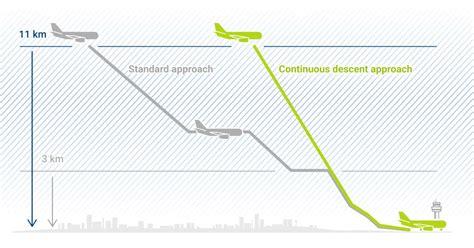
Continuous Descent Approach (CDA) is a technique used by aircraft during landing. It allows planes to descend smoothly from a high altitude with minimal thrust, avoiding level flight whenever possible while following safety regulations and air traffic control instructions. The main goal of CDA is to reduce noise, fuel consumption, and emissions by maintaining a steady descent path that aligns with the glide slope for landing.
In contrast to traditional approaches, where planes descend in steps with level segments in between, CDA keeps aircraft higher for longer periods. This leads to reduced engine thrust and, consequently, less fuel use, lower emissions, and decreased noise levels as the aircraft approaches the runway. Ideally, a CDA begins at the top of descent and continues until the final approach starts, following a smooth glide path.
However, CDAs aren’t feasible for every flight or at every airport all the time. Many airports are working towards maximizing the number of flights utilizing CDA techniques to improve environmental impacts. To support this transition, the International Civil Aviation Organization (ICAO) is developing a CDA Implementation Manual. In Europe, EUROCONTROL has already published guidance material to help facilitate this process.
At the pan-European level, a Joint Industry CDA Action Plan has been established. This plan outlines specific actions aimed at ensuring rapid CDA deployment across the European aviation sector. The goal is to implement CDA at over 100 airports and at least 50 airports by the end of 2013, while also committing to a minimum of 20 airports adopting CDA each year. By doing so, it is expected that CDA could save more than 150,000 tonnes of fuel annually and reduce CO2 emissions significantly, along with lowering noise impact on the ground.
The FAA’s NextGen initiative also promotes optimized descent profiles (OPD), which allow aircraft to maintain a continuous descent from their initial approach to landing. These procedures have been tested and successfully implemented at various airports, including Los Angeles International Airport. OPD takes advantage of the aircraft’s Flight Management System (FMS) to ensure efficient descent without level flight segments.
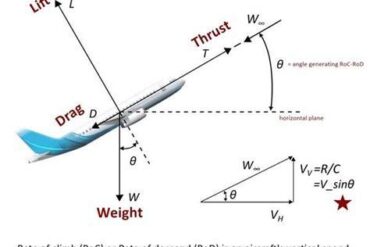
However, safety concerns arise with the implementation of CDA, especially during busy air traffic periods. When multiple aircraft are approaching an airport, pilots may need to adjust their throttles and landing gear settings, which can increase drag and require more thrust. Before any CDA operations begin, a local safety assessment must be conducted to address issues such as the interaction between CDA and non-CDA traffic, cockpit workload, and the need for accurate distance-to-go information to ensure safe landings.
In conclusion, CDA represents a significant advancement in landing procedures that can benefit the environment and improve efficiency in air travel. As more airports adopt these practices, the aviation industry moves closer to a greener future.