The V-22 Osprey is now one of the most recognizable military aircraft in the world, combining the vertical takeoff and landing capability of a helicopter with the speed and range of a turboprop airplane. Yet the basic idea behind the Osprey is far older than its operational career suggests. Long before the V-22 entered service, American engineers were already wrestling with the difficult problem of making an aircraft transition between vertical and conventional flight. One of the most unusual attempts came from a company that had already disappeared from the aircraft manufacturing business: Curtiss-Wright.
The Curtiss-Wright X-100 and X-200/XV-19 programs of the late 1950s and early 1960s represented an important but largely forgotten branch of American tiltrotor development. The aircraft looked radically different from the Osprey, using multiple relatively short propellers rather than two enormous proprotors. Nevertheless, the underlying ambition was strikingly similar. The designers wanted an aircraft that could hover without a runway, then rotate its propulsion system and fly efficiently at much higher speeds.
The story is especially interesting because Curtiss-Wright was not initially expected to become a major participant in the emerging VTOL revolution. The company had abandoned its aircraft division in 1952 after struggling to secure significant postwar military contracts. By the late 1950s, however, engineers inside the company saw an opportunity to return to aircraft development by solving one of the fundamental aerodynamic problems facing vertical-flight machines.
The result was an experimental family of aircraft that helped generate valuable aerodynamic and flight-test data. Although the X-19 never successfully completed its planned helicopter-to-airplane transition, the lessons from the program did not simply disappear. Some of the information gathered during the short life of the aircraft later contributed to the broader technological foundation from which the Bell XV-15 and ultimately the V-22 Osprey emerged.
The Bell XV-3 Opened the Door to Tiltrotor Flight
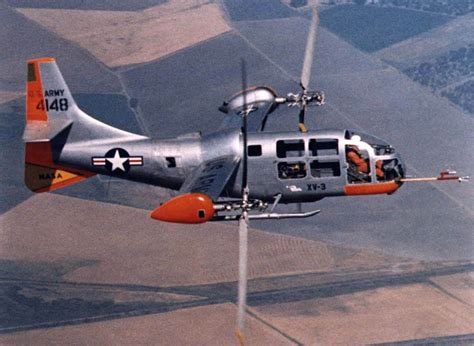
Curtiss-Wright was not the first American company to seriously investigate tiltrotors. Bell Helicopter’s XV-3 had already demonstrated that an aircraft could combine helicopter-style vertical flight with airplane-style forward flight. Two XV-3 prototypes were constructed under a joint U.S. Army and Air Force research program, with the first aircraft making its initial flight in August 1955.
The early XV-3 program was far from straightforward. The first prototype crashed only a few months after its first flight, forcing engineers to learn from a difficult and unforgiving test program. The second aircraft eventually became much more useful, completing 110 transitions between helicopter and airplane modes from 1958 to 1962.
The XV-3 demonstrated that the concept was technically possible, but its configuration also revealed important aerodynamic limitations. Its relatively long and narrow rotor blades were not particularly effective when the aircraft was operating as a vertical-lift machine. Curtiss-Wright engineers believed they could approach the problem differently.
That difference became the defining feature of the X-100.
Curtiss-Wright X-100 Used Shorter Propellers With Wider Blades
Henry Borst, Curtiss-Wright’s chief aerodynamicist in its propeller division, played an important role in the company’s decision to return to aircraft development. Borst had experience on several ambitious aircraft projects, including the Lockheed XP-88 and Convair XFY Pogo, and understood the aerodynamic compromises involved in unconventional aircraft.
Curtiss-Wright’s engineers focused on the relationship between propeller diameter, blade area, and vertical lift. Their theory was that shorter propellers with wider blades could generate a substantial propeller disk effect without encountering some of the compressibility problems associated with very long rotor blades.
That idea produced the X-100, an aircraft that looked almost improvised compared with later tiltrotors. Its fuselage was slender, with two small stub wings extending outward. At the leading edge of each wing was a nacelle containing a tilting propeller system. Rather than mounting separate engines in the nacelles, Curtiss-Wright installed a single Lycoming YF53 turboshaft engine in the center of the fuselage.
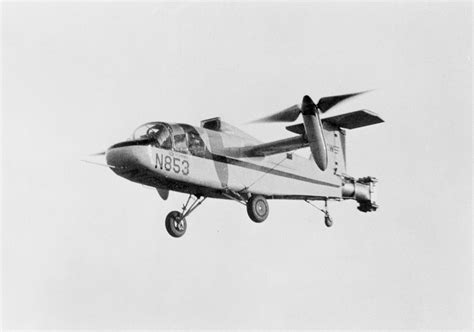
The X-100 also featured fixed tricycle landing gear and room for two crew members. Its unusual configuration was not merely an aesthetic experiment. Curtiss-Wright was attempting to make vertical flight more efficient while retaining the aerodynamic benefits of a conventional fixed-wing aircraft once the propulsion system had rotated forward.
Tethered hovering tests began in April 1959. Test pilot Bill Furlich subsequently made the aircraft’s first rolling takeoff in March 1960. While the X-100 was still being tested, Curtiss-Wright was already developing a substantially larger successor.
The X-200 Became the Curtiss-Wright X-19
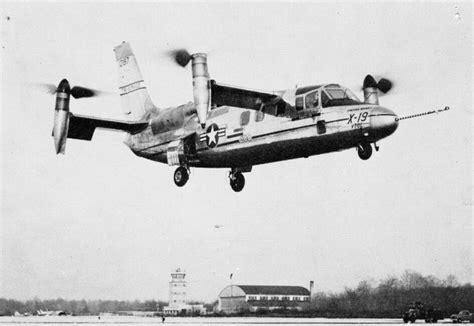
The next aircraft was designated X-200 during development and was later redesignated X-19 under a tri-service agreement involving the Army, Navy, and Air Force. Unlike the privately developed X-100, the larger aircraft attracted official military interest and became the most ambitious aviation project undertaken by Curtiss-Wright after its return to aircraft manufacturing.
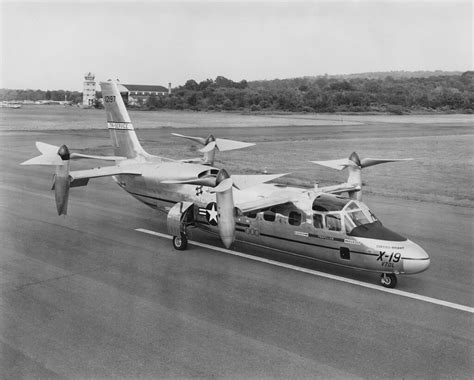
The X-19 used a tandem arrangement of tilting propulsion units, giving the aircraft its distinctive appearance. Four propellers were distributed across its wing and tail structures, creating a configuration that was dramatically different from the twin-engine, twin-proprotor arrangement eventually used by the V-22.
The basic objective, however, was familiar. The aircraft was supposed to take off vertically, transition into forward flight, cruise at much higher speed than a conventional helicopter, and return to a vertical landing. That combination promised to eliminate one of the central compromises of military aviation: helicopters offered excellent access to confined landing areas but sacrificed speed and range, while fixed-wing aircraft offered superior performance but generally required runways.
The X-19 attempted to occupy the space between those two categories.
Flight Testing Exposed the X-19’s Biggest Problems
Curtiss-Wright built two X-19 demonstrators, but the company faced a major obstacle that had nothing to do with aerodynamic theory: money. The program did not receive enough funding to refine and test critical systems as extensively as engineers needed.
One particularly important area was the aircraft’s gearbox system. A tiltrotor depends on complicated mechanical arrangements to transmit engine power to propulsion units while allowing those units to change orientation. Reliability in this area would remain a major challenge for later generations of tiltrotor aircraft as well.
The first X-19 flights began in November 1963. Testing revealed that several of the problems identified on the X-100 had not disappeared. Propeller downwash remained troublesome, while throttle response was slower than desired. Parts failures and other technical difficulties repeatedly delayed the program.
The planned first full hover-to-cruise transition was eventually pushed back to 1965. Before that milestone could be achieved, however, disaster struck.
During a test flight, a gearbox failure combined with pilot error resulted in the loss of the aircraft. Both pilots successfully ejected, but the destruction of the first X-19 dramatically weakened the already fragile program. The Air Force’s limited enthusiasm for the aircraft provided little incentive to continue investing in a project that had not yet demonstrated its defining capability.
The second aircraft therefore never completed the intended flight program.
NASA Found Value in the Failed Tiltrotor Program
The X-19’s cancellation could easily have made it nothing more than an obscure footnote in American aviation history. Instead, its test results retained considerable value.
According to NASA, the X-19 completed 50 flights, reaching a maximum speed of approximately 454 mph and an altitude of 25,600 feet. Although the aircraft never completed the full hover-to-cruise transition, NASA concluded that the program demonstrated the general feasibility of its tandem tiltrotor configuration.
The aircraft also provided information about dynamic and longitudinal stability, hovering behavior, and transition performance. Those areas were particularly important because a tiltrotor is not simply a helicopter with movable propellers. During transition, the aircraft’s aerodynamics, propulsion, control systems, and structural loads all change dramatically.
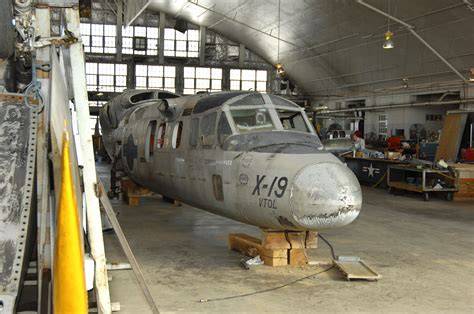
The surviving X-19 eventually found a permanent home at the National Museum of the United States Air Force, where it remains a reminder of a technological path that did not directly lead to production but nevertheless contributed to the development of future tiltrotors.
The aircraft was transferred to the museum in 2007, decades after Curtiss-Wright’s aircraft manufacturing ambitions had ended.
Why the V-22 Osprey Took Decades to Arrive
The most important question is why an apparently workable tiltrotor concept did not become a practical military aircraft immediately after the X-19.
The answer was not simply that engineers lacked imagination. The technology was extraordinarily difficult, and for much of the 1960s and 1970s, the military did not have a sufficiently urgent operational requirement to justify the expense and complexity.
Conventional helicopters were improving rapidly, while fixed-wing aircraft already provided excellent speed and range. A tiltrotor therefore occupied an uncomfortable middle ground: potentially superior to both in certain missions, but much more complicated than either.
That calculation changed dramatically after the 1979 Iranian hostage crisis and the failed Operation Eagle Claw rescue mission. The operation exposed the difficulty of conducting long-range missions that required aircraft to combine the range and speed of airplanes with the vertical landing capability of helicopters.
The United States subsequently investigated other solutions, including the experimental Operation Credible Sport modification of the C-130 Hercules, which attempted to dramatically shorten takeoff and landing distances using rocket-assisted systems. That project also encountered serious difficulties and ultimately failed to become an operational solution.
Tiltrotors suddenly looked much more relevant.
The XV-15 Connected Early Experiments to the Osprey
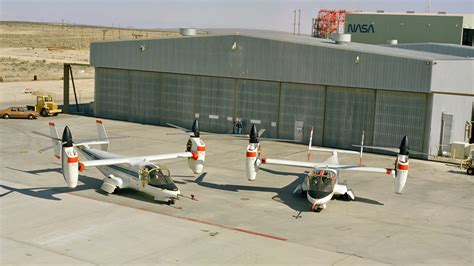
By the 1970s, Bell had developed another major experimental aircraft: the XV-15. Two examples were built, with the first flight taking place in 1977. The XV-15 looked considerably closer to the eventual V-22 than either the XV-3 or X-19.
Its success provided an important bridge between experimental research and a military aircraft capable of entering operational service. NASA operated the XV-15 aircraft for years, with the type eventually retired in 2003.
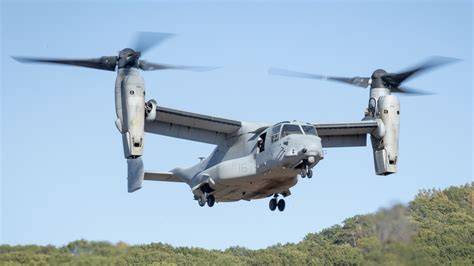
The Bell-Boeing V-22 Osprey incorporated lessons from this much broader history. Its two large wingtip-mounted proprotors can rotate from a vertical orientation for helicopter-style operations to a forward-facing configuration for airplane-like cruise.
The Osprey’s development itself was long and difficult, and its early operational history included accidents, safety concerns, modifications, and periods of grounding. Nevertheless, the aircraft ultimately demonstrated that tiltrotor technology could move beyond the experimental stage and become a practical military capability.
Curtiss-Wright’s Forgotten Contribution Still Matters
The X-19 never became an operational aircraft, and it would be misleading to describe it as a direct prototype of the V-22. The engineering configurations were substantially different, and the decades separating the two programs contained numerous experimental aircraft, technological advances, and changes in military requirements.
Yet the Curtiss-Wright X-100 and X-19 were important stepping stones. They demonstrated that engineers could build, test, and operate aircraft designed around the difficult compromise between vertical lift and high-speed forward flight. Their data also survived long enough to become useful to later researchers.
Curtiss-Wright itself did not survive as an aircraft manufacturer. The company eventually shifted toward components and systems such as actuators, aircraft controls, valves, and surface-treatment services. Its final aircraft, the X-19, therefore marked the end of an aviation chapter rather than the beginning of a production dynasty.
Ironically, that final aircraft represented a technology that would become increasingly important decades later.
Tiltrotors Are Entering a New Generation
The legacy of these early experiments extends beyond the V-22. Modern military planners continue to value aircraft capable of operating without conventional runways while covering significantly greater distances than traditional helicopters.
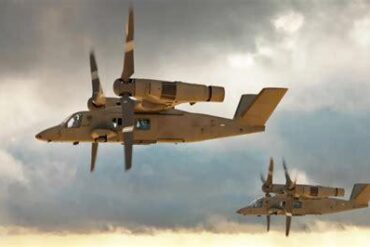
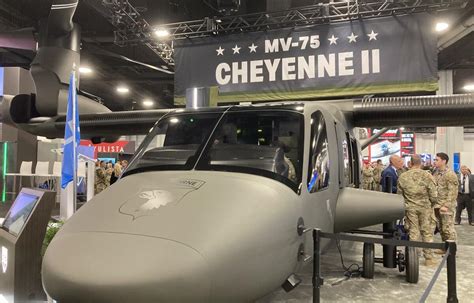
The U.S. Army’s MV-75 Cheyenne II, for example, represents another stage in the evolution of high-speed vertical-lift aircraft and is intended to perform missions traditionally associated with helicopters while offering substantially greater speed and range.
At the same time, the commercial eVTOL industry is developing aircraft based on related concepts. Companies working on electric vertical-takeoff aircraft are exploring configurations that combine distributed propulsion, tilting rotors, fixed wings, and autonomous flight controls. Some of these technologies are also being considered for military applications, including logistics, troop movement, and unmanned systems.
That makes the strange-looking X-100 and X-19 more relevant than their brief careers might suggest. They belonged to an era when engineers were still discovering what a tiltrotor could and could not do.
The V-22 Osprey did not appear from nowhere. It was the product of decades of experiments, failures, aerodynamic research, mechanical breakthroughs, and changing military requirements. Among those forgotten experiments was Curtiss-Wright’s remarkable four-propeller X-19, an aircraft that never achieved its defining transition but nevertheless helped demonstrate that the boundary between helicopter and airplane did not have to be permanent.