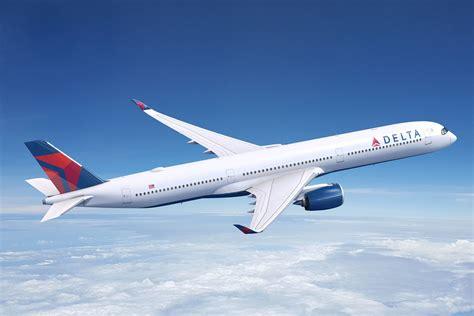
Delta Air Lines is entering the 2025 winter season with a sharpened global strategy driven by the versatility, efficiency, and premium appeal of the Airbus A350. This aircraft has become the centerpiece of Delta’s long-haul ambitions, enabling the airline to rebuild and expand its international footprint while strengthening its domestic network through strategic aircraft positioning. As winter schedules settle in, the A350 reveals where Delta sees the strongest passenger demand and the most profitable opportunities across the globe.
Delta’s A350 fleet has effectively replaced the Boeing 777 and the retired 747, establishing a modern, fuel-efficient foundation for long-haul widebody operations. With a composite fuselage, superior cabin altitude, enhanced humidity levels, and exceptionally quiet interiors, the aircraft delivers a noticeably better experience for long-duration travel. Beyond comfort, the A350 plays a crucial role in Delta’s operational economics, cutting fuel burn and reducing maintenance demands while delivering long-range performance that makes previously challenging markets commercially viable.
This winter, the aircraft stands at the heart of Delta’s global strategy. The airline is deploying the jet where passenger demand is strong, premium cabin uptake is reliable, and operational efficiencies can be maximized. The result is a refined map of high-value routes in Asia, Oceania, and major US corridors.
Delta’s Highest-Demand A350 Routes in Winter 2025
According to December 2025 schedule data from Cirium, Delta’s A350 program is centered on ultra-long-haul Asia-Pacific routes and key domestic corridors that support aircraft repositioning for long-haul departures. The winter lineup reflects strong transpacific recovery, heightened holiday travel, and a strategic focus on premium-heavy gateways.
Delta’s top ten A350 routes for December 2025 showcase an airline leveraging its flagship aircraft where it performs best—high-demand, high-yield, long-distance segments. Atlanta remains the undisputed center of operations, but Los Angeles, Detroit, and Seattle all play critical roles in connecting passengers across the Pacific.
Why Atlanta Remains the Nucleus of Delta’s A350 Strategy
Atlanta’s Hartsfield-Jackson International Airport continues to function as Delta’s operational powerhouse. With over 80 years of dominance and unmatched domestic connectivity, it remains the backbone of the network. Approximately 80% of the US population lives within a two-hour flight of Atlanta, which amplifies the airport’s role as a connecting hub for international travel.
Delta’s A350s cycle through Atlanta to launch long-haul missions to Korea, Japan, and occasionally Europe. The airport’s efficient layout, multiple parallel runways, and high-throughput infrastructure allow Delta to maximize fleet utilization even during peak winter traffic. The A350’s advanced cabin environment—lower pressurization equivalent, higher humidity, and quieter engines—makes it the preferred aircraft for long-distance travelers connecting through Atlanta.
Atlanta to Incheon: The Crown Jewel of the A350 Network
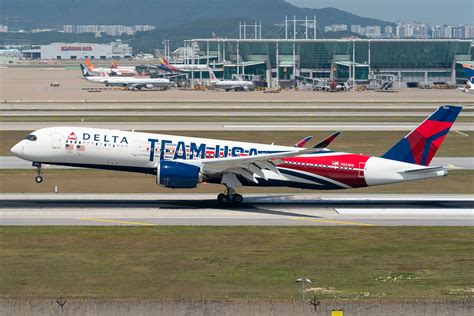
The Atlanta–Seoul Incheon (ICN) route stands as Delta’s single busiest A350 assignment this winter, operating 241 roundtrip flights in December 2025. This is not merely a strong-performing route—it is the cornerstone of Delta’s East Asian strategy.
The joint venture between Delta Air Lines and Korean Air has transformed ICN into the carrier’s primary East Asian hub, with Terminal 2 offering streamlined transfers and coordinated operations. Delta funnels a massive volume of transpacific passengers into Incheon, using the A350’s premium cabins to attract business travelers and high-yield leisure traffic.
Passengers onboard enjoy Delta One Suites, Premium Select, and a sophisticated entertainment and connectivity package designed for flights consistently exceeding 10 hours. The A350’s long-range capability and fuel profile make this route both profitable and dependable even during the winter season.
The partnership with Korean Air, launched in 2018, provides broad reciprocal benefits, integrated scheduling, and seamless onward connectivity across Asia, solidifying this route as the flagship of Delta’s transpacific portfolio.
Los Angeles to Sydney: Delta’s Pacific Heavyweight
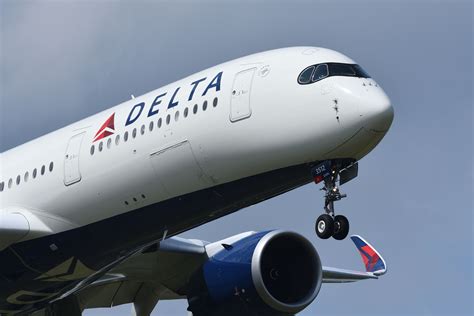
Delta’s expansion into Oceania has accelerated since the introduction of the A350. The Los Angeles–Sydney (LAX–SYD) route is one of the airline’s most prestigious long-haul services, recording 178 roundtrip flights in December. This route has historical significance—when Delta launched service to Sydney in 2009 using the 777-200LR, it became the first airline to operate to all six inhabited continents.
The A350 now elevates the route’s economics and passenger appeal. Outfitted with Delta’s most advanced cabins, including the fully enclosed Delta One Suite, the aircraft provides a competitive edge against Qantas, United, and American, all of which aggressively serve the market.
The A350’s Rolls-Royce Trent XWB engines allow Delta to cut fuel burn by roughly 25% compared to the retired 777-200LR, enabling winter operations without compromising load factors or profitability. Additionally, Delta’s recent expansion to Brisbane and Melbourne strengthens its network in the South Pacific, positioning LAX as the hub of its Oceania ambitions.
Atlanta to Los Angeles: Domestic Capacity With Global Intent
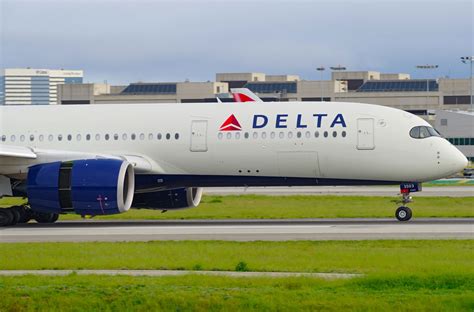
The Atlanta–Los Angeles (ATL–LAX) corridor may seem like an unusual place to find a long-haul aircraft, yet Delta deploys the A350 here for highly strategic reasons. This is one of the premium-rich domestic routes in the country, frequented by business travelers, entertainment industry professionals, and transiting international passengers.
This route sees 129 roundtrip A350 flights in December, reflecting Delta’s preference to use revenue-generating domestic flights to reposition aircraft for transpacific journeys instead of operating empty ferry segments. It also allows travelers to enjoy a world-class long-haul cabin on a two-thousand-mile domestic hop.
The wider fuselage, bespoke lighting system, and quiet interior of the A350 deliver a noticeably smooth experience even for travelers flying purely within the United States. Delta markets this service as a premier domestic option, cementing LAX’s importance as a long-haul launchpad for the A350 fleet.
Delta’s Broader 2025 A350 Strategy
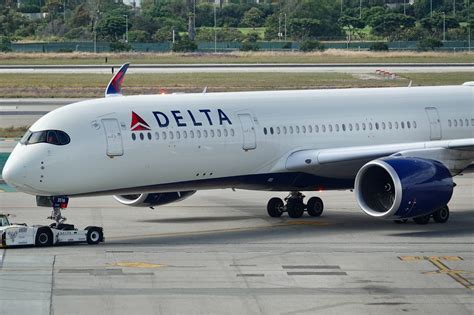
Delta’s winter 2025 deployment reflects the airline’s long-term strategy with the A350: fuel efficiency, premium positioning, and fleet commonality. The aircraft serves as the backbone of Delta’s post-pandemic international rebuilding, enabling the retirement of older and costlier types while supporting profitable expansion into high-demand markets.
The A350 was chosen over the Boeing 787 and 777X for practical reasons. The 787 was too small for Delta’s expected loads, while the 777X was too large and plagued by production delays. The A350 also meshes seamlessly with Delta’s existing Airbus fleet. Pilots transitioning from the A330 require minimal additional training, reducing operational complexity and cost.
This winter’s network is only a precursor to further expansion. Deliveries of the larger A350-1000 begin in 2026, signaling Delta’s intent to increase capacity on ultra-long-haul routes across the Pacific. This variant offers greater seating and payload capability, positioning Delta to compete more aggressively with carriers such as Singapore Airlines, Cathay Pacific, and Qantas.
Holiday Travel Dynamics and Domestic A350 Boosts
The holiday travel season amplifies demands across both domestic and international markets. Delta uses the A350 as a flexible high-capacity tool during December, allowing the airline to boost availability on dense domestic routes while positioning aircraft for long-haul departures.
Besides the prominent ATL–LAX route, Delta occasionally deploys the A350 on flights to Minneapolis–St. Paul, Detroit, Salt Lake City, and even Phoenix or Orlando depending on holiday demand spikes. These flights do not always appear in frequency rankings, but they form an important part of Delta’s winter operations.
Winter also drives strong traffic to warmer regions, particularly Latin America and the Caribbean. Delta capitalizes on this with connecting itineraries through Atlanta and Los Angeles, where the A350 often serves as the anchor for high-value transpacific travel.
For travelers seeking an ideal winter escape in a premium cabin, Delta’s Australian network is particularly attractive this season. The combination of long-haul comfort, modern inflight technology, and high service consistency places the A350 at the center of these desirable itineraries.
The Global Significance of Delta’s Winter A350 Operations
Delta’s winter 2025 network reveals a clear strategic focus: transpacific expansion, premium revenue optimization, and fleet efficiency. The A350 is not merely a workhorse—it is a symbol of Delta’s evolving identity as an airline that prioritizes technological sophistication and passenger experience.
Its presence on the world’s busiest transpacific lanes showcases Delta’s resurgence in a market once dominated by competitors. Its deployment on key domestic routes highlights the type’s versatility and the airline’s commitment to smart, revenue-generating aircraft utilization. With the upcoming A350-1000 poised to join the fleet, Delta’s winter network represents not a peak, but a preview of broader ambitions.
As the final weeks of 2025 unfold, the Airbus A350 stands as the aircraft shaping Delta’s global reach, bridging continents, strengthening partnerships, and guiding the airline’s strategy into the next decade.