Delta Air Lines is set to give Austin a significant new connection to Europe, launching daily nonstop service from Austin-Bergstrom International Airport (AUS) to Paris Charles de Gaulle Airport (CDG) on March 27, 2027. The new route will be operated with the Airbus A330-900neo and represents a notable shift in Austin’s international aviation landscape. More importantly for the competitive market, Delta will become the only U.S. airline operating a nonstop route from Austin to Europe, giving the carrier a distinction that none of its domestic rivals currently holds at the Texas airport.
Austin already has a growing European network, but those services are operated by foreign carriers. British Airways flies to London Heathrow, KLM connects Austin with Amsterdam, and Lufthansa serves Frankfurt. Delta’s arrival therefore changes the character of Austin’s transatlantic market rather than simply adding another European destination. For travelers who prefer a U.S. airline, the Paris service will provide a direct option that previously did not exist.
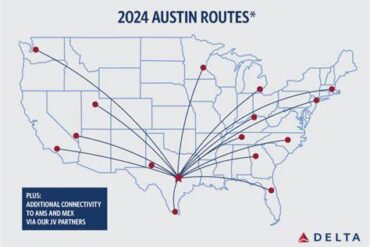
The timing is also significant. Delta is not treating Paris as an isolated international experiment. The airline is building a much larger presence at Austin-Bergstrom, with plans to operate more than 70 peak-day departures to approximately 30 destinations by summer 2027, compared with just 28 peak-day departures in 2019. The Paris route is consequently one part of a broader strategy to establish Austin as an important focus city rather than simply another spoke in Delta’s domestic network.

Delta’s Austin to Paris Route Starts March 27, 2027
Delta will begin the Austin-Paris nonstop route on March 27, 2027, with daily summer-season flights aboard the Airbus A330-900neo. The aircraft is particularly well suited to the strategy because it provides widebody capacity without requiring the much larger passenger volumes associated with some of Delta’s biggest long-haul aircraft.
The A330-900neo will offer four cabins on the route. Delta One suites will provide lie-flat seating, privacy doors and premium dining, while Delta Premium Select will give travelers wider seats and additional space. Delta Comfort+ will offer extra legroom, and Main Cabin passengers will receive features including memory-foam seat cushions and seatback entertainment. This gives Delta the ability to serve several different segments of the Austin-Paris market rather than relying solely on high-yield business travelers.
Paris also offers value beyond the nonstop destination itself. Through Delta’s partnership with Air France-KLM, passengers arriving at Charles de Gaulle can connect onward to nearly 70 destinations across Europe, India and Africa. That network is crucial to the economics of the new route because Austin does not need to generate enough local demand to fill every seat to Paris independently. Connecting passengers can help support the service throughout the season.
The Air France-KLM joint venture also gives Delta a broader presence between Austin and Europe. When the new Paris service is combined with KLM’s existing Amsterdam operation and the broader partnership network, Delta and its joint-venture partners will offer up to 10 weekly nonstop flights between Austin and Europe during peak summer. For travelers, that means the importance of the new route extends well beyond the number of flights operated by Delta itself.
Why Paris Is a Major Addition for Austin Travelers
For Austin passengers, the most obvious benefit is convenience. A nonstop flight eliminates the need to connect through a major U.S. hub before beginning a transatlantic journey. That matters particularly for travelers heading to Europe from Central Texas, where a connection through Atlanta, New York, Chicago or another gateway can add several hours to an already long journey.
Paris is also one of Europe’s most important connecting points. A passenger whose final destination is not France can use Charles de Gaulle as a gateway to other European markets, while Delta’s relationship with Air France creates additional opportunities for international connections. The route therefore has the potential to capture both Austin-Paris traffic and connecting traffic beyond Paris, making the market considerably larger than the nonstop city pair suggests.
Austin’s economic profile strengthens that proposition. The city has developed into one of the United States’ major technology and business centers, with a large population of corporate travelers and an increasingly international economy. Paris, meanwhile, is not only a major tourism destination but also an important center for technology, finance, luxury goods, manufacturing, media and international business.
The new route should therefore appeal to multiple passenger groups. Leisure travelers gain a simpler way to reach France, business travelers receive a direct link between two globally connected cities, and passengers traveling elsewhere in Europe or beyond can use Delta and Air France-KLM’s network to continue their journeys after one stop.
Delta Is Expanding More Than Just Its International Network
The Paris announcement comes alongside several other changes that demonstrate how aggressively Delta is expanding at Austin-Bergstrom. The airline plans to introduce daily nonstop Austin-San Diego service on April 12, 2027, using the Airbus A319. Delta will also make its Austin-Cancun route year-round instead of restricting it to the winter season.
Another important change involves San Jose, California. Delta will begin Austin-San Jose service on October 6, 2026, and plans to increase the route to two daily flights on the A319 beginning April 12, 2027. The route links two major technology employment centers, making the additional frequency particularly relevant to corporate travelers and business activity between the two cities.
Taken together, these changes show that Delta is building an interconnected network rather than simply adding a prestigious international route. Domestic flights can feed the Paris service, while the expanding international network can generate additional demand for Delta’s domestic routes. That kind of network effect is especially important at a focus city that does not have the enormous connecting traffic base of Delta’s established hubs.
Local infrastructure investment reinforces the message. Delta already operates a Sky Club at Austin-Bergstrom and plans for a second, larger lounge as part of the airport’s future terminal expansion. The airline has also been allocated 15 gates in the planned Concourse A, which is expected to become Delta’s primary operating area when completed.
Delta currently employs more than 900 people in the Austin area and has established a flight attendant base of more than 100 employees at the airport. Those commitments are difficult to characterize as a temporary response to seasonal demand. They point toward a longer-term effort to make Austin an important part of Delta’s network.
Austin’s European Network Is Becoming More Competitive
By summer 2027, Austin-Bergstrom is expected to have nonstop service to four European capitals: London Heathrow with British Airways, Amsterdam with KLM, Frankfurt with Lufthansa and Paris with Delta. The composition of that network is particularly interesting because Delta will enter a market where European airlines already have established positions.
British Airways was the first carrier to launch transatlantic service from Austin in 2014. KLM and Lufthansa subsequently expanded the airport’s European reach. For years, however, travelers looking for a nonstop European flight from Austin did not have a U.S. airline option. Delta’s Paris service changes that dynamic.
The growth of the overall market makes the timing more logical. OAG schedule data indicated that airlines offered approximately 352,000 two-way seats between Austin and Europe during summer 2026, representing a 9.1% increase from the previous year. That growth suggests the market is expanding enough to support additional capacity, even as airlines continue to evaluate how much international service Austin can absorb.
Austin’s international network is also far broader than its European routes. Aeromexico serves Mexico City, Copa Airlines connects the airport with Panama City, Air Canada flies to Toronto and Montreal, Viva Aerobus serves Monterrey and Mexico City, and WestJet operates seasonal Calgary service. With approximately 19 airlines serving around 136 destinations as of August 2026, Austin is increasingly functioning as a genuinely international airport rather than a primarily domestic Texas gateway.
Delta’s Strategy Mirrors Its Tampa Investment
Delta’s decision to deploy an A330-900neo from Austin is not without precedent. The airline has pursued a similar strategy at Tampa International Airport, where it introduced year-round A330-900neo service to Amsterdam. That operation became Delta’s first scheduled widebody international route from Tampa and was followed by a much larger infrastructure commitment.
Delta subsequently agreed to a 20-year anchor lease for at least six gates at Tampa’s new $1.528 billion Airside D terminal. The facility includes international-arrival infrastructure and a purpose-built Delta Sky Club, creating the physical capacity for the airline to expand its presence in the future.
The parallels with Austin are difficult to overlook. In both cities, Delta is using a widebody aircraft to create international connectivity from a large but non-hub U.S. airport. Instead of forcing passengers to travel through Atlanta or New York before reaching Europe, Delta is attempting to capture demand locally and use its joint-venture network to make the international service more useful.
The Airbus A330-900neo is central to that approach. A larger aircraft can require substantially more demand to operate profitably, particularly when a route lacks a deep connecting network of its own. The A330-900neo gives Delta a middle ground: widebody international capability with capacity better matched to a secondary city’s demand.
If Austin-Paris performs strongly, the airport will already have much of the foundation needed for further growth. Delta will have an expanding customer base, local employees, airport gates, lounge infrastructure and access to the Air France-KLM network. Adding another European destination would therefore become an incremental expansion rather than the creation of an entirely new operation.
Delta and United Are Taking Different Paths Overseas
Delta’s Austin strategy also fits into a wider U.S. airline trend toward serving international markets that were previously considered too thin for traditional long-haul operations. United Airlines is pursuing a similar objective, although it is using a very different aircraft and network structure.
United announced a major international expansion for summer 2027 that includes 10 new destinations. The plan features Okinawa from San Francisco and nine European destinations from Newark and Washington Dulles, including Luxembourg City, Toulouse, Marseille, Ibiza, Valencia, Terceira, Ljubljana, Olbia and Catania. Eight of those new destinations reportedly have no competing nonstop service from another U.S. airline.
United is relying heavily on the Airbus A321XLR, which is scheduled to make its international debut for the airline in December 2026. The aircraft is intended to replace the Boeing 757-200 as a thin-route transatlantic workhorse, allowing United to open markets where passenger demand may be insufficient for a larger widebody.
Delta is taking the opposite approach at Austin. Rather than using a narrowbody to reach a relatively small European city from one of its established hubs, Delta is using a widebody to connect a major U.S. growth market directly with one of Europe’s most important gateways. The two strategies look different operationally, but they share the same fundamental logic: match aircraft and network capacity to the specific demand available in each market.
What Delta’s Paris Service Means for Austin’s Future
The most important question is whether Austin-Paris becomes a successful standalone route or the beginning of something much larger. Delta’s investment suggests the airline sees enough long-term potential to justify building a substantial local operation around it. The combination of more than 70 peak-day departures, approximately 30 destinations, additional gates, lounge expansion and a growing employee base gives the carrier considerably more infrastructure than it would need for a single seasonal international flight.
Austin’s rapid growth provides another reason for optimism. The city has become an increasingly important business and technology center, while its appeal as a leisure destination continues to attract visitors from around the world. As international demand grows, airlines have more opportunities to replace connecting itineraries with nonstop service, particularly on routes supported by strong corporate and premium-cabin demand.
For Delta, Paris is therefore about more than adding another destination to a route map. It establishes the airline as Austin’s first U.S. carrier with a nonstop European route and gives passengers a new gateway into the Air France-KLM network. At the same time, it strengthens Delta’s broader position at an airport where its presence has expanded dramatically since 2019.
By March 2027, Austin travelers will have another way to cross the Atlantic without first connecting through a distant U.S. hub. And for Delta, the Airbus A330-900neo arriving from Austin to Paris could represent something even more consequential: the first major step toward turning Austin into a long-term international focus city.