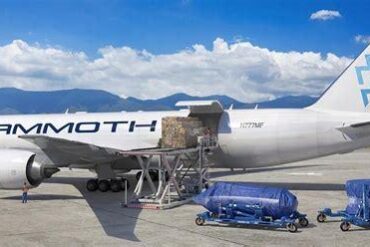
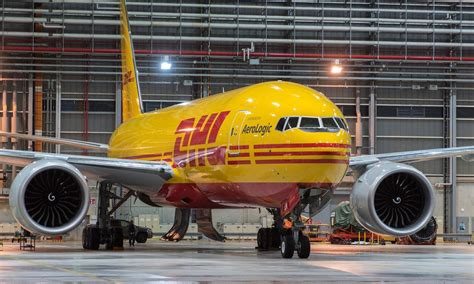
DHL’s long-planned expansion of its converted widebody freighter fleet has reached a major milestone. Mammoth Freighters has delivered its first Boeing 777-200LRMF, an aircraft converted from a former passenger jet into a dedicated freighter for DHL Air UK. The handover took place on August 21, 2026, marking the first commercial delivery from Mammoth’s 777-200LR freighter conversion program.
The aircraft, MSN 32222, carries registration N703DN and began life as a Boeing 777-200LR built in 2009 for Delta Air Lines. After years of passenger service, the aircraft was selected for conversion at Mammoth’s facility in Fort Worth, Texas. It will now enter DHL Express’s intercontinental cargo network, adding long-range capacity without requiring DHL to acquire another factory-new freighter.
The delivery is significant for more than just DHL. It represents the point at which Mammoth Freighters moves from development into commercial production after a lengthy certification program. The company received its FAA Supplemental Type Certificate for the 777-200LRMF in April 2026, clearing the way for customer deliveries. DHL had originally expected its first converted aircraft in 2024, meaning the program ultimately reached service roughly two years later than initially planned.
For aviation enthusiasts, there is another reason this aircraft deserves attention: N703DN can be followed as it enters DHL service using live flight-tracking platforms. Once the aircraft begins regular operations, its movements will offer a real-world look at how DHL integrates converted 777s into one of the world’s most extensive express cargo networks.
The First Boeing 777-200LRMF Has Entered Commercial Service
Mammoth Freighters handed the aircraft to Jetran, the Texas-based aircraft lessor, rather than directly to DHL. Jetran is responsible for supplying aircraft to operators under its agreements, including DHL and other major cargo customers. In this case, the converted 777 will be operated by DHL Air UK, making it part of DHL Express’s long-haul European network.
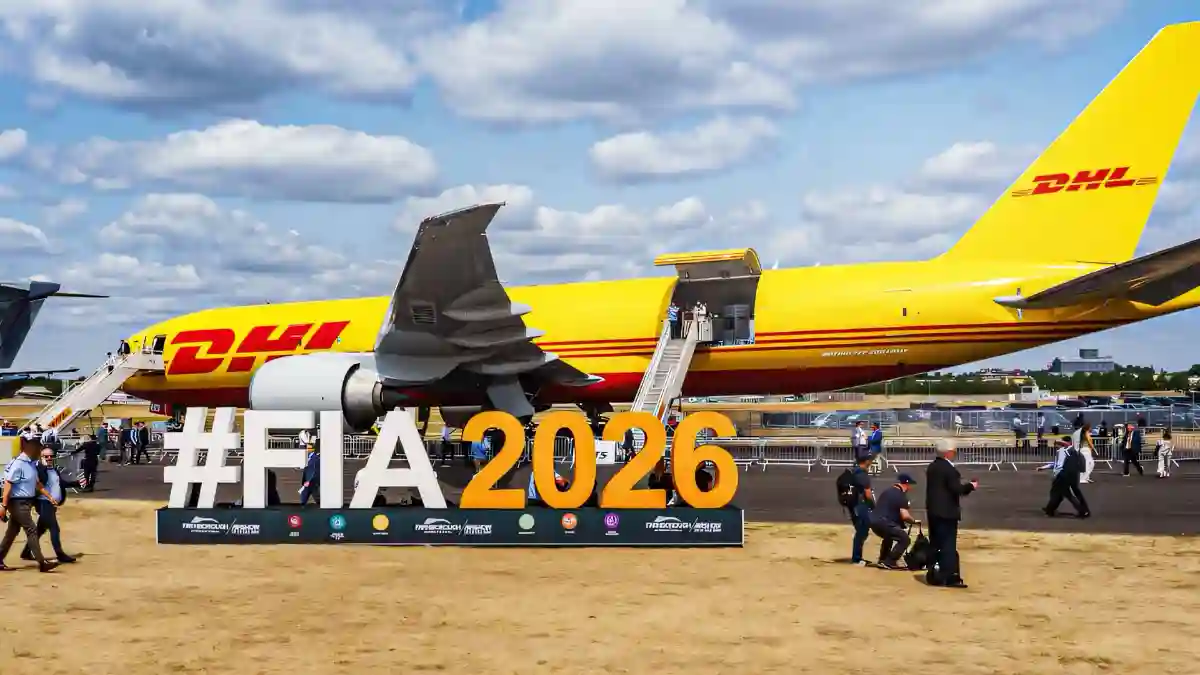
The aircraft’s public debut came only weeks before delivery. In July 2026, it appeared on static display at the Farnborough International Airshow, giving the aviation industry its first close look at Mammoth’s completed 777-200LRMF. On August 21, the aircraft officially moved into the commercial phase of its life.
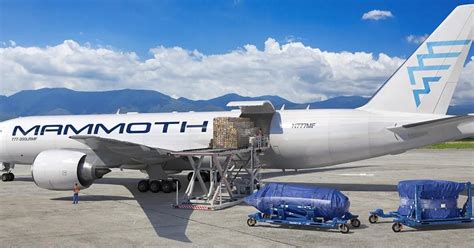
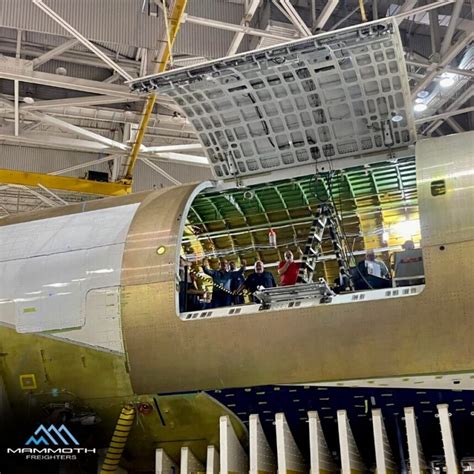
The transformation from passenger aircraft to freighter is extensive. Mammoth removes the passenger cabin, modifies the internal structure, reinforces the main deck floor, installs a large cargo door, and integrates a dedicated cargo-handling system. The result is not simply an aircraft with seats removed. It becomes a structurally modified freighter designed around the very different demands of heavy commercial cargo operations.
Mammoth’s certification of the aircraft is particularly important because a freighter conversion must demonstrate that the modified airframe can safely withstand the loads and operational stresses associated with cargo transportation. The FAA certification in April 2026 therefore represented a critical regulatory step before the first customer aircraft could be delivered.
The delivery also validates Mammoth’s production concept. The company was founded in December 2020 and had to develop an entirely new commercial conversion program while navigating engineering, manufacturing, certification, and supply-chain challenges. Delivering the first aircraft transforms the 777-200LRMF from an ambitious industry project into an operating aircraft.
How the Converted 777 Compares With the Boeing 777F
The attraction of the 777-200LRMF is straightforward: it offers performance close to Boeing’s factory-built 777F while being based on an aircraft that already exists.
Mammoth’s converted aircraft is designed to carry approximately 231,000 pounds (104,800 kilograms) of payload and fly about 4,800 nautical miles (8,890 kilometers) at maximum payload. The factory-built Boeing 777F, meanwhile, has a payload of approximately 227,000 pounds (103,000 kilograms) and a range of around 4,970 nautical miles (9,200 kilometers).
Those figures place the two aircraft remarkably close in practical cargo capability. The factory-built freighter has a modest range advantage, while the converted aircraft offers slightly higher stated maximum payload. For DHL, the key point is that the conversion does not create a dramatically inferior freighter simply because the aircraft started life carrying passengers.
Both aircraft also use members of the GE90 engine family, giving operators substantial commonality in propulsion technology. That commonality becomes particularly valuable for a company such as DHL, which already operates a large fleet of Boeing 777 freighters.
The Mammoth aircraft has another distinctive feature: its main-deck cargo door. Measuring approximately 163 inches, or 4.14 meters, wide, the opening is around 16.5 inches wider than the approximately 146.5-inch door on the factory-built 777F.
That additional width matters when cargo dimensions become the limiting factor. Express logistics operations routinely handle machinery, industrial equipment, oversized packages, and other freight that does not necessarily fit neatly into conventional cargo dimensions. A wider main-deck opening gives cargo handlers more flexibility when loading irregularly shaped shipments.
The converted aircraft can accommodate 22 standard 96-by-125-inch pallet positions in its primary configuration. That makes it a serious long-haul freighter rather than merely a secondary cargo aircraft.
Why DHL Chose Conversion Instead of Buying More New 777Fs
The most compelling argument for the Mammoth program is economic.
A new-build Boeing 777F carries a list price of more than $350 million before negotiated discounts. Mammoth has not publicly disclosed a fixed purchase price for its converted aircraft, but company representatives have indicated that the conversion can deliver capabilities close to a factory freighter while avoiding roughly $100 million in additional cost associated with a new-build aircraft.
For a global logistics company adding multiple aircraft, that difference can become enormous.
DHL originally committed to nine 777-200LRMF aircraft through Jetran in April 2023. Although certification delays pushed the first delivery well beyond the original 2024 target, DHL subsequently increased its commitment to 13 aircraft.
That decision is revealing. DHL did not abandon the program when certification slipped. Instead, it expanded the order, suggesting that the economics and operational concept remained attractive enough to justify continued investment.
Four of DHL’s 13 aircraft are expected to enter commercial service before the end of 2026, with the remaining nine scheduled to follow during 2027 as Mammoth increases production.
The strategy also addresses a problem that cannot be solved simply by placing another new-aircraft order. Boeing’s factory-built 777F production capacity is constrained, and customers can face lengthy waits for new aircraft. A passenger-to-freighter conversion gives DHL another avenue for obtaining widebody cargo capacity.
Instead of waiting years for a new airframe to emerge from a factory, DHL can acquire an existing 777-200LR and transform it into a freighter.
The 777-200LR Provides a Small but Valuable Conversion Pool
There is, however, a limitation to the 777-200LRMF program: Boeing did not build many 777-200LRs.
Only about 60 examples were produced during the variant’s production run. After excluding aircraft operated by governments and airframes unlikely to become available for conversion, Mammoth estimates that roughly 40 to 50 potential conversion candidates remain.
That scarcity makes every suitable aircraft valuable.
The 777-200LR was designed for extremely long-range passenger operations, which gives it an attractive foundation for a freighter. Yet its limited production run means Mammoth cannot build a conversion business around an enormous supply of retired 777-200LRs.
The company’s answer is the larger 777-300ERMF.
Mammoth’s Boeing 777-300ERMF Could Transform the Market
The 777-300ER offers Mammoth something the 777-200LR cannot: a huge pool of potential donor aircraft.
Boeing produced more than 800 777-300ERs, creating a dramatically larger supply of aircraft that could eventually transition from passenger service to cargo operations. The 777-300ERMF is therefore potentially much more important to the long-term freighter-conversion market.
Mammoth expects FAA certification for the 777-300ERMF before the end of 2026. The aircraft is designed to provide approximately 25% more cargo volume than the factory-built 777F, with a payload capability of roughly 216,000 pounds (98,000 kilograms).
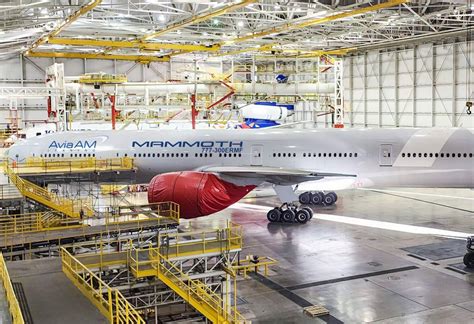
The 777-300ER and 777-200LR share important structural characteristics, including the same wing, engine pylons, and center wing box. The major difference is the 777-300ER’s substantially longer fuselage, which adds about 33 feet, or 10 meters, to the aircraft.
That additional length gives the 777-300ERMF a significant volume advantage. For cargo operators, volume can be just as important as payload weight because express shipments often fill an aircraft physically before reaching its maximum structural payload.
Mammoth already has a launch customer for the larger conversion. AviaAM Leasing, part of Avia Solutions Group, has ordered six 777-300ERMFs.
Mammoth will also face direct competition from Israel Aerospace Industries, whose 777-300ERSF conversion received certification in September 2025. That means the larger 777 freighter market is evolving into a contest between competing conversion platforms rather than a single-provider opportunity.
DHL’s Converted 777s Will Supplement Its Existing Fleet
DHL is not using the Mammoth aircraft because it has suddenly lost interest in the factory-built 777F. Quite the opposite.
The company has invested heavily in the 777F since ordering 14 aircraft in 2018, with deliveries continuing through 2021 and additional aircraft subsequently joining the fleet. These factory-built freighters remain central to DHL Express’s intercontinental network.
The converted aircraft are intended to supplement rather than replace those new-build 777Fs.
DHL’s cargo fleet also includes Boeing 767-300Fs, Boeing 757-200 freighters, Airbus A330 freighters, and other aircraft operated through its airline subsidiaries and partner carriers. The Mammoth 777s will give the company another long-range widebody platform while helping replace capacity previously supplied by leased Boeing 747-400 freighters.
That transition is important. The 747-400 has enormous cargo capability, but four-engine aircraft are increasingly difficult to justify economically compared with modern twin-engine widebodies. The 777 provides a combination of range, payload, fuel efficiency, and fleet commonality that makes it a natural replacement platform.
The arrival of converted 777s therefore fits into a much broader modernization strategy.
Fleet Commonality Makes the Mammoth Freighter Especially Attractive
One of the less visible advantages of the 777-200LRMF is operational commonality.
The 777-200LR and 777F share the same basic pilot type rating. A pilot already qualified on the 777 family does not need an entirely separate type-rating pathway simply because the aircraft has been converted into a freighter.
For DHL, this reduces complexity.
Maintenance organizations can also benefit from commonality in aircraft systems, components, spare parts, and ground-support equipment. Cargo-handling infrastructure already established for DHL’s 777F fleet can be used with the converted aircraft.
This is one reason the Mammoth freighter makes more sense for DHL than introducing a completely different widebody aircraft type. The company gets additional cargo capacity while keeping much of the existing operational ecosystem intact.
At the same time, DHL is positioning the converted aircraft as an interim capacity solution while it prepares for the next generation of purpose-built freighters, including the Boeing 777-8F and Airbus A350F.
The Mammoth aircraft can therefore perform an important bridge role: provide capacity now while the next generation of factory-built freighters moves through development, certification, production, and delivery.
You Can Track DHL’s First Converted 777 Live
For aviation followers, the most interesting part begins when N703DN starts flying regular DHL missions.
Live flight trackers can reveal the aircraft’s departure airport, destination, flight path, altitude, speed, and operational movements when the aircraft’s tracking data is available. That makes it possible to follow the former Delta passenger jet as it transitions into its new identity as a DHL freighter.
The aircraft’s registration is particularly useful for tracking because N703DN provides a direct identifier for searches across compatible flight-tracking services. Once the aircraft appears on a scheduled DHL cargo rotation, enthusiasts can monitor where the first Mammoth-converted 777 is being deployed.
Its early missions should also provide useful clues about how DHL intends to use the aircraft. A long-range freighter such as the 777-200LRMF is well suited to intercontinental routes where payload demand justifies widebody capacity and where the economics of a twin-engine aircraft provide an advantage over older four-engine freighters.
The aircraft’s movements will consequently be more than just interesting dots on a map. They will provide a real-world demonstration of how passenger aircraft are being recycled into the next generation of global cargo capacity.
The Bigger Meaning of DHL’s First Converted 777
The delivery of DHL’s first Mammoth-converted Boeing 777-200LRMF signals a broader change in the air cargo industry.
Passenger-to-freighter conversions are becoming increasingly important as older widebody passenger aircraft leave airline fleets. Instead of being dismantled immediately, suitable airframes can receive a second career carrying packages, machinery, electronics, pharmaceuticals, industrial components, and other freight around the world.
Mammoth’s first delivery proves that the concept can move from engineering drawings to an FAA-certified commercial aircraft. DHL’s commitment to 13 aircraft gives the program an anchor customer with a global network, while Jetran’s wider order book provides additional opportunities for expansion.
The economics are equally important. When an operator can obtain 777F-like payload capability at substantially less acquisition cost, conversion becomes more than a way to extend an aircraft’s useful life. It becomes a strategic fleet-management tool.
The first 777-200LRMF is therefore both an aircraft and a test case. If Mammoth can achieve its planned production rates, deliver the remaining DHL aircraft on schedule, and successfully certify the 777-300ERMF, the company could become a significant supplier in the growing widebody freighter conversion market.
For DHL, the immediate objective is simpler: put more efficient long-haul cargo capacity into the network. For aviation watchers, however, there is now an equally compelling opportunity—watch the first Mammoth-converted 777 take flight and follow its new life with DHL in real time.