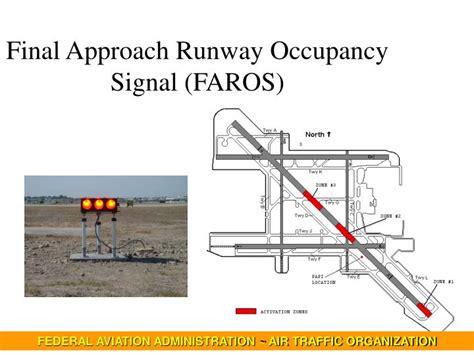
The Final Approach Runway Occupancy Signal, commonly known as FAROS, is an initiative supported by the FAA. It is currently being tested in the U.S. as part of efforts to improve safety measures against runway incursions. FAROS provides crucial visual signals to aircraft that are on final approach for landing, indicating that the runway ahead is occupied by another aircraft or a vehicle.
This system modifies the Visual Approach Slope Indicator (VASI) or Precision Approach Path Indicator (PAPI) lights from steady to flashing when a potential hazard is detected. Importantly, the PAPI or VASI systems themselves remain unchanged in their primary function of guiding pilots on their approach angle, even if the FAROS activation prompts the lights to flash temporarily.
FAROS relies on embedded inductive loops installed at runway entry and exit points. These loops detect moving traffic by sensing disturbances in the magnetic field they generate. The signals from these loops automatically trigger the FAROS visual warnings, enhancing pilot awareness without replacing or interfering with air traffic control (ATC) authority or flight crew protocols. Activation of FAROS does not invalidate any existing ATC landing clearance.
In many scenarios, FAROS may be activated during short final approaches when another aircraft departs from the same runway or when a vehicle crosses it under ATC clearance. The Federal Aviation Administration mandates that both Notice To Airmen and Automatic Terminal Information Service (ATIS) notifications be issued whenever the FAROS system is in use at an airport. It’s important to note that FAROS is not designed to serve as a safety net against collision hazards that could arise during simultaneous operations on intersecting runways.