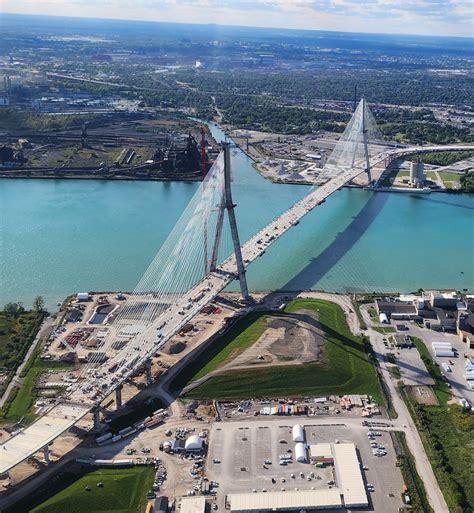
The Gordie Howe Bridge dispute has erupted into one of the most symbolic flashpoints in modern U.S.–Canada relations, transforming what was once a celebrated infrastructure milestone into a political standoff with global implications. At the center of the controversy stands a 1.5-mile engineering marvel stretching across the Detroit River — and a war of words between U.S. President Donald Trump and Canadian Prime Minister Mark Carney that has intensified already fragile bilateral ties.
When President Trump declared on February 9, 2026, that he would not allow the bridge to open until the United States was “fully compensated,” the statement sent shockwaves through policymakers, industry leaders, and border communities alike. The bridge, designed to streamline cross-border trade and relieve congestion, suddenly became a bargaining chip in a broader geopolitical narrative.
Carney’s measured response — that the issue “will be resolved” — suggested diplomatic engagement rather than escalation. Yet the stakes extend far beyond rhetoric. The Gordie Howe International Bridge is not merely concrete and steel; it is an artery through which more than $700 billion in annual bilateral trade flows between the two economies.
The Political Shockwave: Trump’s Threat to Block the Gordie Howe Bridge
Trump’s public post asserted that the bridge was constructed with “virtually no U.S. content” and implied that Canada unfairly benefited from the project. He further claimed that Canada owns both sides of the bridge and suggested that the United States should possess “at least one half” of the asset.
Those assertions quickly collided with documented agreements. The 2012 cross-border accord governing the project clearly stipulates that the bridge is fully financed by Canada, with ownership shared between the Government of Canada and the State of Michigan. It also mandates that iron and steel used in construction must be produced in either the United States or Canada. In other words, the claim of exclusion does not align with the contractual record.
Trump’s remarks added a layer of uncertainty not because the legal framework is unclear, but because executive authority over border operations introduces practical levers that could delay inspections, approvals, or operational certifications. Even without a formal mechanism to “block” the bridge, administrative bottlenecks can function as de facto obstruction.
Prime Minister Mark Carney’s Diplomatic Countermove
Prime Minister Carney, speaking from Ottawa, emphasized that Canada financed the bridge at a cost exceeding $4 billion, while reiterating that American steel and workers were involved in construction. His tone reflected pragmatic diplomacy rather than confrontation.
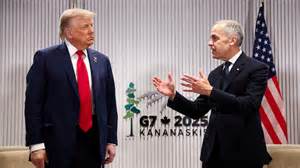
Carney’s remarks underscored a strategic posture: reinforce facts, avoid inflaming nationalist sentiment, and preserve economic continuity. Canada’s leadership understands that the Windsor–Detroit corridor represents the busiest commercial border crossing in North America. Escalation carries direct economic consequences for manufacturing supply chains on both sides.
Michigan Pushback: Economic Stakes for the Auto Industry
The reaction within Michigan was swift and bipartisan. Governor Gretchen Whitmer defended the bridge as essential for jobs and the state’s automotive sector. The project, she noted, exemplifies cross-border cooperation that benefits unionized workers in both nations.
U.S. Senator Elissa Slotkin went further, warning that halting the bridge would damage Michigan’s economy. The Detroit–Windsor corridor functions as a synchronized manufacturing ecosystem, particularly for the automotive industry, where components routinely cross the border multiple times before final assembly. Disrupting that flow is not symbolic; it is measurable in lost production hours and financial losses.
The Ambassador Bridge Factor and the Moroun Family Dispute
The controversy cannot be understood without examining the decade-long legal conflict involving the Ambassador Bridge, owned by Detroit’s Moroun family. For nearly a century, the Ambassador Bridge has served as the primary commercial crossing between Windsor and Detroit.
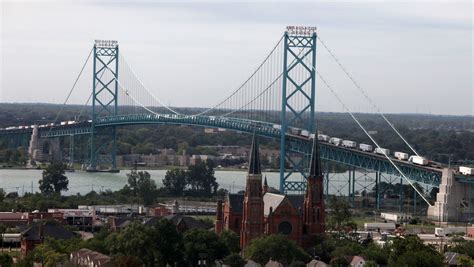
The Morouns have argued that the Gordie Howe Bridge infringes on exclusive toll-collection rights and have sought compensation. During Trump’s first term, they urged him to halt the project, although he then described the bridge as a “vital economic link.” The reversal in tone reflects shifting political dynamics rather than structural changes in the project itself.
The Gordie Howe Bridge introduces competition into a corridor long dominated by a private entity. That economic disruption is as much a subplot as the current political theater.
Engineering Ambition: The Longest Cable-Stayed Bridge in North America
The Gordie Howe International Bridge is more than a diplomatic pawn. Designed by AECOM, the structure will become the longest cable-stayed bridge in North America upon opening. Its twin towers rise 722 feet, deliberately shaped to echo the curve of a hockey stick in tribute to its namesake — NHL legend Gordie Howe.
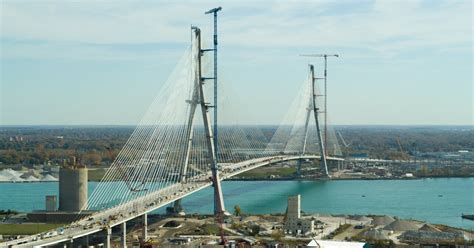
Unlike the Ambassador Bridge, which funnels traffic into Windsor city streets before connecting to Highway 401, the new bridge provides a direct freeway-to-freeway link between Ontario’s Highway 401 and Michigan’s I-75. That redesign eliminates eight traffic lights and numerous bottlenecks that currently slow truck movement.
Estimates suggest the bridge could save approximately 850,000 truck hours annually, translating into billions of dollars in long-term logistics savings. For industries dependent on just-in-time manufacturing, those hours represent stability and competitiveness.
Trade, Tariffs, and Rising Bilateral Tensions
Trump’s threat regarding the bridge arrives amid broader tensions. He previously warned of 100% tariffs on Canadian goods if Canada pursued deeper trade engagement with China. He also threatened decertification of Canadian-made Bombardier jets and floated 50% tariffs on aircraft manufactured north of the border.
In a particularly inflammatory post, he suggested that a Canadian trade deal with Beijing would “Eat Canada Alive,” escalating rhetoric beyond conventional diplomatic language. He also criticized Ontario’s decision to remove American alcohol from provincial shelves in response to U.S. tariffs.
These disputes form the backdrop to the bridge controversy. Infrastructure has become entangled in trade policy, and symbolic leverage is being deployed in a broader negotiation landscape.
The Strategic Importance of the Windsor–Detroit Corridor
The Windsor–Detroit crossing accounts for more than a quarter of total U.S.–Canada trade. Automobiles, agricultural products, energy resources, and industrial goods traverse this corridor daily. During the 2022 trucker protests, traffic disruptions underscored the vulnerability of relying on limited crossings.
The Gordie Howe Bridge was conceived precisely to address that fragility. By adding redundancy and modern inspection facilities, it enhances both economic efficiency and national security resilience. From supply chain continuity to emergency response capacity, the bridge serves strategic functions beyond commerce.
Public Reaction and National Identity
Public response in Canada has been intense. Many Canadians point out that their government financed the entire construction cost while agreeing to shared ownership. Social media platforms have filled with assertions that the United States contributed no funding, amplifying perceptions of unfair criticism.
This dispute touches a sensitive chord in Canadian national identity. Earlier remarks by Trump suggesting that “Canada lives because of the United States” were met with Carney’s pointed rebuttal: “Canada thrives because we are Canadian.” Infrastructure now sits at the intersection of sovereignty, pride, and economic interdependence.
What Happens Next for the Gordie Howe Bridge?
Major construction is complete. Final inspections and testing are underway. The Windsor-Detroit Bridge Authority has indicated that operational readiness is near.
Whether Trump can meaningfully delay the opening depends on regulatory discretion at border crossings and federal coordination. However, blocking a fully constructed, internationally negotiated infrastructure project would invite legal challenges and economic backlash from American stakeholders, particularly in Michigan.
The economic calculus favors resolution. Automotive manufacturers, logistics firms, and regional chambers of commerce view the bridge as indispensable. Even amid political volatility, supply chains exert their own gravitational force.
A Symbol of Strained Partnership — or Renewed Cooperation?
The Gordie Howe Bridge dispute reflects more than a policy disagreement; it illustrates how infrastructure can become a geopolitical symbol. Built to embody cooperation between two of the world’s closest allies, the bridge now stands as a test of diplomatic resilience.
If the matter is resolved as Carney suggests, the opening ceremony may transform into a statement of pragmatic cooperation overriding rhetorical escalation. If tensions persist, the bridge risks becoming a monument to mistrust.
Yet steel cables and concrete pylons have a quiet persistence. They are engineered to withstand stress — wind loads, thermal expansion, the relentless force of gravity. Political strain, too, can be weathered when mutual economic interests remain aligned.
The Gordie Howe International Bridge was designed to connect two nations physically. Whether it ultimately reconnects them politically will define the next chapter of U.S.–Canada relations — and determine whether this landmark crossing is remembered as a flashpoint or a foundation.