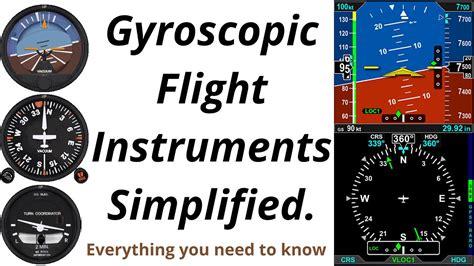
Gyroscopic flight instruments play a crucial role in aviation, utilizing mechanical gyroscopes to enhance navigation and control. These instruments are found in most general aviation aircraft and many older commercial planes. Common examples include attitude indicators, heading indicators, and turn coordinators. The gyroscopes inside these instruments can be powered either electrically or by vacuum systems, and they rely on basic gyroscopic principles to accurately display the aircraft’s attitude.
One key principle is known as rigidity in space. This means that a spinning gyro rotor maintains its orientation unless acted upon by an external force. According to Newton’s First Law, a body in motion tends to stay in motion at a constant speed and direction unless something interferes. Therefore, as long as no external forces disturb it, the gyro rotor will keep a steady position relative to the horizon. To achieve this stability, the rotors in gyroscopic instruments are made from heavy materials and spin at impressive speeds, typically between 10,000 and 15,000 revolutions per minute.
Attitude and heading indicators use gyros as stable references. Once the rotor is in motion, it holds its position even when the aircraft moves around it. This allows pilots to determine the aircraft’s actual attitude or direction based on the gyro’s stable position.
Another important concept is precession, which refers to the movement of the rotor axis due to external forces. If a force is applied to a stationary gyro rotor, it will shift in that direction. However, if the rotor is spinning, the force causes it to move in a way that seems to act 90 degrees in the direction of rotation. This phenomenon creates a new plane of rotation that aligns with the applied force. Precession can lead to gradual drift in the gyro readings, which is why it’s essential for pilots to crosscheck the heading indicator with a magnetic compass regularly, making necessary adjustments.
Gyroscopic instruments are typically powered either electrically or pneumatically. In electric systems, the rotor acts as part of an electric motor. In pneumatic systems, a vacuum pump reduces pressure in the instrument case, drawing in filtered cabin air to spin the rotor. However, vacuum instruments can under-read if the vacuum pressure drops, making them less suitable for high-altitude operations.