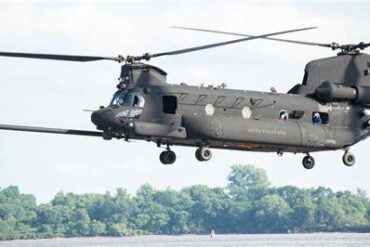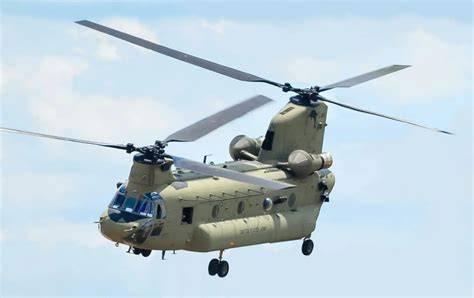
The Boeing CH-47 Chinook has already outlived several generations of military aircraft, but the US Army is not preparing to let its famous heavy-lift helicopter disappear anytime soon. A new contract worth up to $472 million is helping modernize the Chinook’s avionics and sustainment systems, extending the usefulness of a design that first flew in 1961 and entered US Army service in 1962. More than six decades after its introduction, the tandem-rotor helicopter remains central to the Army’s heavy-lift capability.
The contract, awarded to Collins Aerospace, is not the entire modernization program and does not represent a simple $472 million upgrade to one batch of helicopters. Instead, it forms part of a much larger effort involving structural improvements, drivetrain changes, fuel-system enhancements, rotor upgrades, digital modernization, and long-term sustainment. The broader program is expected to keep the Army’s CH-47 fleet relevant well into the 2040s, even as planners begin thinking about what might eventually replace it.
That longevity is remarkable because the original Chinook belongs to an era when many of today’s defining military technologies either did not exist or were still experimental. Yet the basic tandem-rotor configuration has proved unusually adaptable. The Army can replace major components, strengthen aging airframes, install new engines and systems, and continuously refresh the helicopter’s digital architecture without abandoning the fundamental design that made the Chinook so useful in the first place.
The $472 Million Collins Aerospace Chinook Contract
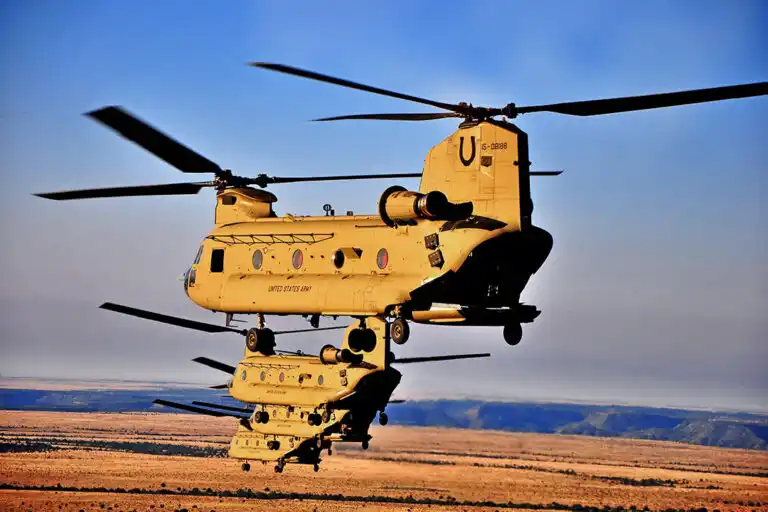
In August 2026, RTX announced that its Collins Aerospace subsidiary had received a US Army contract worth up to $472 million to provide engineering services supporting the modernization and sustainment of the CH-47 Chinook fleet. Collins will concentrate on avionics-related work, helping the Army address aging equipment while introducing a more flexible architecture for future technology upgrades.
The importance of the contract lies less in the headline dollar figure than in what the work represents. Military aircraft can remain operational for decades only when their electronics, communications, navigation equipment, software, and mission systems evolve alongside changing operational requirements. A helicopter with a mechanically sound airframe can still become difficult to operate if its avionics depend on obsolete components or systems that cannot communicate effectively with newer equipment.
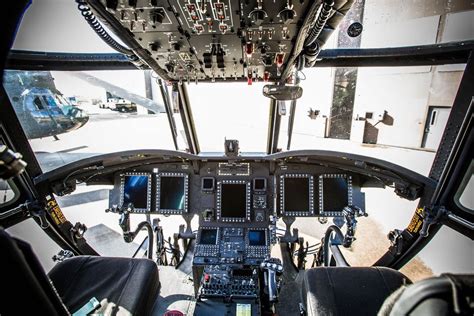
Collins is therefore working on what could be described as the digital side of the Chinook’s modernization. Its engineering work is intended to integrate communications, navigation, and mission subsystems into a flexible cockpit architecture. The objective is to make future technology insertion easier rather than repeatedly redesigning the helicopter every time a major electronic system becomes obsolete.
The work will be conducted in Huntsville, Alabama, and Cedar Rapids, Iowa, bringing together expertise associated with Army aviation engineering and Collins Aerospace’s avionics operations. The company says the approach emphasizes open and reusable architectures that can support greater commonality across Army aviation platforms.
That commonality matters because military aircraft modernization can become expensive when every platform uses unique hardware and software. An open architecture allows new technologies to be introduced with less integration work, potentially reducing the delays and costs associated with replacing obsolete components. For an aircraft expected to remain in service for decades, that flexibility can be just as important as any individual avionics upgrade.
The Chinook’s Bigger CH-47F Block II Modernization
The Collins contract should not be confused with the entire CH-47F Block II program. The Army’s modernization strategy effectively involves two closely connected tracks. One focuses on the physical helicopter, while the other keeps its electronic systems current.
The mechanical and structural side includes strengthening the airframe, improving the drivetrain, increasing torque capability, redesigning the fuel system, and upgrading the rotor system. These changes are intended to improve the helicopter’s ability to carry heavier loads while increasing durability, efficiency, and operational sustainability.
The Block II effort is particularly important because the Army is not simply adding new electronics to old helicopters. It is effectively recapitalizing the platform. Existing airframes can undergo extensive refurbishment and modernization, while new-build aircraft can incorporate many of the same components. This creates a fleet that shares key systems even when individual helicopters have very different histories.
Fuel efficiency is another important part of the equation. A heavy-lift helicopter consumes significant quantities of fuel during demanding operations, and improvements to the fuel system can affect range, logistics requirements, and mission planning. Likewise, improvements to the drivetrain and rotor system can increase the useful capability of the aircraft without requiring the Army to develop an entirely new heavy-lift helicopter.
The result is a familiar-looking Chinook with substantially different capabilities underneath its iconic tandem rotors.
Why the Army Still Needs the CH-47 Chinook
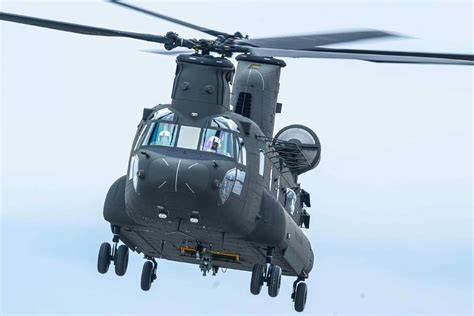
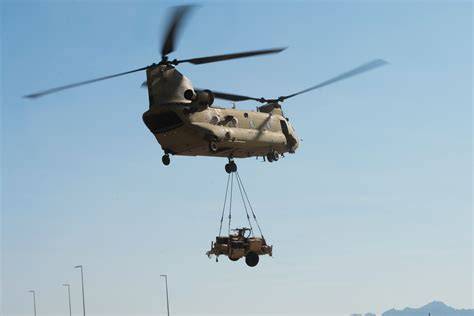
The Army describes the CH-47F as its only heavy-lift helicopter, making the platform difficult to replace quickly. Its missions extend far beyond simply moving cargo between bases. Chinooks conduct troop transport, air assault support, resupply, casualty evacuation, cargo movement, parachute operations, and search-and-rescue missions.
The current CH-47F has an increased maximum gross weight of approximately 54,000 pounds, or 24,493 kilograms. That capacity gives commanders an air-mobility option that smaller helicopters cannot replicate. Heavy external loads, large internal cargoes, personnel movements, and difficult resupply missions all benefit from the Chinook’s combination of lifting power and relatively mature operating infrastructure.
Its tandem-rotor arrangement is also central to the helicopter’s identity. Instead of relying on a conventional main rotor and tail rotor, the Chinook uses two large counter-rotating rotor systems. This arrangement eliminates the need for a tail rotor and provides substantial lifting capability within a relatively compact footprint.
More importantly, the Army already possesses decades of experience operating the aircraft. Pilots, maintainers, logisticians, spare-parts networks, training infrastructure, and operational doctrine have all developed around the Chinook. Replacing the helicopter would therefore involve far more than purchasing a new airframe. It would mean rebuilding a large ecosystem of personnel, equipment, facilities, procedures, and supply chains.
That helps explain why modernization remains attractive even though the Chinook is a design from the 1960s.
The Army Is Reducing the Number of Chinooks
The modernization story becomes more complicated when fleet numbers are examined. Earlier plans called for a much larger Block II program, but the Army’s latest budget documents indicate that the planned number of conventional CH-47F aircraft has been reduced.
The Army Acquisition Objective in earlier planning covered 501 H-47 aircraft, consisting of 432 CH-47F helicopters and 69 MH-47G aircraft. The MH-47G is a specialized Special Operations variant with its own acquisition strategy, although it will share common Block II components.
The newer fiscal planning picture is considerably smaller for the conventional fleet. The Army is expected to divest 35 CH-47F helicopters in fiscal 2027, while the broader modernization plan is being reconsidered. This means the $472 million Collins agreement is supporting a fleet that is simultaneously being modernized and reassessed in size.
That may initially appear contradictory, but the two decisions can coexist. The Army can reduce the number of aircraft it operates while investing more heavily in the helicopters it intends to keep. In other words, modernization does not necessarily mean maintaining every existing airframe.
The same principle appears elsewhere in Army aviation. Older helicopters are being retired while newer or modernized versions are retained. For the Chinook, this creates a more concentrated fleet built around aircraft with improved structural condition, updated systems, and greater long-term supportability.
From 539 Aircraft to a More Focused Chinook Fleet
Previous budget documents described a Block II program involving as many as 539 aircraft, with an estimated program cost of roughly $22 billion, or approximately $41 million per airframe when spread across the planned fleet. The latest acquisition objective is smaller, meaning the eventual total program cost could also change.
The reduction is significant because it shows that the Army is making decisions about force structure at the same time it modernizes its aircraft. The service is not simply buying as many upgraded Chinooks as possible. Instead, it is determining how many heavy-lift helicopters it believes it will need in the future and then deciding how best to allocate modernization funds.
The fiscal 2027 documents identify 24 CH-47F aircraft for a rapid-fielding tranche, with completion targeted around 2030, alongside the planned 69 MH-47G aircraft under the separate Special Operations effort. Meanwhile, the Army continues to evaluate the larger previously envisioned CH-47F quantity.
This makes the future Chinook fleet more difficult to describe with a single number. The broad modernization architecture remains important, but the exact number of helicopters receiving every element of the program can change as budgets, force requirements, and acquisition priorities evolve.
The central conclusion, however, remains clear: the Chinook is not going away soon.
Renew and New Build: How Old Chinooks Become Newer Aircraft
One of the most interesting aspects of the program is the Army’s use of the term “Renew and New Build.” Rather than treating every helicopter as either an untouched legacy aircraft or a completely new machine, the approach combines substantial refurbishment of existing airframes with new production.
This matters because a helicopter’s age alone does not determine its remaining usefulness. A carefully inspected and extensively rebuilt airframe can receive new systems and continue operating for many additional years. At the same time, new-build helicopters can incorporate the same modernization standards, allowing the fleet to retain commonality.
Boeing’s production activity illustrates this approach. During the first half of 2026, the company reported delivering three renewed Chinooks and five new Chinooks. The term “renewed,” however, should not automatically be interpreted as meaning that every one of those aircraft had already received the complete Block II configuration. It refers more broadly to existing airframes returning to service following substantial refurbishment and modernization.
That distinction is important when assessing how quickly the full Block II fleet is actually being created. The Army’s modernization program is a continuing process rather than a single production event.
The Avionics Challenge: Fighting Obsolescence
For an aircraft expected to remain operational into the 2040s, avionics obsolescence may be one of the biggest long-term challenges. Electronics evolve much faster than aircraft structures. A component that was advanced when installed can become difficult to source or impossible to support long before the helicopter’s airframe reaches the end of its useful life.
The Army’s digital cockpit support effort is designed to confront that problem. Funding is intended to provide hardware, software, engineering services, and technology insertion while keeping aircraft available for missions.
The modernization specifically addresses capabilities such as Assured Positioning, Navigation, and Timing, cryptographic modernization, and improved integrated Aircraft Survivability Equipment. These systems are increasingly important in an environment where navigation signals can be contested, communications can be disrupted, and aircraft may face sophisticated electronic and physical threats.
An open architecture gives the Army a way to respond to these challenges without repeatedly rebuilding the entire aircraft. Instead, new systems can be integrated into an architecture designed to accommodate future changes.
For a helicopter whose basic design dates back more than sixty years, that may be the key to reaching the 2040s.
Will a New Heavy-Lift Helicopter Eventually Replace the Chinook?
The Army has already shown interest in what could eventually succeed the Chinook, but the replacement remains far less mature than the current modernization effort. Early reporting in 2024 indicated that the service had begun exploring a next-generation heavy-lift rotorcraft, although the concept was still in its infancy.
The Army’s immediate priority is the Future Long-Range Assault Aircraft, now designated the MV-75, which is expected to enter service in the early 2030s. The MV-75 will bring a different approach to Army vertical lift, but it is not an immediate one-for-one replacement for the Chinook.
A future heavy-lift successor could potentially build on technologies associated with tiltrotors and other advanced vertical-lift concepts. Yet developing such an aircraft, testing it, establishing production, and building an entirely new support infrastructure would take many years.
That timeline explains the Chinook’s extraordinary staying power. The Army can see beyond the current helicopter, but it cannot afford to wait for an aircraft that does not yet exist.
Why the $472 Million Contract Matters
The $472 million Collins Aerospace contract is therefore best understood as one piece of a much larger strategy. It is not simply about installing a newer cockpit in an old helicopter. It is about ensuring that the Chinook’s avionics, communications, navigation, survivability systems, and digital architecture remain supportable as the aircraft enters another decade of service.
The broader CH-47F Block II effort tackles the physical limitations of the platform, while the Collins work helps address the rapidly changing digital environment around it. Together, these efforts allow the Army to extract additional value from an aircraft whose fundamental configuration has survived for more than six decades.
Few military aircraft can claim that kind of longevity. The Chinook first flew when the Cold War was still in its early years, yet its modern descendants continue to perform missions that remain fundamental to Army operations. Its future is not being secured by nostalgia or by refusing to retire an old design. It is being secured through continuous modernization.
The eventual replacement will come. But until the Army develops, tests, funds, and fields a credible next-generation heavy-lift aircraft, the CH-47 Chinook remains the proven answer. With stronger airframes, upgraded drivetrains, improved fuel and rotor systems, and a modernized digital backbone, the Army is effectively turning a 1960s helicopter into a platform designed to remain relevant well into the 2040s.
That is the real significance of the $472 million contract: not preserving an aircraft in the past, but giving one of the world’s longest-serving military helicopters a credible path into the future.