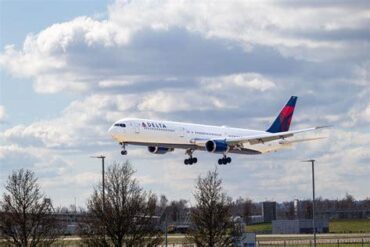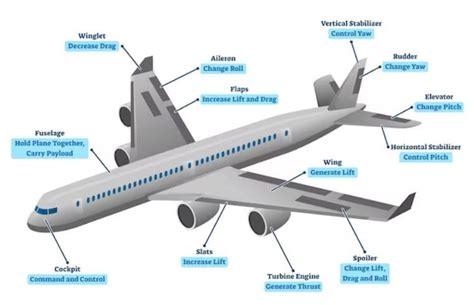
Landing gear refers to the parts of an aircraft or spacecraft that support its weight and enable mobility on the ground or water. It is crucial for the airplane during various stages, including parking, taxiing, taking off, and landing. While most landing gear consists of wheels, some planes use floats for water landings or skis for snowy conditions.
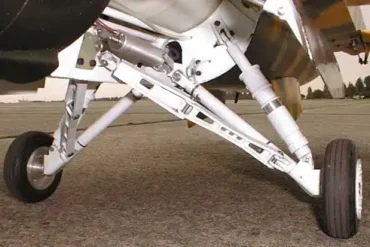
For small aircraft, the typical landing gear setup includes three wheels: two main wheels positioned on either side of the fuselage and a third wheel located at the front or rear. When the rear wheel is used, it is called conventional landing gear, often seen in tailwheel airplanes. In this design, the main wheels are located ahead of the center of gravity (CG), supporting most of the plane’s weight. The tailwheel, found at the back of the fuselage, provides additional support. This layout allows for adequate clearance for larger nose-mounted propellers and is particularly useful for operations on uneven terrain. Consequently, it is popular among small general aviation aircraft like the PIPER L-18C and C170.
However, having the CG behind the main landing gear can make directional control tricky on the ground. For instance, if the pilot permits the aircraft to swerve at low speeds, they might struggle with rudder control. The CG may try to move ahead of the main gear, potentially causing the airplane to ground loop. Additionally, when the tailwheel touches down, it might create enough lift, depending on the speed, due to the increased Angle of Attack (AOA), which could cause the plane to take off again unintentionally. Another drawback of tailwheel landing gear is reduced visibility for the pilot while the tailwheel is close to the ground, necessitating specific training for operation.
When the third wheel is at the nose, it’s known as a nosewheel, forming what’s called tricycle gear. This design offers several advantages over conventional landing gear. It allows stronger braking during high-speed landings without risking a nose-over. It also helps prevent ground looping by offering better directional stability since the CG is ahead of the main wheels. This design keeps the aircraft moving straight, enhancing forward visibility for the pilot during key phases like takeoff and landing. A steerable nosewheel or tailwheel aids in controlling the plane on the ground. Most aircraft use rudder pedals to steer, regardless of wheel type. The brakes are typically located on the main wheels and can be controlled via hand controls or foot pedals. Independent foot pedals allow for differential braking, which means applying different pressures to the left and right main landing gear. This method can enhance steering during ground operations.
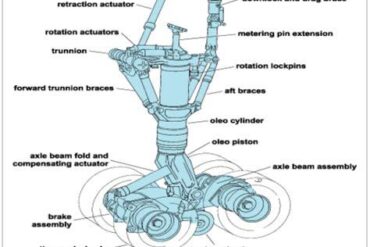
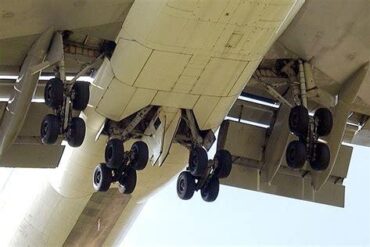
Landing gear can also be categorized as fixed or retractable. Fixed landing gear remains extended, offering simplicity and lower maintenance needs. In contrast, retractable landing gear is designed to streamline the aircraft by stowing the gear inside during cruising flight, reducing drag. Fixed landing gear is common in slower general aviation aircraft, while most commercial planes utilize retractable designs. Larger aircraft often require more complex landing gear systems, including multiple wheels. For example, the Airbus A340 features a main landing gear with three components, while the AIRBUS A-380-800 and Boeing B747 Series have four. Some large cargo planes, like the ANTONOV An-124 Ruslan and ANTONOV An-225 Mriya, also include dual assemblies in their nose landing gear, adding to the complexity.
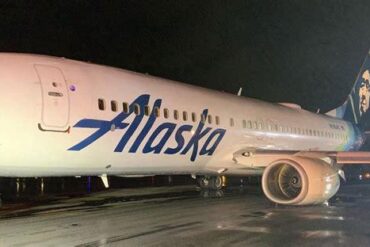
Retractable landing gear is usually powered by the hydraulic system, with emergency extension systems available in case of failure. These may involve a manual crank, pump, or mechanical free-fall mechanism. Sometimes, airflow assists in locking the gear into position. Landing with the gear retracted or unlocked can lead to serious issues, including loss of directional control, runway excursions, structural damage, or even fires.
This section highlights accidents and incidents where landing gear played a role. For instance, on November 16, 2012, an Air Contractors Airbus A300 veered off the runway in Bratislava due to an abnormal response from the nose gear, stemming from incorrect assembly. Similarly, on July 12, 2000, a Hapag Lloyd Airbus A310 could not retract its landing gear after takeoff and ultimately landed unpowered, causing significant damage but no injuries. These examples illustrate the critical importance of proper landing gear functionality and maintenance in aviation safety.