Hartsfield-Jackson Atlanta International Airport (ATL) stands at the center of North American aviation in 2025, maintaining its long-held distinction as the busiest airport on the continent and the world. With an operational scale that continues to eclipse major global hubs, ATL remains a rare example of how geography, infrastructure, and strategic airline partnerships can merge into a single, unmatched powerhouse. Its momentum recovered rapidly after the pandemic years, reclaiming its global crown in 2021 and accelerating further through 2024 and 2025. The capability to process 108.1 million passengers in 2024 alone reinforces just how deeply embedded ATL is within both U.S. and global air travel patterns. Built deliberately, expanded relentlessly, and optimized continuously, the airport remains a living case study of aviation design done right.
The airport’s position might surprise casual travelers who assume that larger international gateways such as London Heathrow (LHR), Tokyo Narita (NRT), or Dubai International Airport (DXB) would hold the top spot. Yet ATL surpasses them—in some cases by tens of millions of passengers—by leveraging domestic and international connectivity in ways those hubs cannot replicate. Its structural advantage is grounded not in spectacle or luxury but in pure, disciplined efficiency. Long before skyscrapers defined the skyline of modern Atlanta, the foundations of a future world aviation leader were already being laid.
The origins of ATL trace back to the early 1920s, when aviation was still an untested frontier. The story began with William Hartsfield, who would later serve as mayor and become one of the city’s most influential advocates for aviation. With remarkable foresight, he recognized early that flight would eventually rival railroads as the engine of national transportation. His vision aligned perfectly with that of Asa Candler, the Coca-Cola founder, who donated the land that would become Candler Field. This stretch of land has since transformed into the world’s most active air gateway.
Candler Field opened on a converted speedway and quickly attracted pioneering aviation companies eager to establish roots in the American South. The first official flight arrived in 1926, marking the beginning of an evolution that would accelerate through the decades. By 1928, Pitcairn Aviation began operating from Atlanta, followed by Delta Air Service in 1930. These early tenants would eventually become commercial titans—Eastern Air Lines and Delta Air Lines—with Atlanta emerging as their primary base of operations.
Delta’s first trial service between Birmingham and Atlanta soon turned permanent, and Eastern Air Lines pioneered continuous passenger service from Atlanta to New York. These early developments positioned the airport not just as a southern travel node, but as a national connector, placing Atlanta firmly on the map at a time when air travel was still far from mainstream.
Growth Milestones That Cemented ATL’s Status
As early as the 1940s, ATL demonstrated signs of future dominance. Both Delta and Eastern contributed aircraft to the U.S. military effort during World War II but continued to support the airport through training programs and operational activity. During this era, daily takeoffs soared to an astonishing 1,700 per day, a remarkable figure considering the state of aviation technology at the time. The airport doubled in size throughout the decade, reinforcing Atlanta’s growing aviation significance.
The 1960s marked another leap forward. The 1961 opening of a modern, jet-age terminal—costing $21 million—created the largest air terminal in the United States at the time. Designed to handle six million passengers annually, it surpassed expectations dramatically by serving more than nine million within a single year. The explosive growth demonstrated that demand for air travel in the southeastern United States was far stronger than industry planners anticipated.
The 1980s delivered yet another pivotal upgrade when a new terminal complex, then the world’s largest, opened its doors. Championing much of this advancement was Mayor Maynard Jackson, whose dedication to modernization and inclusion reshaped the airport’s infrastructure and operations. By this time, ATL was designed to accommodate 55 million passengers annually and spanned 2.5 million square feet. Runway expansion continued through the decade, with new and lengthened runways enhancing traffic flow.
ATL entered the 1990s and 2000s with major new additions, including Concourse E in 1994, the central atrium in 1996, and a fifth runway in 2006. The renaming of the airport in 2003 to Hartsfield-Jackson Atlanta International Airport honored the two visionary mayors whose leadership contributed to its extraordinary evolution.
The Numbers That Define the Busiest Airport in North America
By 2025, ATL holds a commanding lead in both domestic and international capacity. OAG confirms that the airport’s schedule supports 62.7 million seats, placing it ahead of global heavyweights like Dubai International Airport and Tokyo Haneda Airport. While passenger volume remains slightly under pre-pandemic 2019 highs, ATL continues to outpace all competitors by millions.
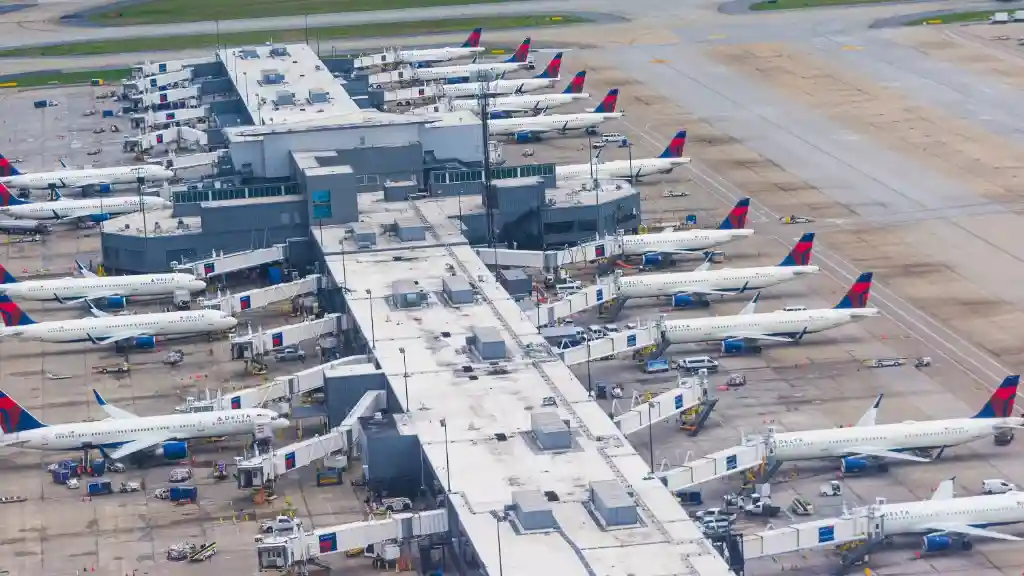
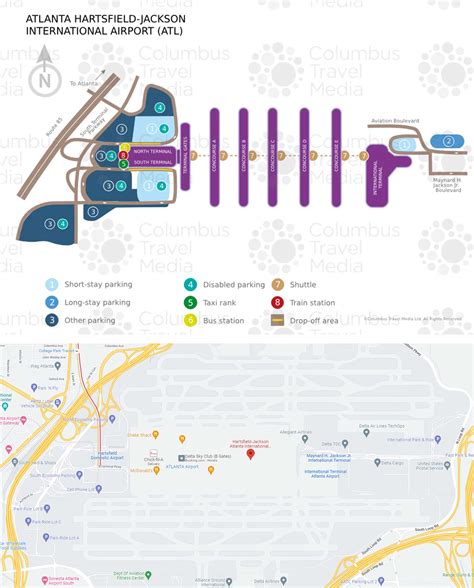
Domestically, Dallas/Fort Worth (DFW), Denver International Airport (DEN), and Chicago O’Hare (ORD) follow ATL in activity levels, but the Atlanta hub remains unmatched in raw throughput. The airport features 393 concessions, 197 gates, and five parallel runways, including one measuring 12,390 feet, long enough to accommodate the Airbus A380 effortlessly.
In a typical day, the airport manages more than 2,500 arrivals and departures, averaging two aircraft movements every minute. Travelers have access to 157 domestic destinations and 40 international destinations from Atlanta, making it one of the most connected cities on the continent. In 2024, the airport handled 796,224 flights, a historic figure that underscores its operational might.
Why ATL Works: Geography, Design, and Strategy
ATL’s continued dominance is not an accident. The airport thrives because of deliberate choices shaped by geography, design logic, and an unusually favorable competitive landscape. Unlike metropolitan regions such as New York, which are divided across multiple major airports, Atlanta centralizes nearly all regional and long-distance air traffic into a single mega-hub. This concentrated demand fuels the airport’s growth and prevents fragmentation of passenger volume.
Atlanta’s location presents significant advantages. The airport sits roughly 10 miles south of downtown on flat, expansive land, offering abundant space for runway and terminal expansions that would be impossible in cities constrained by coastlines or dense development. The region’s road and rail infrastructure provides smooth access to central business districts and suburbs. Roughly 80% of the U.S. population is within a two-hour flight, giving ATL unmatched reach.
Competition is also minimal. The nearest major airports—Nashville (BNA) and Charlotte (CLT)—are too distant to act as substitutes for most travelers, giving ATL a natural monopoly over much of the southeastern U.S. population. Many travelers willingly drive several hours to access ATL’s superior route network.
The airport’s design further strengthens its role. All five runways run parallel, enabling up to 250 aircraft operations per hour with remarkable efficiency. Aircraft landing on a distant runway can reach even the farthest gate in roughly ten minutes. This seamless flow ensures short taxi times, fast turnarounds, and consistent schedule reliability.
Delta Air Lines: The Engine Powering Atlanta’s Global Reach
Delta Air Lines is the single largest contributor to ATL’s success. Headquartered at the airport, Delta cemented Atlanta’s position in global aviation when it introduced the hub-and-spoke system in 1955. This strategic model allowed passengers from smaller markets to connect through a central hub—ATL—on their way to major destinations. The system transformed Atlanta into a gateway not only for the Southeast but for domestic and international travel.
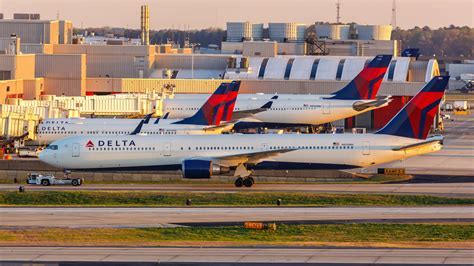
Delta’s mergers throughout the decades expanded the airline’s fleet and long-haul capabilities. In 2025, Delta schedules 968 daily flights serving 215 destinations, a figure that dwarfs the operations of most U.S. carriers. The airline accounts for 70% of ATL’s total traffic, meaning the airport and airline have grown symbiotically for more than half a century.
In 2023 alone, Delta carried 51 million connecting passengers through ATL, exceeding the total passenger count of many major airports worldwide, including San Francisco International Airport and Seattle-Tacoma International Airport. Delta’s alliances with Virgin Atlantic and Air France further extend ATL’s global reach into Europe, the Middle East, and beyond.
A Future That Extends ATL’s Aviation Dominance
ATL’s grip on the number-one global position appears secure for the foreseeable future. The airport consistently handles more annual passengers than Dubai or Heathrow, and its operational foundation shows no signs of strain. In 2023, ATL moved 17 million more passengers than Dubai International Airport and outperformed Heathrow by 25 million. Its ability to handle more connecting passengers than any other airport underscores the significance of its central U.S. location and its design philosophy.
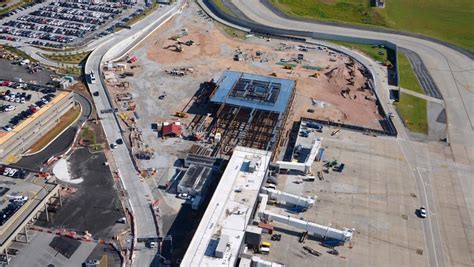
Future development plans—including terminal renovations, concourse expansions, and enhanced international facilities—ensure ATL can accommodate rising demand. Long-term projections anticipate additional gate capacity, advanced baggage handling systems, and improvements to the airfield designed to keep pace with projected industry growth.
ATL’s past is marked by continuous expansion. Its present is defined by global leadership. Its future promises more of the same. No geographic constraints. No competitive airport within 250 miles. A dominant airline partner with worldwide reach. And land availability that other major cities could only dream of.
As 2025 unfolds, Hartsfield-Jackson Atlanta International Airport stands not merely as North America’s busiest airport, but as one of its most enduring achievements in transportation planning and aviation innovation. Its unmatched record of efficiency, scalability, and connectivity ensures that its global position remains secure long into the future.