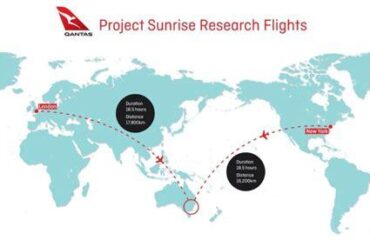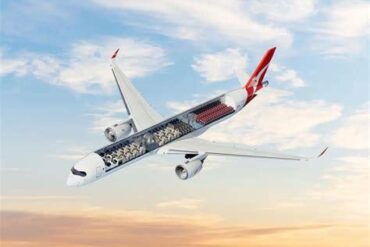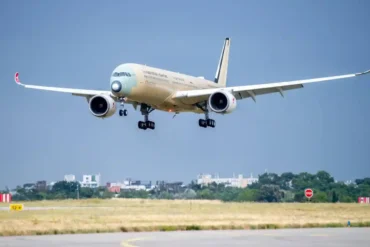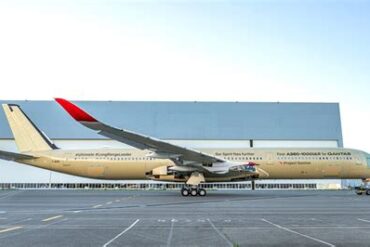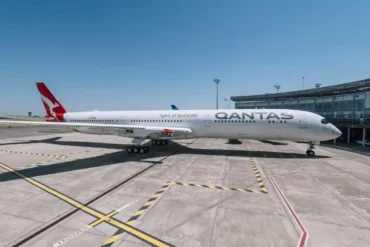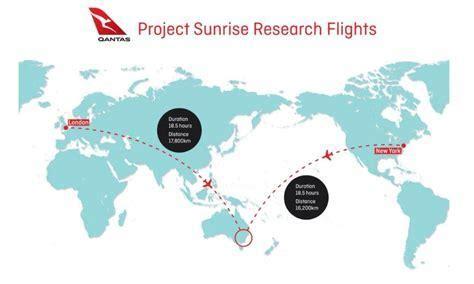
Ultra-long-haul aviation has always demanded compromises, but Qantas Project Sunrise takes those compromises to an extraordinary level. The airline is preparing an Airbus A350-1000 variant designed to connect Australia with destinations such as London and New York without the traditional stopover. The headline is spectacular: nonstop flights approaching 22 hours. Yet the real story is not simply how far the aircraft can fly. It is what Qantas has been willing to give up to make that range possible.
The aircraft assigned to this mission will carry only 238 passengers, a remarkably low figure for an Airbus A350-1000. A conventional A350-1000 can accommodate substantially more travelers, while high-density configurations can push the number far higher. Qantas has therefore sacrificed a significant amount of potential passenger capacity before the aircraft even leaves the ground.
That decision affects almost every aspect of the aircraft’s economics and design. Seats have effectively been exchanged for fuel, space, crew facilities, passenger wellbeing, and operational margin. The result is not an aircraft optimized to carry the largest possible number of people. Instead, it is an aircraft optimized around a very different objective: staying airborne for almost an entire day while keeping the journey commercially viable and physically tolerable.
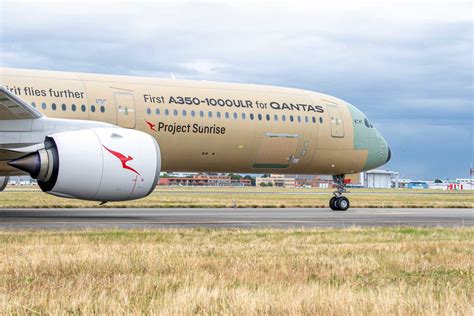
The Airbus A350-1000 Was Rebuilt Around Range
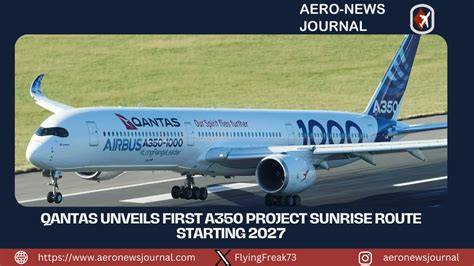
At the heart of Project Sunrise is an unusually demanding fuel requirement. The Qantas aircraft is based on the Airbus A350-1000, but the ultra-long-range mission requires extensive modification. One of the most important changes is the installation of a 20,000-liter rear center fuel tank, giving the aircraft substantially greater fuel capacity than a conventional configuration.
That additional fuel is what makes missions beyond 9,700 nautical miles possible. For Qantas, this opens the door to some of the world’s most challenging commercial routes, including Sydney–London and Sydney–New York. These are not merely long flights. They push the boundaries of what a conventional widebody aircraft can accomplish while retaining adequate fuel reserves.
Fuel, however, is not a free resource from an aircraft’s perspective. Every additional liter increases weight, and every kilogram carried into the sky influences performance. The aircraft must lift that fuel during takeoff, carry it through the first portion of the journey, and burn it progressively over thousands of miles.
Qantas therefore needed more than a larger fuel tank. The aircraft’s maximum takeoff weight rises to 319 tonnes, while other modifications include strengthened landing gear and aerodynamic refinements. These changes allow the A350-1000ULR to handle the physical demands created by its unusually heavy fuel load.
The result is an aircraft in which fuel becomes the dominant design consideration. On an ordinary long-haul aircraft, airlines often think in terms of how many passengers and how much cargo can be carried while still achieving the required range. Project Sunrise reverses that logic. Range comes first, and everything else must fit around it.
Why Qantas Chose Only 238 Seats
The most obvious sacrifice is the cabin’s 238-seat capacity. This number is particularly striking because the same basic A350-1000 platform can accommodate far more passengers depending on configuration. A typical three-class layout can approach 372 seats, while dense configurations can reach approximately 480.
Qantas is therefore leaving a considerable amount of potential seating capacity unused.
At first glance, that might appear commercially inefficient. An airline normally wants to maximize the number of passengers carried by an aircraft because seats generate revenue. Every empty seat represents revenue that cannot be recovered once the aircraft departs. On a flight lasting 22 hours, however, the mathematics become more complicated.
Passengers have weight. Their baggage has weight. Food, beverages, service equipment, and other cabin supplies have weight. When the aircraft is already carrying an enormous quantity of fuel, each additional kilogram becomes more significant.
Reducing passenger numbers creates additional weight margin. That margin can be allocated toward fuel or other requirements that make the ultra-long-range mission practical. Qantas is effectively accepting fewer revenue-generating seats in exchange for the ability to operate routes that would otherwise require a connection.
This is one of the most important economic ideas behind Project Sunrise. Qantas does not need to make the aircraft profitable by selling as many seats as possible. Instead, it is betting that some travelers will pay a premium for the ability to fly directly from Australia to major global destinations.
For a passenger traveling between Sydney and London, avoiding a stop in the Middle East or Asia can save hours of airport time, eliminate a connection, reduce the risk of missed onward flights, and create a fundamentally different travel experience. The airline is therefore targeting the value of time rather than simply the volume of passengers.
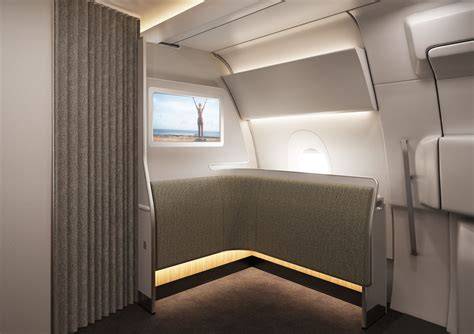
Fewer Seats Create More Cabin Space
The sacrifice in capacity produces an unexpected advantage: Qantas can devote more of the aircraft to the passengers who remain onboard.
A 22-hour flight cannot be approached like a conventional eight- or ten-hour international service. Spending nearly an entire day inside a pressurized aluminum-and-composite tube presents physical and psychological challenges. Passengers need opportunities to move, stretch, hydrate, eat, sleep, and change their posture.
Qantas has consequently planned a more spacious cabin environment, including redesigned seating areas and a dedicated Wellbeing Zone. This space represents an important philosophical change. Rather than viewing the passenger as someone who simply remains seated until arrival, Qantas recognizes that movement becomes increasingly important as flight duration increases.
The Wellbeing Zone is designed to provide an area where passengers can leave their seats, stretch, move around, and refresh themselves. On a journey approaching 22 hours, even seemingly modest improvements to mobility can become meaningful.
But space has an opportunity cost in aviation. Every square meter used for a communal area is space that could otherwise contain seats, galleys, lavatories, or other revenue-generating functions. Qantas is deliberately accepting that cost.
That is why the 238-seat figure matters beyond simple capacity. The number reflects an entire cabin philosophy. Qantas is not merely installing fewer seats because it needs to reduce weight. It is also using the resulting space to create an aircraft more suited to the unusual demands of ultra-long-haul travel.
In that sense, the missing seats are part of the product.
Cargo Is Another Major Sacrifice
Passenger capacity is not the only revenue source affected by the Project Sunrise configuration. Cargo capacity also takes a back seat.
Long-haul airlines frequently rely on the belly of passenger aircraft to carry freight. This can be an important additional source of revenue, particularly on international routes connecting major commercial centers. But the economics become less attractive when an aircraft must carry enough fuel for an almost 22-hour journey.
The aircraft’s available weight must be divided among fuel, passengers, baggage, cargo, crew, equipment, and operating reserves. Fuel requirements for Project Sunrise consume an unusually large portion of that available weight.
Consequently, Qantas cannot treat the aircraft’s lower deck as an unlimited freight compartment. Cargo must fit within the remaining payload envelope after the aircraft has satisfied the requirements of the ultra-long-range mission.
This represents another fundamental change in the airline’s business model. A conventional long-haul A350 can generate revenue from a combination of passengers and freight. The Project Sunrise aircraft is much more heavily dependent on its passengers.
The strategy therefore becomes more premium-oriented. Qantas needs the revenue generated by those 238 passengers to justify an aircraft that sacrifices considerable capacity in order to fly farther.
Crew Rest Requires Valuable Space
Passengers are not the only people who must survive a 22-hour flight. The flight crew must remain capable of performing safety-critical duties from departure through arrival, making crew fatigue management one of the most important operational considerations.
Pilots cannot simply remain at their stations for the entire journey. Cabin crew also need appropriate rest periods. Ultra-long-haul operations therefore require dedicated crew-rest facilities and carefully structured working patterns.
Those facilities consume aircraft space that could otherwise be used for passengers or cargo. Additional crew members can also increase weight, while provisions, equipment, and operational supplies add further demands to the aircraft’s payload.
Yet this is an area where Qantas has very little room for compromise. A long flight is not successful merely because the aircraft has enough fuel to reach its destination. The people operating the aircraft must remain sufficiently rested and alert to handle normal operations as well as unexpected situations.
The result is another invisible cost of ultra-long-haul travel. Passengers see their spacious seats and additional facilities, but much of the aircraft’s unusual configuration exists because the crew must also be supported throughout an exceptionally long duty period.
Project Sunrise therefore becomes a balancing act between fuel, payload, cabin space, crew requirements, and safety margins.
The 22-Hour Flight Changes Route Planning
The extraordinary duration of Project Sunrise flights also transforms the way routes are planned.
On a shorter international flight, weather deviations, air traffic restrictions, or minor delays may be manageable without dramatically changing the overall mission. On an ultra-long-haul flight, however, every decision can have a much larger impact because the aircraft is operating with a carefully calculated fuel strategy.
A route cannot simply be selected because it represents the shortest distance between two airports. Flight planners must consider weather, winds, airspace restrictions, diversion opportunities, traffic conditions, and fuel requirements.
The aircraft’s extended range does provide useful flexibility. If the crew needs to avoid adverse weather or congested airspace, having substantial range can make alternative routing more practical. Nevertheless, the mission still depends on maintaining appropriate reserves.
This makes operational resilience especially important. A technical issue thousands of miles from the destination cannot be treated in exactly the same way as a problem encountered on a shorter flight with numerous nearby diversion airports.
Maintenance standards therefore become critical. An aircraft assigned to an ultra-long-haul mission must be prepared for flights in which a relatively small technical disruption could have consequences across an enormous distance.
Scheduling also becomes more demanding. The aircraft and crew need sufficient time between missions, while maintenance teams must account for the unique demands placed on an aircraft operating some of the world’s longest commercial flights.
Why Qantas Is Willing To Sacrifice Efficiency
Project Sunrise may appear inefficient if judged solely by conventional airline metrics. A 238-seat aircraft could seem like an underutilized A350-1000, especially when other operators configure the same aircraft with hundreds more seats.
That interpretation misses the point.
Qantas is not trying to maximize the number of passengers it can carry between Sydney and London with a stop along the way. It is trying to create a nonstop product that changes the value proposition of the journey.
The aircraft’s low seat count, large fuel capacity, additional crew facilities, spacious cabin, and reduced cargo capability are interconnected decisions. Removing one constraint would place pressure on another.
Adding more passengers would increase payload. Increasing cargo would do the same. Adding more seats could require reducing cabin space. Reducing cabin space could undermine passenger wellbeing on an exceptionally long journey. Carrying less fuel could threaten the range or operational margins.
The aircraft therefore represents a carefully balanced system rather than a collection of isolated design choices.
The Singapore Airlines Precedent
Qantas is not the first airline to explore the economics of an aircraft configured specifically for ultra-long-haul operations. Singapore Airlines has already operated Airbus A350-900ULR aircraft on exceptionally long routes, including services connecting Singapore with New York and Los Angeles.
Those aircraft demonstrate that there can be a market for long-distance flying when the cabin, aircraft configuration, and passenger proposition are designed around the mission.
Qantas is taking the concept even further with Project Sunrise. Australia occupies a geographically isolated position relative to many of its major international markets, so nonstop connectivity has particular value.
For Australian travelers, a direct Sydney–London or Sydney–New York flight is not merely a novelty. It removes a major structural inconvenience from international travel: the connection.
That convenience is precisely what allows Qantas to justify an aircraft that carries far fewer people than a conventional A350-1000.
What Passengers Actually Gain
From the passenger’s perspective, the most important benefit is obvious: time saved by eliminating the stopover.
But the value proposition extends beyond the clock. A connection introduces airport transfers, security procedures, boarding processes, potential delays, and the possibility of missed connections. It also forces travelers to interrupt the natural rhythm of a long journey.
A nonstop flight consolidates the experience into one continuous operation.
Qantas is also using the limited passenger capacity to create a cabin intended to feel less crowded. More space, improved seating concepts, premium accommodation, and the Wellbeing Zone all reflect the understanding that comfort becomes progressively more important as flight time increases.
There is an interesting paradox here. The flight is longer than almost any conventional commercial journey, yet the airline is attempting to make it feel less exhausting by giving passengers more space and reducing the number of people onboard.
The objective is not to make 22 hours feel short. That would be unrealistic. The objective is to make 22 hours manageable.
The Real Price of Nonstop Connectivity
Every breakthrough in aviation has a price, and Project Sunrise is no exception. Qantas is paying for extreme range through a combination of reduced capacity, higher fuel requirements, limited cargo flexibility, additional crew facilities, greater operational complexity, and a cabin designed around human endurance.
The 238 seats may therefore be the most visible symbol of the project, but they are only one part of a much larger equation.
The aircraft sacrifices seats so it can carry fuel. It sacrifices cargo capacity because the fuel is heavy. It sacrifices cabin space to support crew and passenger wellbeing. It accepts greater operational complexity because a flight lasting almost an entire day leaves less room for error.
Yet these sacrifices are precisely what make the concept possible.
When Project Sunrise aircraft begin operating their planned services in 2027, the significance will not simply be that Qantas has introduced another long-range Airbus A350. The more important achievement will be demonstrating that an airline can build a viable commercial operation around the idea of ultra-long-haul nonstop travel.
The aircraft is essentially a lesson in aviation economics: range is never free. It must be purchased with fuel, weight, space, capacity, and complexity.
Qantas has chosen to pay that price because it believes the reward is worth it. Instead of carrying hundreds of additional passengers on a shorter journey with a connection, the airline will carry just 238 people across an enormous distance in one uninterrupted flight.
That is the fundamental bargain behind Project Sunrise. Qantas sacrificed capacity to buy range, sacrificed density to buy comfort, and sacrificed operational simplicity to buy nonstop connectivity.
The result is an aircraft unlike the typical high-capacity widebody. It is not designed to win by carrying the most people. It is designed to win by doing something those aircraft cannot easily do: connecting Australia with the other side of the world without stopping.
For a journey that can last 22 hours, that difference is the entire point.