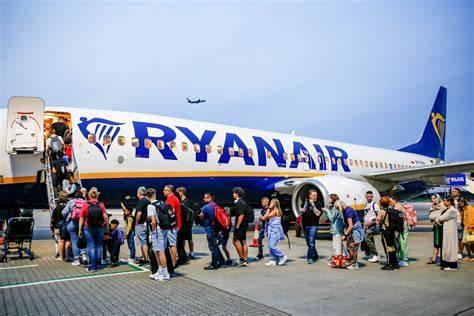
Passengers on a Ryanair service bound for the United Kingdom did not simply arrive late. They arrived in the wrong country. A flight that began at Alicante-Elche Airport (ALC) on Spain’s Costa Blanca, bound first for Cornwall Newquay Airport (NQY) and then rerouted toward Bristol International Airport (BRS), ended the night back on the same Spanish tarmac it had left hours earlier, more than 910 miles from its intended destination. Two separate weather diversions turned routine travel into an eight-hour airborne loop that carried paying customers across Ireland, England and the English Channel before returning them to Spain.
The sequence began when the aircraft departed Alicante for Newquay, the small regional gateway serving Cornwall in south-west England. Adverse weather over the British Isles made the approach to Newquay unsafe, forcing the crew to divert to Dublin Airport (DUB) instead. That first diversion placed the jet, its passengers and its crew in Ireland, far from both the origin and the destination, and set the stage for a far more punishing second leg the following evening.
From Dublin to Bristol: A Second Attempt That Never Landed
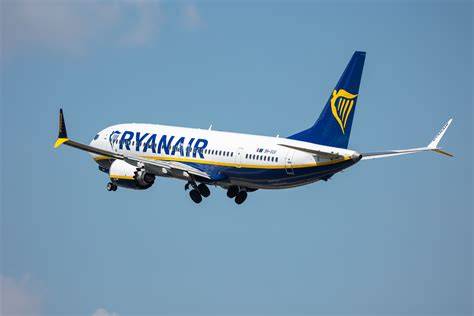
The aircraft later departed Dublin for Bristol on Saturday, October 24, with the airline’s stated plan being to land in Bristol and then move passengers onward to Newquay by bus. The jet climbed to a cruising altitude of 27,000 feet on the crossing to England. Then, advised of challenging conditions, the crew abandoned its approach before descending below 20,000 feet, sending the aircraft into a holding pattern over the English Channel while the situation on the ground was assessed.
Rather than commit to an increasingly marginal landing, the jet climbed back to a higher altitude and headed south to evaluate its next steps. The crew weighed a series of diversion options at regional airports across the United Kingdom, and the aircraft was tracked making a U-turn while operational viability elsewhere in Britain was examined. Persistent, unrelenting weather ruled out those alternatives one by one, and the decision hardened into something unusual: head back to Spain.
Why Ryanair Flew the Aircraft All the Way Home to Alicante
On paper, returning to the original departure point looks like the costliest possible answer to a diversion problem. The operational logic sits in the aircraft’s scheduling. Alicante was the jet’s home base, and the flight had already left late that evening. The outbound run to Newquay, the diversion to Dublin and the abortive attempt at Bristol had pushed the airframe, its passengers and its crew steadily further from where the airline needed them to be the next morning.
Flying back to Alicante repositioned the aircraft at its base, allowing engineers, crew and scheduling to reset the airframe for the following day’s roster. That single decision protected a chain of morning departures that would otherwise have collapsed into a cascade of delays and cancellations across the network. For the passengers strapped inside it, the calculation produced a result that felt almost absurd: a flight to Britain that never set foot in Britain, and a landing in the same Spanish city where their journey had started.
Inside Flight FR2955: The Final Landing at 2:15 AM
Ryanair flight 2955 touched down in Alicante at 2:15 AM local time, having logged roughly eight hours of flying and two separate diversions for a trip that should have ended with a short transfer into Cornwall. The distance between where the aircraft finally parked and the Newquay terminal its passengers had booked was more than 910 miles (1,465 km). Weather, not mechanical failure, drove every turn of the night.
The Aircraft Involved: Boeing 737-800 Registration 9H-QDK
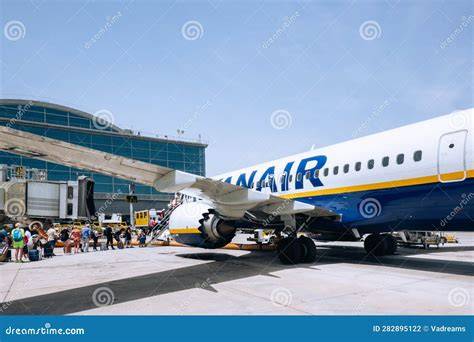
The jet at the centre of the incident is 9H-QDK, a Boeing 737-8AS with manufacturer serial number 44760 and line number 6182. It first flew on November 18, 2016, and was delivered to Ryanair on November 28, 2016, initially flying under the Irish registration EI-FTJ. On March 17, 2020, the airframe was transferred to Malta Air, the Ryanair Group carrier, and assigned its current registration. Configured in a standard all-economy layout, the aircraft seats up to 189 passengers and is now approaching ten years in service.
What the Diversion Means for Disrupted Passengers
Routing the aircraft home was a sound fleet decision, but it left travellers stranded in Spain at two o’clock in the morning with no seat on a flight to Britain. Passengers aboard such diversions typically face rebooking onto the next available connection, overnight accommodation where schedules permit, and refunds or compensation assessed under UK and EU air passenger rights depending on the delay on arrival at the final booked destination. Adverse weather can qualify as an extraordinary circumstance, which affects whether cash compensation is payable even when rebooking and assistance obligations still apply.
The episode also illustrates how tightly weather and scheduling are welded together in short-haul European aviation. A second diversion consumed the crew’s remaining duty window and the aircraft’s overnight slot, leaving the cheapest and most reliable resolution in the hands of the base operation rather than the passengers’ itinerary. Ryanair’s intra-group structure, which lets airframes move between certified carriers, made the repositioning straightforward to execute, even as it made the customer experience unforgettable for all the wrong reasons.