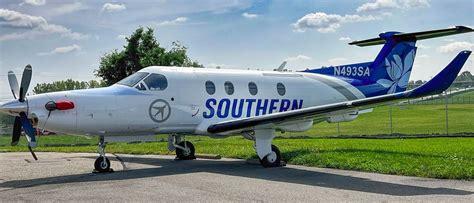
Founded on February 1, 1944, by Frank Hulse, Southern Airways emerged as a vital local-service airline connecting mid-sized and small cities across the southern United States. With its headquarters at Hartsfield–Jackson Atlanta International Airport, and key hubs in Atlanta and Memphis, Southern played a pioneering role in regional air transportation. Operating scheduled services from 1949 until 1979, the airline helped shape commercial aviation before its eventual merger with North Central Airlines to form Republic Airlines, a lineage that would later be absorbed into Delta Air Lines.
Southern Airways: A Southern Powerhouse in the Skies
By the mid-1950s, Southern Airways had established a firm footprint across the South-Central and Southeastern U.S., with its early network stretching from Memphis south to New Orleans, and east to Charlotte and Jacksonville. What began with routes to just 29 airports by 1953, expanded to over 50 destinations by 1967.
Southern was among the local-service carriers subsidized by the U.S. government, with a significant portion of its operating revenue—$5.35 million of $14 million in 1962—attributed to federal subsidies. This support enabled it to offer scheduled services in underserved areas, contributing to its rapid growth in passenger traffic: from 17 million revenue passenger-miles in 1951 to 853 million by 1975.
Fleet Evolution: From Propellers to Jet-Powered Routes
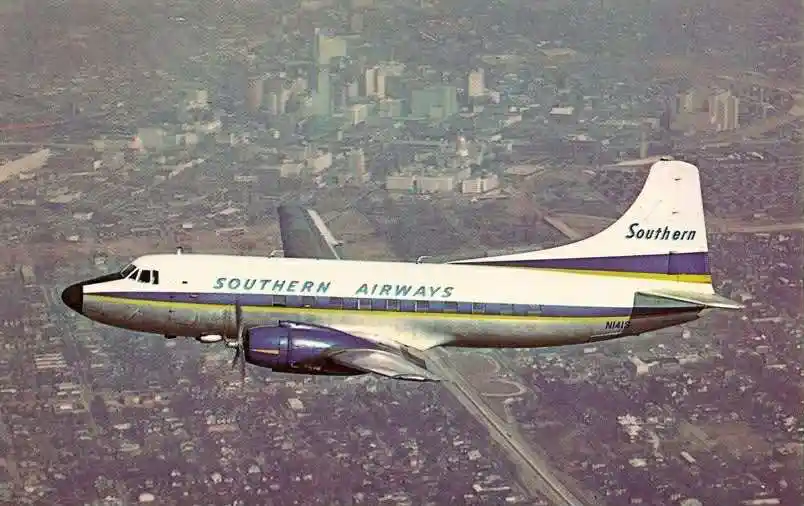
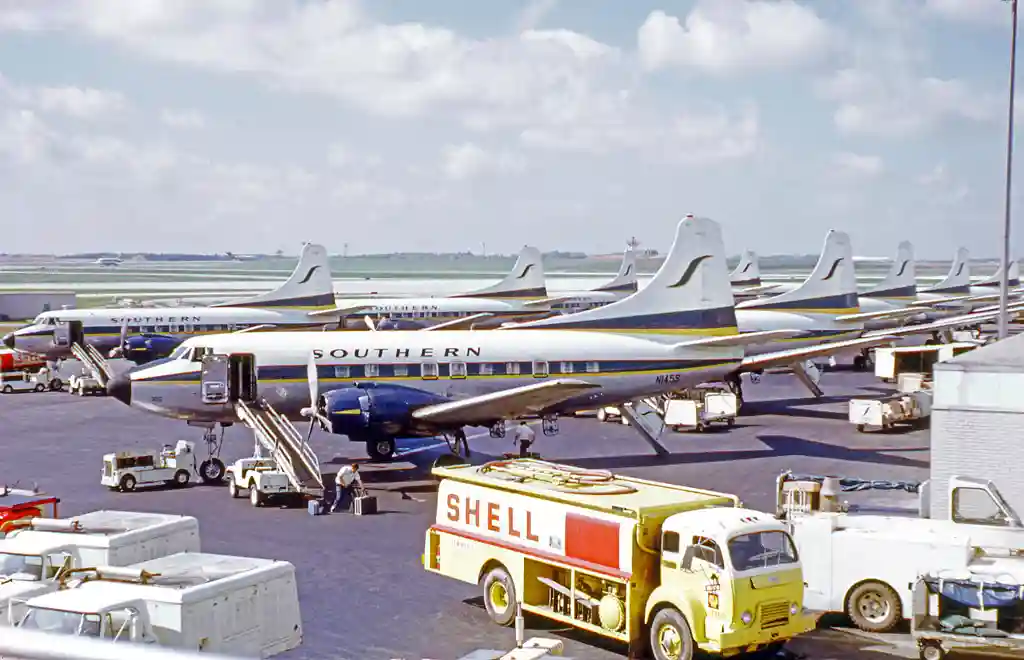
Southern Airways began operations with the iconic Douglas DC-3, a propeller-driven aircraft synonymous with early commercial aviation. The transition to more capable equipment started in 1961, with the acquisition of 22 pressurized Martin 4-0-4 aircraft from Eastern Air Lines. These aircraft offered greater comfort and speed and came equipped with rear ventral stairways, a distinguishing feature at the time.
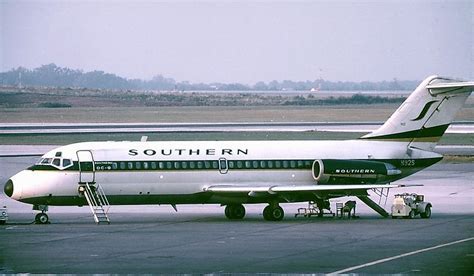
By 1967, Southern had fully embraced the jet age, introducing its first Douglas DC-9-10s, followed by the larger DC-9-30s in 1969. The final Martin 4-0-4 flight took place on April 20, 1978, closing the chapter on propeller operations. By the time of its merger in 1979, the airline had integrated 19-seat Fairchild Swearingen Metroliner “Metro II” commuter jets into its regional fleet, marking its full transition to modern jet services.
Southern was notably different from its peers in that it bypassed turboprop operations, such as the Convair 580 and Fairchild F-27, which were widely used by other regional carriers during the same period.
Expanding the Network: Cities, Strategy, and Reach
During the 1970s, Southern extended its reach beyond its traditional regional base. The airline began jet services to New York City, Chicago, Orlando, and Miami. However, due to regulatory constraints, it was unable to operate direct nonstops between New York or Washington, D.C., and Atlanta. Instead, Southern routed these flights through Columbus, Georgia, continuing with multiple stops through Dothan, Mobile, Panama City, Eglin Air Force Base, and Gulfport/Biloxi.
Its innovative use of DC-9 jets on regional milk-runs allowed it to maintain access to small cities, such as Muscle Shoals, Columbus, Meridian, and Tuscaloosa, while still offering connections to major hubs. One notable route involved a DC-9-14 aircraft flying a 14-hour journey starting in Miami, ending in Chicago, with multiple stops in between.
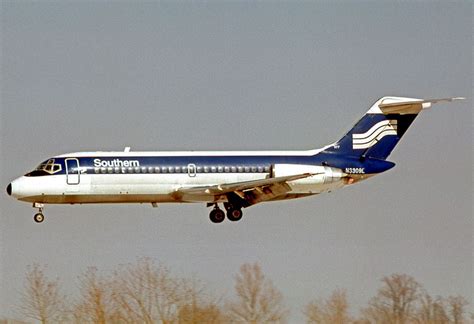
In the mid-1970s, Southern reached further with services to St. Louis, Detroit, Ft. Lauderdale, and its only international destination, Grand Cayman in the Caribbean. By 1978, expansion continued westward from Memphis to Wichita and Denver.
The airline’s brand identity, built around exclusivity and southern charm, was reflected in slogans like “Route of the Aristocrats” and “Nobody’s Second Class on Southern”. Adding to its cult status were its collectible annual shot glasses, which became beloved among aviation memorabilia enthusiasts.
Flight 49 Hijacking: A Crisis in the Sky
On November 10, 1972, Southern Airways became the focus of national and international headlines. Flight 49, a DC-9 scheduled from Memphis to Miami, was hijacked during a stopover in Birmingham, Alabama by three armed individuals carrying handguns and grenades. What followed was a dramatic 30-hour ordeal spanning nine U.S. cities, Toronto, and finally Havana, Cuba.
The hijackers demanded $10 million and threatened to crash the plane into the Oak Ridge nuclear facility. Southern was able to raise $2 million, delivered during a refueling stop in Chattanooga. Eventually, the aircraft was allowed to land in Cuba, where Cuban authorities arrested the hijackers but retained the ransom money. Southern accounted for the payment under a balance sheet item named “Hijacking Payment” and was ultimately reimbursed the full amount by the Cuban government, as part of an attempt to improve U.S.–Cuba relations.
Challenges and Decline in the Late 1970s
Despite its pioneering growth, Southern Airways began facing significant headwinds in the late 1970s. Two tragic accidents, Southern Airways Flight 932 (1970) and Flight 242 (1977), tarnished its safety record and shook public confidence.
Coupled with a changing transportation landscape, the proliferation of interstate highways and growing consumer preference for cheaper or more direct flights from major airports made many of Southern’s multi-stop regional routes less viable. The rapid rise in jet fuel costs further eroded profitability across much of its network.
Faced with these mounting pressures, Southern merged with North Central Airlines on July 1, 1979, giving rise to Republic Airlines, effectively ending Southern’s standalone identity.
Route Map and Geographic Reach
At its peak, Southern Airways served a wide variety of destinations that emphasized both major metropolitan hubs and underserved regional airports across the South and Midwest.
Core hubs included:
- Atlanta, Georgia
- Memphis, Tennessee
Focus cities included:
- New Orleans, Louisiana
- Orlando, Florida
Other major cities served with jet service included:
- New York (LaGuardia)
- Chicago (Midway, later O’Hare)
- Detroit
- Minneapolis/St. Paul
- Denver
- Washington, D.C. (Dulles)
- Ft. Lauderdale
- Tampa
- Miami
- St. Louis
- Grand Cayman
In addition, Southern Airways connected numerous smaller cities such as Anniston, Muscle Shoals, Tupelo, Macon, Greenville, and Florence, often using DC-9 jets on short-hop routes that might only be served by turboprops or commuter aircraft today.
Fleet Overview and Technical Excellence
Southern Airways operated a carefully curated mix of aircraft that evolved with the times while supporting its dual focus on regional accessibility and modern jet service.
- Douglas DC-3 (27 units; 1949–1967): The airline’s initial workhorse.
- Martin 4-0-4 (25 units; 1961–1978): A pressurized upgrade for regional routes.
- Douglas DC-9-14 and DC-9-15 (35 units total; 1967–1979): The backbone of Southern’s jet fleet, including two “Rapid Change” variants for flexible configuration.
- DC-9-31 and DC-9-32CF (10 units total): Longer-range and cargo-capable jets added toward the end.
- Fairchild Swearingen Metroliner “Metro II” (8 units; 1977–1979): Used to maintain regional coverage as smaller cities became harder to serve cost-effectively.
Merger and Legacy: From Republic to Delta
Post-merger in 1979, the newly formed Republic Airlines inherited Southern’s regional strength and route network. Republic would go on to acquire Hughes Airwest, expanding into the western U.S., before being absorbed by Northwest Airlines in 1986. Finally, Northwest merged into Delta Air Lines in 2008, thereby incorporating Southern’s heritage routes, aircraft, and personnel into one of the world’s largest carriers.
Today, Southern’s legacy is felt most profoundly in cities like Memphis, which remained a critical hub for decades, and in the countless smaller communities that were first connected to national air service by Southern’s pioneering efforts.
Conclusion: A Regional Giant Remembered
Southern Airways was much more than a defunct regional carrier. It was a symbol of postwar aviation expansion, of a time when local service airlines brought jet-age travel to rural America. Through innovation, branding, and strategic adaptability, Southern carved out a legacy that lived on through Republic, Northwest, and ultimately Delta.
While its aircraft no longer grace the skies, the memory of its routes, service philosophy, and unique Southern charm continue to endure among aviation historians, collectors, and industry veterans alike.