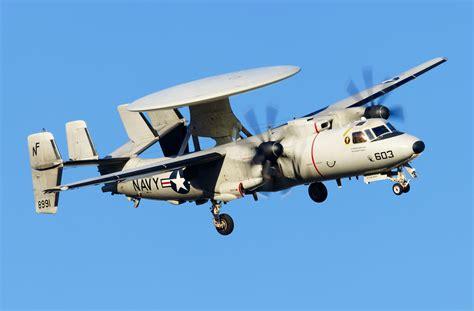
The Northrop Grumman E-2 Hawkeye is one of the least glamorous aircraft aboard a US Navy aircraft carrier, yet its importance may increase dramatically as sixth-generation aviation arrives. It does not have the stealthy silhouette of an F-35C, the enormous speed associated with future fighters, or the futuristic appearance often used to represent next-generation airpower. Instead, the Hawkeye carries a large radar dome above a compact turboprop aircraft, quietly performing one of the most important jobs in a carrier strike group: building and managing the battlespace picture.
The E-2 first entered US Navy service in 1964, making its basic design more than six decades old. That longevity is remarkable by any standard, particularly for a combat aircraft operating from aircraft carriers. Yet the Hawkeye has continuously evolved, culminating in the E-2D Advanced Hawkeye and its planned Block II modernization. Rather than simply giving the aircraft a better radar or faster computer, Block II is designed to make the Hawkeye a more adaptable network node capable of working with increasingly sophisticated manned and unmanned aircraft.
That matters because the future carrier air wing will not be built around one exceptional fighter. It will operate as an interconnected ecosystem involving F-35C Lightning II fighters, F/A-XX sixth-generation aircraft, MQ-25 Stingray tankers, Collaborative Combat Aircraft, F/A-18E/F Super Hornets, surface combatants, satellites, and distributed sensors. Within that ecosystem, the E-2D could become something resembling an airborne quarterback: detecting threats, fusing information, distributing targeting data, and helping coordinate aircraft that may be scattered across enormous areas of ocean.
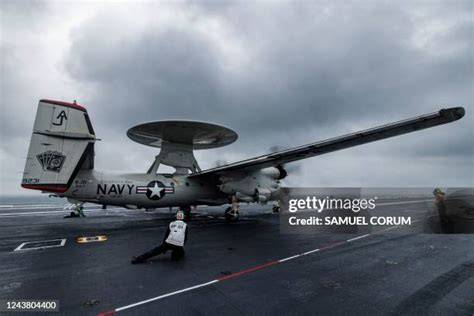
Why the E-2D Hawkeye Matters
The Hawkeye’s traditional mission is airborne early warning and command and control. From its position above the carrier strike group, the aircraft can detect aircraft, missiles, drones, and other contacts beyond the immediate sensing range of ships and fighters. Its elevated position gives its sensors a broader perspective than many systems operating close to sea level, allowing the crew to identify and track threats approaching the carrier force.
The E-2D Advanced Hawkeye represents the most sophisticated version of this concept. Its AN/APY-9 active electronically scanned array radar, advanced mission systems, and tactical networking allow it to perform considerably more than simple surveillance. The aircraft is designed to transform sensor information into an operational picture that commanders and other aircraft can use.
That distinction becomes increasingly important as modern combat moves toward distributed operations. A fighter may possess a powerful radar and sophisticated electronic warfare equipment, but its effectiveness depends on what it can detect, what other platforms know, how quickly information can be exchanged, and whether the entire force can coordinate its actions. The E-2D is specifically designed around that broader problem.
The aircraft also offers something that a stealth fighter cannot easily reproduce: space for people, processors, communications equipment, cooling systems, and mission hardware. Its three mission operators can concentrate on managing the battlespace while pilots in fighters concentrate on flying and fighting. That division of labor could become increasingly valuable as sixth-generation aircraft become overloaded with sensors and electronic systems.
Block II Changes the Hawkeye’s Future
In August 2026, the US Navy approved a modification that allows Northrop Grumman to advance the E-2D Block II program after the aircraft passed its critical design review. Flight testing is planned for Fiscal Year 2029, representing an important milestone in the effort to keep the Hawkeye relevant through the coming decades.
The most consequential change may not be visible from outside the aircraft. Block II is centered on a new software foundation for rapid capability insertion. The objective is to make the aircraft easier to upgrade as new threats, sensors, communication standards, and mission requirements emerge.
The modernization introduces a new cockpit architecture, increased computing power, an Open Mission Systems framework, and stronger cybersecurity. Those changes address one of military aviation’s most difficult long-term problems: an aircraft can remain physically useful while its electronics become obsolete.
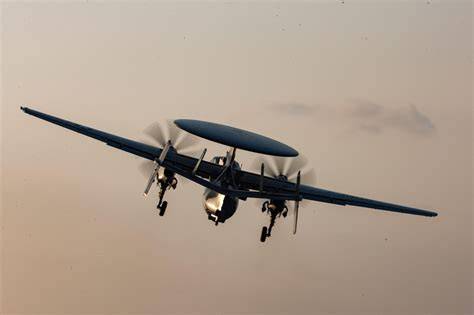
Instead of treating the aircraft as a fixed collection of proprietary systems, an open architecture can allow new capabilities to be incorporated more rapidly. That could reduce the time required to integrate new software and hardware while also making the aircraft less dependent on aging components.
For an aircraft expected to remain in service into the 2040s, that flexibility is crucial. The threats faced by the Navy in 2035 or 2040 may look very different from those encountered when today’s E-2Ds were originally designed. Block II therefore represents an attempt to modernize not only what the Hawkeye can do, but also how quickly it can learn to do new things.
The Hawkeye Becomes a Networked Quarterback
The most interesting description of the future E-2D is the idea of an airborne quarterback. The term captures a fundamental change in how the aircraft could be used.
A traditional early-warning aircraft primarily detects threats and provides warning. A future E-2D, by contrast, can become a central node that receives information from multiple platforms, combines it into a coherent tactical picture, and distributes useful information throughout the force.
Imagine a carrier strike group operating across a huge section of ocean. An F-35C may detect one contact through its sensors. A destroyer’s radar may detect another. A satellite could provide additional information. An unmanned aircraft might identify a third contact. The E-2D can potentially help bring those separate observations together, determine which tracks belong to the same object, and distribute the resulting picture to aircraft and ships that need it.
This is sensor fusion at the fleet level, rather than simply sensor fusion inside an individual aircraft.
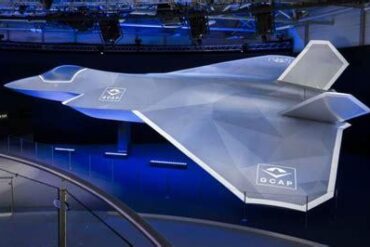
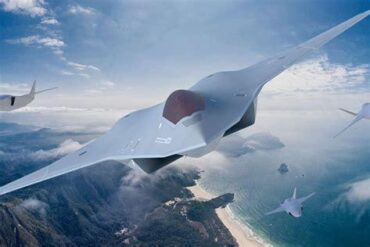
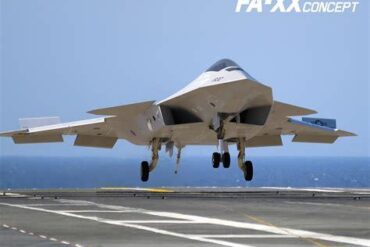
That distinction is particularly important for sixth-generation fighters. Future F/A-XX aircraft are expected to operate in environments where emissions control, stealth, electronic warfare, long-range sensing, and unmanned teaming are central to survival. A fighter may deliberately avoid using every sensor at maximum power if doing so would expose its location. In such circumstances, receiving information from another node can be extremely valuable.
Sixth-Generation Fighters Will Not Fight Alone
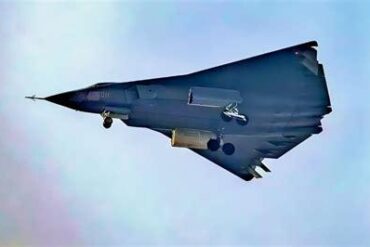
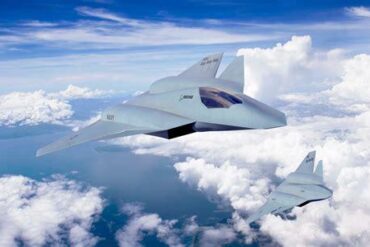
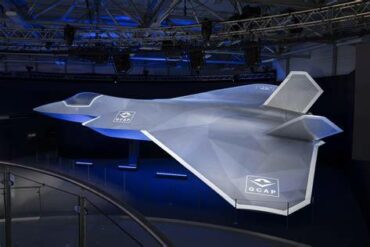
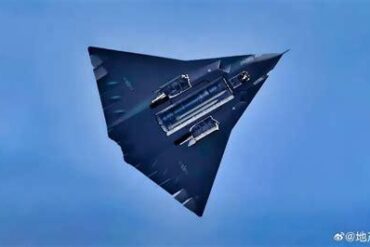
The popular image of sixth-generation air combat often focuses on the aircraft itself. Discussions tend to center on tailless configurations, stealth, advanced engines, artificial intelligence, directed-energy weapons, and enormous sensor capabilities. Those technologies matter, but they represent only part of the equation.
The more profound transformation may be the network surrounding the fighter.
A future F/A-XX could operate alongside unmanned Collaborative Combat Aircraft, receive tanker support from the MQ-25 Stingray, exchange information with F-35Cs, and receive targeting or situational information from ships and other sensors. The E-2D can sit inside that network as a dedicated airborne command-and-control node.
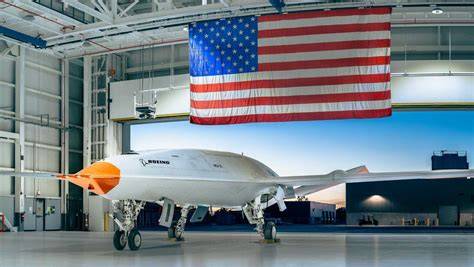
This arrangement could allow each platform to specialize. A stealth fighter can focus on penetrating contested airspace. An unmanned aircraft can move closer to a threat or perform a dangerous sensing mission. A destroyer can contribute long-range radar and weapons. The MQ-25 can extend fighter endurance. Meanwhile, the Hawkeye can help coordinate the information flowing between them.
In other words, the E-2D does not need to outperform every other aircraft. It needs to make the entire force perform better.
That may ultimately be more important than raw aircraft performance.
Why Open Architecture Is So Important
Open architecture may sound like a software engineering detail, but for military aviation it can determine how quickly a combat fleet adapts. Modern aircraft increasingly depend on software for radar processing, electronic warfare, communications, sensor fusion, weapons integration, and mission management.
A closed architecture can make changes slower and more expensive because individual systems may depend heavily on proprietary interfaces. Open architecture attempts to create a more flexible foundation where new applications and capabilities can be integrated without redesigning the entire aircraft.
For the E-2D, that is particularly valuable because the aircraft must communicate with platforms that may not even exist today.
The Navy’s future carrier ecosystem is still evolving. F/A-XX, Collaborative Combat Aircraft, new weapons, improved sensors, and increasingly sophisticated networks will introduce requirements that today’s E-2D designers cannot completely predict. Block II therefore needs to provide enough flexibility for the Hawkeye to evolve alongside them.
The same principle is becoming increasingly important across next-generation fighter development. The lesson is straightforward: a highly capable aircraft that cannot be upgraded quickly can become less useful surprisingly fast.
More Computing Power, More Tactical Information
Block II’s increased computing capacity is another major component of the modernization. Modern battlespaces produce enormous quantities of information, and processing that information quickly can be just as important as collecting it.
The E-2D can serve as a powerful processing and communications hub because its relatively large airframe provides more physical volume than a fighter. That additional space matters for processors, antennas, cooling equipment, power systems, and human operators.
Thermal management is particularly important. Every additional processor, radar component, electronic warfare system, or communications device consumes electrical power and generates heat. That heat must be removed. A larger turboprop aircraft offers engineers considerably more room to address these constraints than a compact stealth fighter does.
Sixth-generation fighters will face exactly this problem, but under much tighter physical constraints. Their designers must balance electrical generation, thermal management, weapons, fuel, sensors, stealth requirements, and aerodynamic performance inside an aircraft optimized for contested operations.
The Hawkeye does not face every one of those constraints to the same degree. That makes it an ideal complementary platform.
A Carrier Air Wing Built Around Multiple Nodes
The future carrier air wing will therefore look less like a collection of individual aircraft and more like a distributed combat system.
The F-35C provides stealth and advanced sensing. The future F/A-XX is expected to add another generation of combat capability. Collaborative Combat Aircraft can provide additional sensing, weapons, and mission capacity. The MQ-25 can extend the reach and endurance of crewed fighters. Surface ships contribute powerful radars, weapons, and command systems.
The E-2D ties many of these elements together from the air.
That role also explains why the Navy does not necessarily want the Hawkeye to become the only central sensor. A sophisticated network must avoid creating a single point of failure. If an adversary can disable one aircraft and blind the entire carrier strike group, the network becomes a vulnerability rather than an advantage.
The Navy is therefore moving toward a more distributed model in which the E-2D is one critical node among several. Space-based sensors will play a growing role, while ships, fighters, unmanned aircraft, and other systems will contribute information.
Yet airborne early warning remains valuable because it provides a sensor platform physically present with the carrier force and capable of operating when other communications or sensing layers are degraded.
Six Decades Old, But Still Relevant
The Hawkeye’s longevity is perhaps its most impressive characteristic. Few combat aircraft can remain operationally important for more than 60 years while undergoing such profound technological transformation.
The current Navy inventory is reported at 74 E-2 aircraft, compared with a stated requirement for 86. In 2026, the Navy contracted for three additional E-2Ds, with the first expected to be delivered in 2030. The service has also requested funding for another six Block II aircraft in Fiscal Year 2027.
The numbers underline the aircraft’s continued importance.
Other nations have recognized the same value. France, Japan, Egypt, Mexico, and Taiwan operate members of the E-2 family, while Israel and Singapore have previously operated the type. France is especially notable because its E-2Cs operate from the aircraft carrier Charles de Gaulle, demonstrating the aircraft’s continuing relevance to carrier aviation beyond the United States.
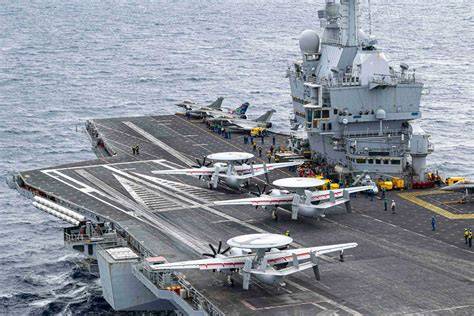
China’s development of the carrier-based Xi’an KJ-600 also highlights the enduring usefulness of this aircraft category. Its broad configuration reflects a simple operational reality: a carrier needs a platform capable of seeing beyond the horizon and coordinating aircraft operating around the task force.
The Quiet Backbone of Future Naval Airpower
The E-2D will never receive the same attention as the fighters it supports. It is not designed to win an air-to-air engagement by itself, and its appearance lacks the dramatic qualities normally associated with future combat aircraft.
Yet that is exactly what makes its role so interesting.
Every new generation of fighter becomes more dependent on information, connectivity, sensor fusion, and coordinated operations. As individual aircraft become harder to detect and increasingly capable, the ability to connect them into a coherent force becomes more important.
The E-2D Block II is being designed for that environment. Its open architecture, greater computing capacity, improved interfaces, rapid software insertion, cybersecurity enhancements, and tactical data capabilities are intended to ensure that an aircraft whose origins stretch back to the 1960s can continue coordinating aircraft designed decades later.
The future Navy will not simply send sixth-generation fighters into the sky and expect them to operate independently. Those fighters will be nodes in a much larger system. And somewhere above the carrier strike group, the familiar silhouette of an E-2 Hawkeye is likely to remain one of the aircraft making that system work.
The Hawkeye may therefore be the least-discussed aircraft in the future carrier air wing, but it could become one of its most consequential. Sixth-generation fighters may be the stars of the next era, yet the E-2D could be the aircraft helping conduct the orchestra.