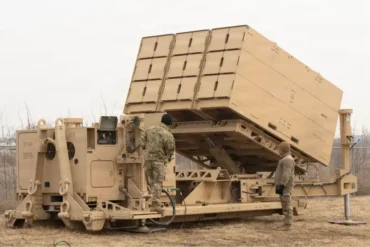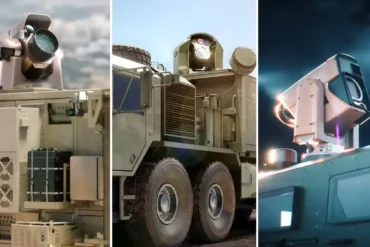
The U.S. Army has taken a major step toward deploying directed-energy weapons by awarding its first production contract for a high-energy laser air defense system. On September 24, 2026, the Army awarded AeroVironment, Inc. a $468.8 million contract to bring the Locust X3 into production, giving the service a new tool designed specifically to confront the growing threat from drones.
The move reflects a fundamental change in modern air defense. The war in Ukraine has demonstrated how inexpensive unmanned aircraft can be used in large numbers against military equipment and positions. A drone costing roughly $1,000 can force defenders to consider using an interceptor missile worth millions of dollars, creating an increasingly difficult economic equation.
Locust X3 Brings 20 to 35 kW of Laser Power
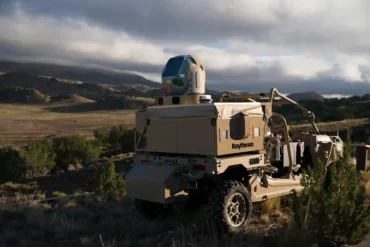
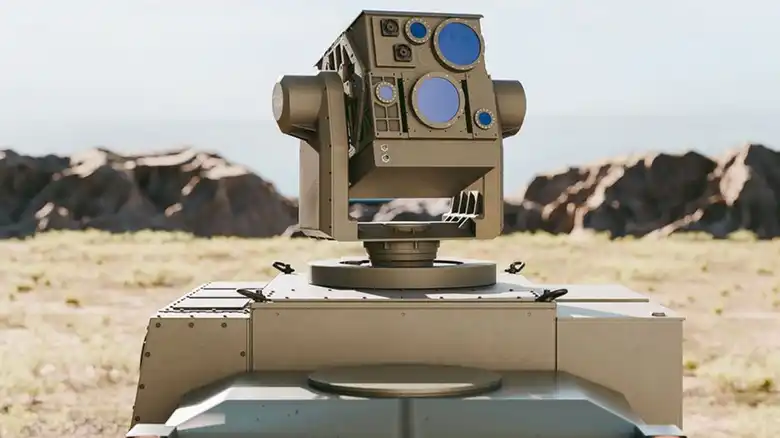
The Locust X3 is described as a third-generation directed-energy weapon capable of producing 20 to 35-plus kilowatts of power. According to AeroVironment, that output is sufficient to disable or destroy Group 1 through Group 3 uncrewed aerial systems, covering a substantial portion of the drone threats encountered by military forces.
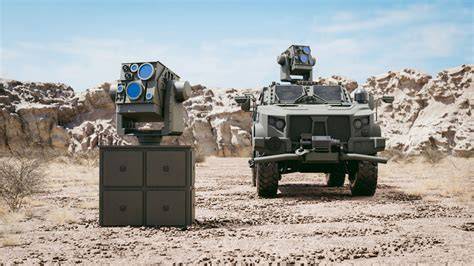
The system’s potential advantage is not simply its ability to destroy an aircraft without using conventional ammunition. A laser can potentially engage repeated targets without requiring the defender to carry a separate missile for every interception. This makes directed energy particularly attractive against drone swarms, where the number of incoming targets can quickly overwhelm conventional defenses.
The Army’s interest also comes from the enormous difference between interceptor costs and drone prices. A Patriot missile can cost around $3.7 million, while a THAAD interceptor can cost approximately $15.5 million. Using weapons at those prices against low-cost drones can rapidly consume expensive defensive inventories.
A Mobile Laser Designed for Army Operations
Unlike some fixed or experimental laser systems, Locust X3 has been designed with mobility and modularity in mind. It can reportedly be configured for vehicle-mounted, containerized, fixed, semi-fixed, or maritime operations, giving military planners several ways to integrate the system into different defensive networks.
For the Army, vehicle integration is especially important. Locust X3 is intended to be compatible with platforms such as the Joint Light Tactical Vehicle, which is progressively replacing the older Humvee across Army formations. The service is also examining potential compatibility with the Infantry Squad Vehicle.
This mobility could allow laser-equipped units to move alongside maneuver forces rather than remaining tied to permanent installations. Such flexibility matters when protecting forward positions, logistics areas, command posts, and other assets vulnerable to persistent drone surveillance and attack.
Artificial Intelligence Helps Track Drone Targets
Locust X3 also incorporates artificial intelligence for detecting, tracking, and prioritizing targets before engagement. That function could become increasingly important as defensive systems face multiple drones simultaneously and must determine which targets represent the greatest immediate threat.
The operator interface is another unusual feature. AeroVironment says the system uses a Microsoft Xbox controller, providing an interface familiar to many soldiers and potentially simplifying operator training.
Important performance details remain undisclosed. The Army and AeroVironment have not publicly provided the system’s exact range or cost per shot, among other specifications. Nevertheless, the nearly half-billion-dollar production contract indicates that Locust X3 has advanced beyond experimentation and into a new stage of Army air-defense development.
The first Army acquisition of a high-energy laser therefore represents more than another weapons contract. It signals an effort to build an air-defense architecture in which inexpensive drones can be countered with a weapon designed around the economics and operational realities of modern warfare.