Chicago O’Hare International Airport is accelerating one of the most important pieces of its multibillion-dollar redevelopment as United Airlines and American Airlines push the airport’s existing gate capacity toward its limits. Chicago plans to break ground on the first phase of the new Concourse E later in 2026, bringing 14 additional gates into service by 2030 before a second phase adds another ten gates by 2034.
The change represents a significant shift in the construction strategy for ORDNext, O’Hare’s ambitious modernization program. Concourse E had previously been viewed as a project that could wait until after the airport’s new Global Terminal was prioritized. Rising construction costs and concerns about airline funding had pushed the second satellite concourse toward the back of the schedule. Now, the rapid expansion plans of O’Hare’s two dominant carriers have made additional gates an immediate operational requirement.
For Chicago, the timing is especially important because the existing Terminal 2 must eventually be demolished and replaced by the O’Hare Global Terminal. That redevelopment will temporarily disrupt a substantial amount of existing gate capacity. Accelerating Concourse E gives the airport another source of gates before the most disruptive stages of the transformation begin, allowing O’Hare to expand while simultaneously rebuilding its central passenger complex.
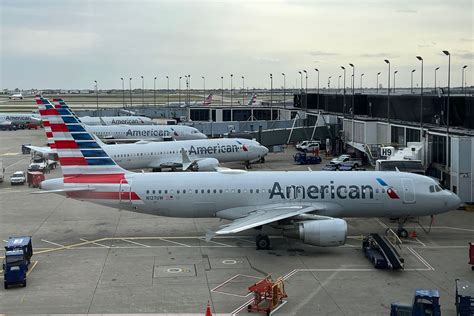
Chicago O’Hare’s Existing Gate Network Is Already Under Pressure
O’Hare currently operates four passenger terminals—Terminals 1, 2, 3, and 5—with 199 gates across its concourses. Terminal 1 contains Concourses B and C and is United’s primary home at the airport, while Terminal 3, with Concourses G, H, K, and L, serves as American’s principal operating base. Terminal 2 contains Concourses E and F and accommodates United and other domestic operations, while Terminal 5 handles most international and common-use activity.
The distribution illustrates why gate capacity has become such a sensitive issue. United’s enormous Chicago operation extends beyond Terminal 1 into other concourses, while American has a similarly extensive footprint centered on Terminal 3. Following the latest gate reallocation, United is expected to have preferential use of 91 gates, compared with 66 for American from October. That allocation has become increasingly contentious as both airlines seek room to expand their schedules.
O’Hare’s gate shortage is not simply a matter of airlines wanting more favorable terminal space. The airport is experiencing a genuine mismatch between planned flight growth and physical infrastructure. Aircraft need gates for boarding, servicing, cleaning, catering, and passenger processing, while construction can temporarily remove existing positions from service. When those factors collide, even a major airport with nearly 200 gates can find itself operating with surprisingly little flexibility.
The problem becomes more complicated because Terminal 2 occupies the exact area Chicago wants to transform into the Global Terminal. The existing facility has 43 gates, including a 16-gate Concourse E that will eventually disappear. The replacement Global Terminal is designed to be nearly twice the size of Terminal 2 and will accommodate domestic and international operations for United, American, and their alliance partners.
ORDNext Is Being Reordered Around Gate Capacity
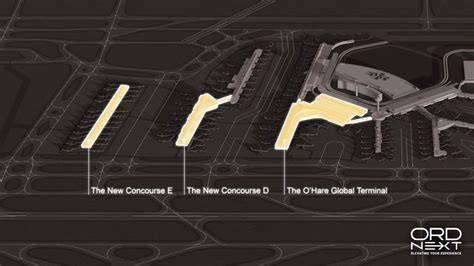
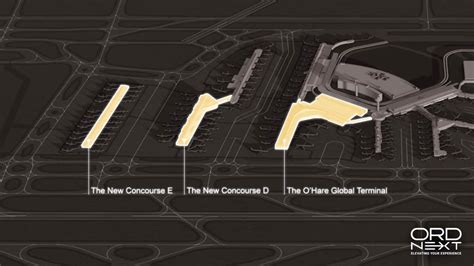
The broader ORDNext plan is intended to transform O’Hare’s central terminal complex while adding two new satellite facilities farther west. The new Concourse D and Concourse E will connect to the Global Terminal through an underground passenger tunnel, creating a larger and more flexible airport layout.
Concourse D is already moving ahead. The 580,000-square-foot facility broke ground in August 2025 after Chicago approved a project costing approximately $1.3 billion. It will provide 19 gates when it opens in late 2028, including positions that can be configured to accommodate larger widebody aircraft.
Concourse E, however, had a much less certain future. In 2024, Chicago reached a compromise with United and American after the redevelopment program was revealed to be roughly $1.5 billion over budget. The agreement placed the Global Terminal higher on the priority list while making construction of the second satellite dependent on available funding.
That arrangement made sense when the primary concern was controlling the cost of the airport’s enormous redevelopment program. But circumstances have changed. United and American are now pursuing significant schedule growth, while federal restrictions have highlighted how little spare capacity O’Hare has during peak periods.
Under the revised construction sequence, Concourse D is scheduled to finish in 2028, the Global Terminal will begin construction in 2029, and the first phase of Concourse E will begin in 2026. The first 14 gates are targeted for 2030, followed by ten additional gates in 2034.
| Project | Gates | Construction Start | Target Opening |
|---|---|---|---|
| Concourse D | 19 | August 2025 | Late 2028 |
| Concourse E Phase 1 | 14 | 2026 | 2030 |
| O’Hare Global Terminal | — | 2029 | 2033 |
| Concourse E Phase 2 | 10 | 2030 | 2034 |
The sequence is revealing. Concourse E is no longer simply an optional expansion project. It has become part of the infrastructure needed to make the wider redevelopment possible.
United Is Driving a Major Expansion at O’Hare
United’s growth plans are one of the clearest reasons Chicago is moving faster. The airline initially planned its largest-ever O’Hare schedule for summer 2026, with as many as 750 daily departures to 222 destinations. Federal intervention subsequently forced the carrier to reduce that schedule, leaving roughly 650 daily departures for the summer.
Even after those reductions, United’s operation remains considerably larger than it was previously. The airline continues to view Chicago as one of its most important global hubs, connecting a huge domestic network with international destinations across Europe, Asia, Latin America, and beyond.
The carrier’s ambitions also mean that gate demand is not simply a temporary problem created by one particularly busy summer. New routes, additional frequencies, larger aircraft, and continued network development can all increase the amount of time an airline needs at the airport.
That creates a difficult planning equation for Chicago. If United continues adding flights while the airport simultaneously removes gates for construction, the available margin becomes increasingly narrow.
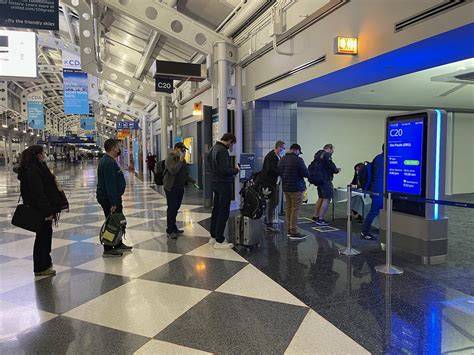
American Airlines Is Expanding Instead of Retreating
American is adding another layer of pressure. After years in which its Chicago operation appeared to be more restrained, the airline has been rebuilding its presence at O’Hare. It planned more than 500 departures on peak days in 2026, with its early-year schedule representing an increase of roughly 168 daily flights from the comparable previous period.
American’s strategy is also extending into long-haul flying. The airline plans to restore service between Chicago and Tokyo Narita, demonstrating that its O’Hare ambitions are not limited to adding domestic frequencies.
That matters because long-haul operations can place different demands on airport infrastructure. Widebody aircraft require compatible gates, adequate ramp space, specialized servicing, and efficient passenger flows. As American rebuilds its international network and United maintains its massive hub operation, O’Hare needs infrastructure capable of handling not just more flights, but a more diverse fleet and schedule.
The rivalry between the two carriers therefore has a physical consequence. Both airlines need gates, and neither can easily expand without access to additional infrastructure.
FAA Restrictions Expose O’Hare’s Capacity Problem
The scale of the problem became particularly clear when the Federal Aviation Administration intervened in O’Hare’s schedule planning. Airlines collectively sought more than 3,080 daily operations during peak periods in summer 2026, approximately 15% above the previous year. The FAA instead limited the airport to 2,708 daily operations because of congestion, gate constraints, and ongoing construction.
Those restrictions, initially expected to expire in October, have been extended through October 30, 2027. That extension is significant because it demonstrates that O’Hare’s capacity challenge is expected to persist well beyond a single peak season.
For airlines, a flight restriction is more than an inconvenience. It can prevent carriers from adding attractive frequencies, complicate aircraft scheduling, and make it harder to respond quickly to changing demand. For Chicago, meanwhile, the restrictions provide a powerful incentive to increase physical capacity as efficiently as possible.
The result is a remarkable reversal in priorities. Only a short time ago, the cost of Concourse E was a major concern. Now, the cost of not having enough gates may be even more consequential.
Why Concourse E Must Move Ahead Before the Global Terminal
The most important reason for accelerating Concourse E is the construction of the Global Terminal itself. Chicago cannot simply remove Terminal 2 and its associated gates without providing alternative capacity elsewhere.
The new Global Terminal is scheduled to open in 2033, while the first 14 gates of Concourse E are expected to become available in 2030. That three-year window is critical. It gives O’Hare additional positions before the new terminal becomes operational and provides flexibility as construction reshapes the central airport complex.
The final ten Concourse E gates are planned for 2034, one year after the Global Terminal opens. This creates a phased expansion rather than requiring Chicago to deliver all 24 gates simultaneously.
O’Hare’s Gate Race Is Reshaping the Airport’s Future
The acceleration of Concourse E reveals something fundamental about O’Hare’s redevelopment: the airport is no longer building only for its future network; it is trying to keep pace with growth that is already happening.
United and American have both demonstrated that they want more capacity at Chicago. Their competing expansion plans have transformed gates into one of the airport’s most valuable resources, while construction threatens to remove some existing capacity at precisely the moment demand is increasing.
The 24-gate Concourse E therefore serves two purposes. It will eventually become part of O’Hare’s new satellite system, but in the near term it acts as a buffer against the disruption created by the Global Terminal project.
That makes the revised construction schedule strategically important. Concourse D will provide 19 gates by 2028, Concourse E will add 14 by 2030 and another ten by 2034, while the Global Terminal is targeted for 2033. Together, those projects will fundamentally change how O’Hare distributes aircraft and passengers across the airport.
The irony is that the project once vulnerable to budget cuts has become increasingly difficult to postpone. United and American have effectively turned O’Hare’s gate shortage into an infrastructure deadline. Chicago now has to build not merely because the airport wants to become bigger, but because its two largest airlines are already demanding more room than the existing system can comfortably provide.
If the revised schedule stays on track, O’Hare will enter the next decade with a substantially larger and more flexible terminal system. The real test, however, will be keeping construction moving while airlines continue adding flights. For Chicago, the race is no longer simply to modernize O’Hare. It is to modernize the airport quickly enough that its gates do not become the bottleneck preventing its airlines from growing.