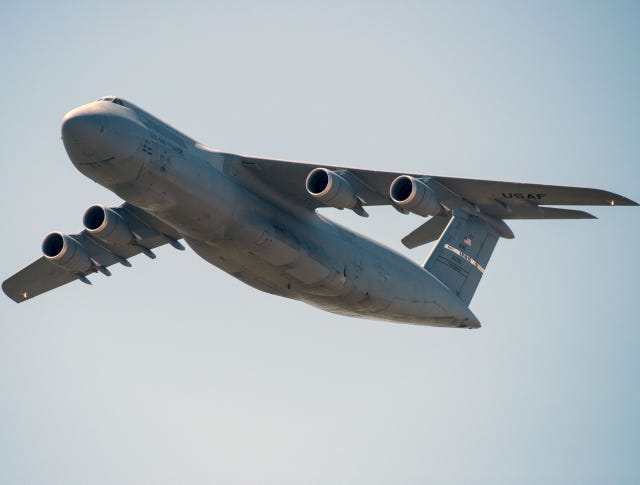
The United States Air Force (USAF) is making a major investment in an aircraft that first entered service more than half a century ago. Rather than replacing the massive Lockheed C-5 Galaxy, the service is spending nearly $143 million to maintain and modernize the software systems that keep the giant strategic airlifter operational.
The decision highlights an important reality of military aviation: age alone does not determine an aircraft’s usefulness. While commercial airlines regularly retire older aircraft because of fuel costs and efficiency concerns, military operators often measure value differently. If an aircraft can still perform its mission effectively, upgrading it may be far more practical than developing an entirely new replacement.
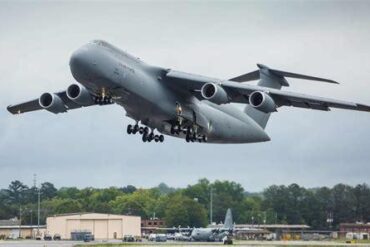
The C-5 Galaxy remains the largest aircraft ever operated by the US Air Force. Designed during the 1960s as a heavy strategic transport, it was built to move enormous military equipment, vehicles, and supplies across continents. More than five decades later, the aircraft continues to provide a capability that few other airlifters can match.
Why The C-5 Galaxy Still Matters To The US Air Force
The origins of the Lockheed C-5 Galaxy trace back to 1964, when the US Air Force launched the Heavy Logistics System program to find a new strategic transport aircraft. The requirement was ambitious: the aircraft needed to carry extremely large payloads while maintaining the ability to fly long distances without frequent stops.
Several major aerospace companies competed for the program, including Boeing, Douglas, and Lockheed. Although Boeing’s proposal was considered strong, Lockheed’s design offered lower projected costs and ultimately won the competition. The aircraft was paired with the powerful General Electric TF39 turbofan engine, one of the first high-bypass engines developed for military aviation.
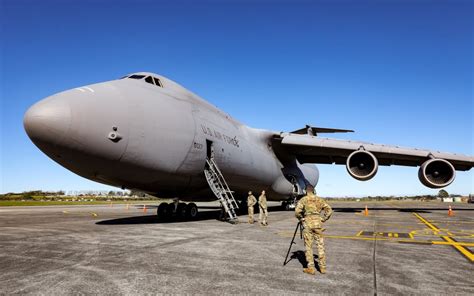
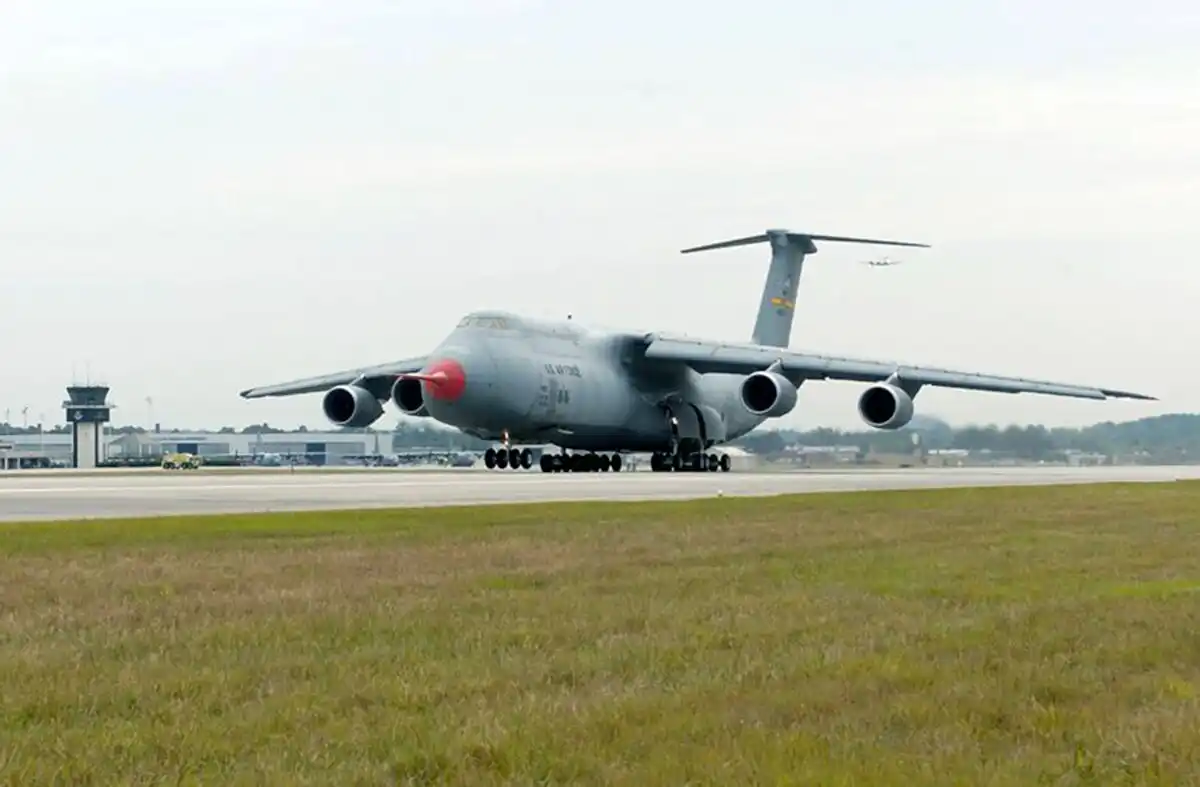
The resulting aircraft was enormous. The C-5 featured a high-mounted wing, four engines, a distinctive T-tail configuration, and a cargo compartment large enough to transport some of the biggest military assets in the American inventory.
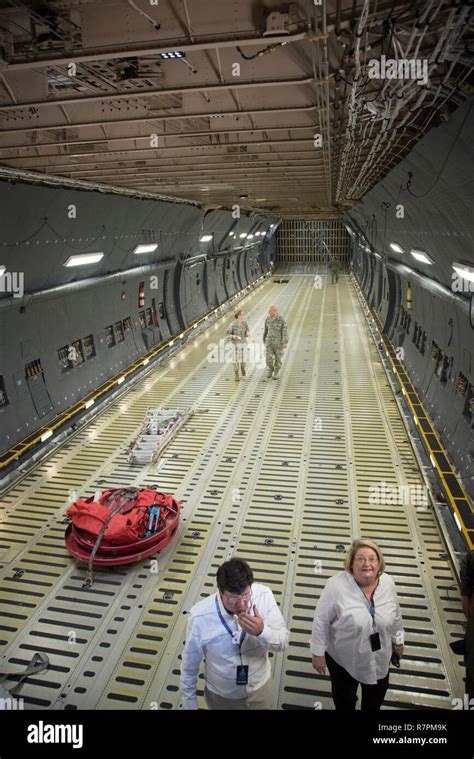
With a length of 247 feet 1 inch (75.31 meters), a wingspan of 222 feet 9 inches (67.89 meters), and a maximum takeoff weight of approximately 381 tons, the Galaxy remains a symbol of American airlift capability. Its internal cargo bay can accommodate up to 36 463L military pallets, while the upper deck can carry dozens of passengers supporting military operations around the world.
The aircraft was designed around one central mission: moving oversized cargo that other aircraft cannot handle. Tanks, helicopters, armored vehicles, humanitarian supplies, and critical military equipment can all be transported by the C-5.
The USAF originally received 81 C-5A aircraft between 1969 and 1973. Production later restarted in the 1980s, resulting in the delivery of 50 improved C-5B models between 1986 and 1989. Two modified C-5A aircraft were also converted into C-5C models for specialized missions involving large satellite cargo.
The $143 Million Software Upgrade For The Aging C-5 Fleet
In July 2026, the US Air Force awarded Lockheed Martin a $142.9 million indefinite-delivery, indefinite-quantity (IDIQ) contract focused on software sustainment for the C-5 fleet.
The contract does not represent a simple software update. Instead, it covers the continuous engineering work required to keep the aircraft’s digital systems reliable, secure, and compatible with modern aviation infrastructure.
As aircraft become older, their physical structures are not the only elements that require attention. Modern military aircraft depend heavily on software controlling navigation systems, communication equipment, mission systems, and compatibility with evolving air traffic management networks.
For the C-5, maintaining updated software is essential because the aircraft must continue operating alongside newer aircraft and within increasingly digital military environments.
Under the agreement, Lockheed Martin will continue supporting the software development infrastructure needed for the aircraft. Work will be conducted through facilities in Marietta, Georgia, and Greenville, South Carolina, where engineers will provide technical assistance, testing, and software updates.
The program is expected to continue through May 2032, allowing the Air Force to gradually address issues, improve reliability, and ensure that the aircraft remains compatible with future operational requirements.
The use of an IDIQ contract gives the Air Force flexibility. Instead of committing to a fixed amount of work immediately, the service can request specific software support tasks as requirements develop.
The sole-source nature of the contract is also significant. Since Lockheed Martin originally designed and built the C-5, the company possesses decades of technical knowledge about the aircraft’s systems, structure, and operational history.
Modernizing Both The Software And Structure Of The C-5M Super Galaxy
The software contract is only one part of a broader effort to keep the C-5 flying. The Air Force has also invested heavily in maintaining the aircraft’s physical condition.
In 2025, the USAF awarded Lockheed Martin another major IDIQ contract worth $211.3 million for structural and maintenance support of the C-5M Super Galaxy fleet.
This separate effort focuses on areas such as structural integrity, corrosion prevention, functional systems reliability, and investigation of aircraft deficiencies.
Separating software modernization from structural maintenance allows specialists to focus on different challenges. The aircraft’s physical structure must remain strong enough for continued heavy operations, while its digital systems must continue evolving with modern technology.
During the 2000s, the Air Force began transforming existing C-5 aircraft into the improved C-5M Super Galaxy configuration. The upgrade included new General Electric F138 engines, based on the commercial CF6 engine family, along with avionics improvements and other enhancements.
A total of one C-5A, 49 C-5Bs, and both C-5Cs were converted to C-5M standards. These upgrades dramatically improved reliability, performance, and operational efficiency compared with the original aircraft.
The C-5M is not the same aircraft that entered service in 1970. Although its basic design remains recognizable, decades of upgrades have transformed it into a modern strategic airlifter.
Why The US Air Force Is Keeping A 50-Year-Old Aircraft
At first glance, spending hundreds of millions of dollars on a decades-old aircraft may appear unusual. However, military aviation follows different economic rules compared with commercial aviation.
Airlines typically retire aircraft because newer models provide better fuel efficiency, lower operating costs, and improved passenger experiences. A 40-year-old passenger aircraft can become financially unattractive even if it remains technically capable.
The military has different priorities. The most important question is whether the aircraft can successfully complete its mission.
The C-5M Super Galaxy provides a unique capability. No other current USAF aircraft can match its combination of payload capacity and strategic range. Replacing it would require designing a completely new aircraft capable of carrying extremely large cargo over global distances.
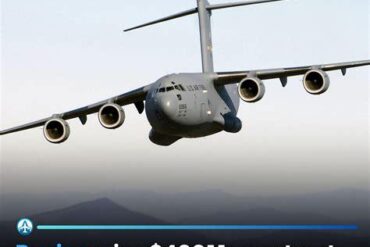
The USAF already operates smaller transports such as the Boeing C-17 Globemaster III and Lockheed C-130 Hercules, but these aircraft serve different roles. The C-17 offers tactical flexibility and short-field capability, while the C-130 specializes in regional missions.
The C-5 exists for situations where size matters most.
For the Air Force, keeping an existing aircraft operational can be more practical than creating a replacement that may take decades and billions of dollars to develop.
The C-5 Galaxy Is Part Of A Long Tradition Of Long-Lived Military Aircraft
The C-5 is not the oldest aircraft family in US military service. The Air Force continues operating several platforms with remarkable service histories.
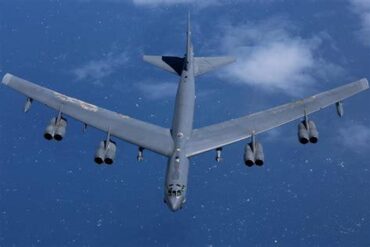
The Boeing KC-135 Stratotanker, introduced in the 1950s, remains a critical aerial refueling aircraft. The Boeing B-52 Stratofortress, also introduced during the 1950s, continues serving as a strategic bomber platform. The Lockheed C-130 Hercules, first introduced in 1956, remains one of the most successful military transport aircraft ever built.
These aircraft demonstrate a key principle of military procurement: a well-designed platform can remain valuable for generations if it receives continuous upgrades.
Technology improvements in military aviation often focus on areas such as stealth, sensors, weapons systems, and electronic warfare. Not every mission requires a completely new aircraft design.
For the C-5, the mission itself has not changed dramatically. The Air Force still needs an aircraft capable of moving massive cargo around the world, and the Super Galaxy continues to perform that role effectively.
The Future Replacement: Next Generation Airlift
Although the Air Force plans to keep the C-5 in service until approximately 2050, it is already considering what comes next.
The future replacement program is currently known as Next Generation Airlift (NGAL). The aircraft is expected to eventually replace both the C-5 Galaxy and the C-17 Globemaster III, creating a new strategic airlift platform for future military operations.
The concept presents a major challenge because the two aircraft perform different missions. The C-5 focuses on maximum payload capacity, while the C-17 provides greater flexibility, including operations from shorter and less-developed airfields.
A future NGAL aircraft would likely need to combine elements of both platforms while introducing new capabilities designed for a more contested battlefield environment.
Future strategic airlifters may require improved survivability, better defensive systems, greater efficiency, and the ability to operate in environments where traditional large aircraft face increased threats.
However, that replacement is still years away. Until then, the C-5M Super Galaxy remains an essential part of American military logistics.
A Digital Lifeline For The World’s Largest US Military Aircraft
The $143 million software investment demonstrates how modern aircraft are no longer defined only by engines, wings, and airframes. Software has become a critical component of military aviation capability.
For the C-5 Galaxy, extending service life is not simply about keeping old aircraft flying. It is about ensuring that a proven strategic asset continues operating safely within a rapidly changing technological environment.
The Air Force’s decision reflects confidence in the C-5M Super Galaxy and its unique capabilities. With structural support, software modernization, and continued engineering improvements, the aircraft that began development in the 1960s is expected to remain a vital part of US military transportation for decades to come.
The C-5 Galaxy may be old by aviation standards, but its mission remains difficult to replace. As long as the United States needs to move the world’s largest military cargo across the globe, the massive Super Galaxy will continue earning its place in the fleet.