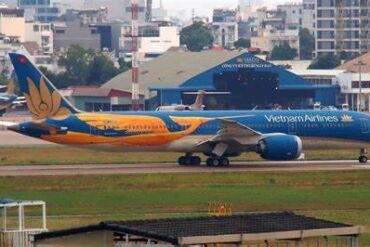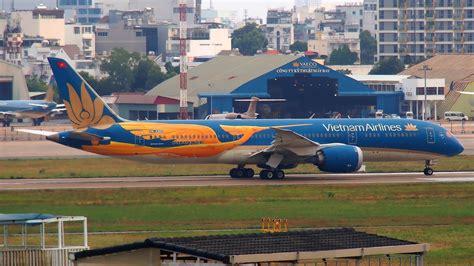
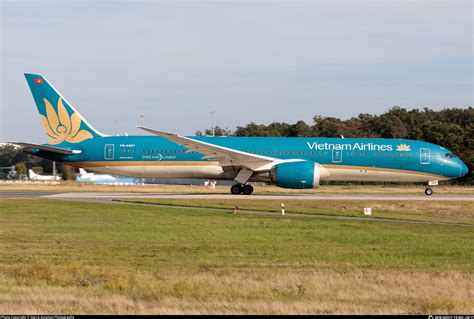
Vietnam Airlines flight VN34 suffered a serious takeoff incident at Munich Airport after brake inputs were recorded during the aircraft’s acceleration, according to an interim investigation by Germany’s Federal Bureau of Aircraft Accident Investigation (BFU). The Boeing 787-9 was attempting to depart for Hanoi on August 15 when repeated left-seat brake pedal movements occurred during the takeoff roll. The aircraft eventually lifted off late, struck the ground with its tail and landing gear, and returned to Munich with significant damage.
The incident involved VN-A867, a roughly ten-year-old Boeing 787-9, carrying 271 passengers and 16 crew members. The aircraft had been scheduled to operate the nonstop service from Munich to Noi Bai International Airport in Hanoi. Although the flight initially appeared to be progressing normally as the widebody entered the runway and takeoff thrust was applied, flight recorder data later revealed braking activity during a phase when the aircraft should have been accelerating toward rotation speed.
The new information is significant because the investigation has now established a clearer connection between the recorded brake commands and the aircraft’s delayed takeoff. Data from the Enhanced Airborne Flight Recorder showed movement of the left-seat brake pedals during the takeoff run. The Boeing 787-9 continued accelerating, but braking commands were simultaneously registered by the braking and steering control units, creating a potentially critical reduction in acceleration during the final stages of the takeoff.
Boeing 787-9 Recorded Brake Inputs During Takeoff
According to the preliminary findings, the aircraft was configured for departure and TOGA thrust was activated as VN34 began its takeoff roll. The aircraft was carrying approximately 136,687 pounds, or 62 tonnes, of fuel, contributing to a total takeoff weight of roughly 529,109 pounds, or 240 tonnes.
Despite the aircraft accelerating, the EAFR recorded rudder pedal movement from the left-seat brake pedals. One braking command reached approximately 27% on the left side, while the right braking and steering control unit registered a maximum command of 17%. The maximum recorded brake pedal position was approximately 7.2 degrees, compared with a possible 12.5 degrees.
The data provides an important indication of what happened during the takeoff. Rather than a simple loss of engine thrust or an obvious runway-performance problem, the aircraft was receiving braking inputs while the pilots were attempting to accelerate. The investigation has not yet established the complete reason for those inputs, meaning the interim findings should not be interpreted as a final determination of responsibility.
Late Rotation Led to Tail and Landing Gear Damage
The consequences became apparent as the aircraft approached the point where it needed to rotate. The calculated rotation speed was approximately 175 knots, but the aircraft rotated at about 163 knots, according to the preliminary investigation data. The late and abnormal departure sequence left the aircraft extremely close to the runway surface as it crossed the area near the threshold.
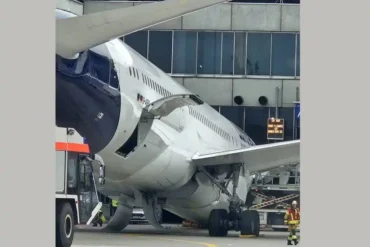
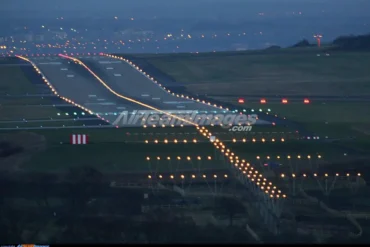
As the Boeing 787-9 lifted off, its main landing gear entered the grass beyond runway 08R. The aircraft’s tail also contacted the ground and struck runway approach-lighting equipment. Approximately 20 runway lights were damaged during the event.
The physical damage extended beyond the runway lighting. Four tires on the left main landing gear were damaged, while the aircraft sustained fuselage damage after its tail contacted the ground. The crew subsequently recognized that the aircraft could not continue its planned flight to Hanoi and made the decision to return to Munich.
VN34 Returned to Munich With 62 Tonnes of Fuel
The return flight created another demanding operational situation because the aircraft still carried approximately 62 tonnes of fuel. The damaged Boeing 787-9 landed at Munich around two hours after its initial departure.
Passengers were safely removed from the aircraft, and no injuries were reported among the 271 passengers or 16 crew members. The Hanoi flight was cancelled, with affected passengers subsequently rebooked onto alternative services.
The absence of injuries contrasts sharply with the extent of the aircraft and infrastructure damage. The event nevertheless demonstrates how a relatively small abnormality during the takeoff roll can develop into a major aviation incident when it occurs at high speed and close to the point of rotation.
Investigation Continues Into the Brake Commands
The BFU’s investigation remains ongoing, and the brake pedal inputs are an important part of the evidence being examined. Investigators will need to establish why the braking commands occurred, how the crew responded to them, and how the inputs affected the Boeing 787-9’s acceleration and rotation.
VN-A867 remains grounded at Munich while repairs are carried out. The aircraft, identified by serial number 39287, had completed a Hanoi-to-Munich flight on August 14 without incident before the accident sequence the following day.
The preliminary findings therefore provide a more detailed picture of the Munich overrun without representing the final investigative conclusion. Recorder data has established that braking activity occurred during the takeoff roll, while the aircraft was accelerating and approaching rotation. The continuing investigation will determine how those inputs occurred and why they ultimately contributed to the late takeoff, tail strike and substantial damage suffered by the Vietnam Airlines Boeing 787-9.