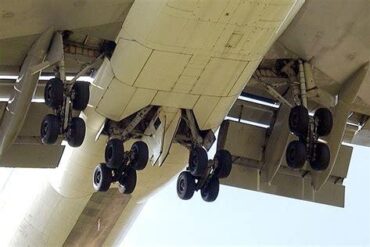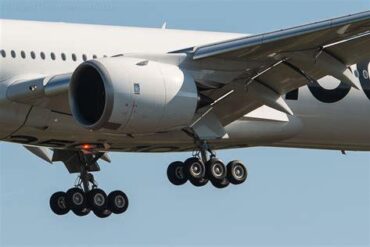
The Boeing 737 has one of the most recognizable landing gear arrangements in commercial aviation. Its nose gear retracts into the forward fuselage, while the two main landing gear assemblies fold into bays beneath the wings and center fuselage. Yet when the aircraft is airborne, something immediately stands out to anyone familiar with modern airliners: the main landing gear wheels remain partially exposed rather than disappearing behind large aerodynamic doors.
At first glance, this seems like an odd choice. Most large commercial aircraft use landing gear doors to cover their wheels and gear bays once the landing gear has retracted. The Airbus A320 family, Boeing 757, Boeing 767, Boeing 777, Boeing 787, and Airbus A330 all use extensive gear-door systems. Covering the wheels creates a smoother underside and reduces aerodynamic drag, so why did Boeing choose a different solution for the 737?
The answer is rooted in the aircraft’s original mission. The 737 was designed in the 1960s as a simple, rugged short-haul aircraft intended to serve smaller airports, including facilities with relatively basic infrastructure. Boeing prioritized low weight, mechanical simplicity, easy servicing, and operational reliability. The absence of full main landing gear doors was not an oversight. It was a deliberate engineering decision that made sense for the aircraft Boeing was building at the time.
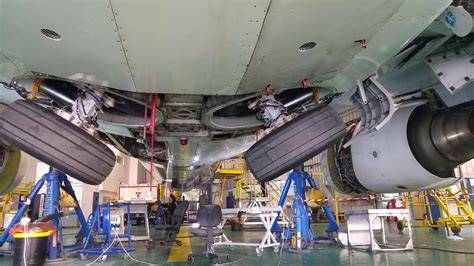
The Boeing 737 Was Designed Around Simplicity
When the first Boeing 737-100 and 737-200 were being developed, commercial aviation looked very different from today. Short-haul airlines needed aircraft that could operate frequent sectors, turn around quickly, and serve airports that did not necessarily have the sophisticated maintenance infrastructure found at major international hubs.
The 737 was therefore designed to be simple and durable. Its low ground clearance was particularly useful because ground crews could reach many areas of the aircraft without specialized equipment. The same philosophy influenced the landing gear design. Boeing did not need to add a complicated collection of doors, hinges, actuators, locks, linkages, and associated maintenance requirements simply to hide the wheels.
A landing gear door may look like a relatively small component, but on an airliner it is part of a sophisticated mechanical system. Doors must open and close reliably, remain synchronized with the landing gear, withstand aerodynamic loads, and operate in extreme environmental conditions. A malfunction can create operational restrictions or require maintenance before an aircraft can return to service.
For the original 737 mission, Boeing decided that the benefits of eliminating unnecessary hardware outweighed the aerodynamic advantage of completely enclosing the wheels. The result was a lighter and mechanically simpler system.
Why the 737’s Low Ground Clearance Matters
The 737’s famously low stance is often assumed to be the direct reason it lacks landing gear doors. That explanation is incomplete. Other low-slung aircraft have used landing gear doors, proving that ground clearance alone does not determine whether doors are practical.
However, the aircraft’s low stance and exposed landing gear have a common origin: Boeing wanted the 737 to be easy to operate and maintain at smaller airports.
The original 737 sat much closer to the ground than many larger commercial aircraft. This helped passengers board without excessively tall stairs or elaborate equipment, while ground personnel could access engines, cargo compartments, and other service areas more easily. At the same time, the relatively compact landing gear could retract into the aircraft without requiring the kind of elaborate door arrangement found on larger aircraft.
That philosophy was especially valuable during the 1960s. A minor landing gear door problem at a major modern airport might be relatively straightforward to repair. At a smaller airport with limited equipment and spare parts, however, a damaged door or actuator could become a much more serious operational problem.
Boeing’s approach was essentially to remove a potential failure point before it could become a problem.
Landing Gear Doors Reduce Drag, But They Add Weight
There is a clear aerodynamic advantage to closing the landing gear bay. Air flowing beneath an aircraft encounters less turbulence when the fuselage and wing surfaces are smooth. Exposed wheels and openings disturb the airflow and generate additional drag.
This matters because commercial aircraft spend most of a flight at cruising altitude, where aerodynamic efficiency is extremely important. Even small reductions in drag can translate into meaningful fuel savings over thousands of flights.
But there is another side to the equation. Landing gear doors add weight.
The doors themselves must be structurally strong enough to survive repeated cycles and aerodynamic forces. Their hinges, actuators, locking mechanisms, sensors, plumbing, wiring, and supporting structures all contribute additional mass and complexity. That weight has to be carried on every flight, including the short sectors for which the early 737 was designed.
The 737-100 and 737-200 were primarily short-haul aircraft. They were not expected to spend many hours cruising across oceans. Consequently, the potential fuel savings from a completely smooth landing gear area were less compelling than they would be on a long-range widebody aircraft.
Boeing therefore accepted a small aerodynamic penalty in exchange for lower structural weight and greater simplicity. For the original aircraft, that was a rational trade-off.

The 737 Does Have Landing Gear Doors
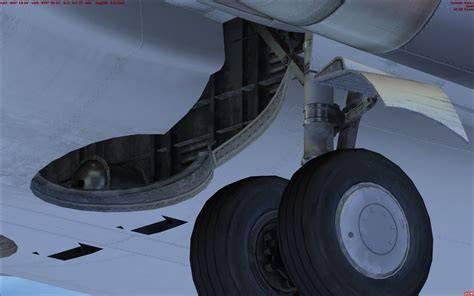
Saying that the Boeing 737 has “no landing gear doors” is technically an oversimplification. The aircraft does have doors associated with its landing gear, but they do not completely enclose the wheels in the way many people expect.
The gear struts and portions of the landing gear assembly are covered as the gear retracts. Boeing also uses rubber seals around the landing gear openings to reduce the aerodynamic disruption caused by the exposed areas.
The wheels themselves sit relatively flush with the underside of the aircraft. Large wheel hubs or covers further improve the aerodynamic shape around the gear. This means the 737 is not simply flying around with a large open hole beneath the fuselage.
The arrangement represents a compromise. Boeing did not attempt to achieve the absolute minimum possible drag. Instead, it created a system that provides a reasonable aerodynamic profile while avoiding the weight and mechanical complexity of fully enclosing the main wheels.
When the landing gear is extended for takeoff or landing, the aerodynamic penalty is naturally much larger. However, those portions of a flight are comparatively brief. During cruise, the gear is retracted and the 737’s streamlined wheel and gear-bay arrangement keeps the drag penalty manageable.
Why Boeing Kept the Design for the 737 Classic and Next Generation
The most interesting part of the story is that Boeing did not redesign the landing gear system when the 737 evolved into a much more capable aircraft.
The 737 Classic, introduced with the 737-300, 737-400, and 737-500, represented a major technological upgrade. The aircraft received new CFM56 engines, a modified wing, a revised cockpit, and other changes. Yet the basic landing gear philosophy remained.
The same was true for the 737 Next Generation, including the 737-600, 737-700, 737-800, and 737-900ER. Boeing introduced a new wing, updated engines, advanced avionics, and substantial aerodynamic improvements, but it did not completely reinvent the landing gear architecture.
That decision reflects an important principle in aircraft development: changing an existing airliner is very different from designing a new one.
A clean-sheet aircraft can be engineered around a completely new landing gear system from the beginning. An updated aircraft must work within the physical, structural, certification, and operational framework of its predecessor.
Adding complete landing gear doors to a later 737 would have required more than simply attaching panels to the underside. The aircraft’s landing gear bays, surrounding structures, mechanisms, systems, and certification requirements would all have been affected.
The 737 MAX Inherited the Same Philosophy

The Boeing 737 MAX is the latest major evolution of the family, and it retains the characteristic landing gear arrangement.
That may seem surprising because the MAX is dramatically more advanced than the original 737-100. It uses CFM LEAP engines, advanced winglets, modern avionics, updated flight controls, and substantially improved aerodynamics. It can also operate long routes that would have been far beyond the ambitions of the original 737.
Yet Boeing still retained much of the original aircraft’s architecture.
This is partly because the MAX was developed as an evolution of the 737 rather than an entirely new aircraft. Maintaining continuity allows Boeing and airlines to preserve many common features, including pilot training, maintenance procedures, airport compatibility, and operational infrastructure.
Completely redesigning the landing gear system would have undermined some of those advantages while increasing development cost and certification complexity.
In other words, the exposed main wheels are a legacy of the 737’s original architecture, but they have survived because that architecture remains useful.
Why the Airbus A320 Does Things Differently

The contrast with the Airbus A320 is particularly interesting. Both aircraft are narrowbody jets with similar six-wheel landing gear arrangements, but their philosophies are different.
The A320 was designed during the 1980s as a clean-sheet aircraft. Airbus had the opportunity to develop its landing gear system without being constrained by a 1960s architecture. The result included main landing gear doors that provide a smoother aerodynamic surface when the gear is retracted.
That does not mean Airbus made the objectively correct choice and Boeing made a mistake. The two aircraft reflect different design priorities and different technological eras.
The A320’s doors offer aerodynamic benefits, particularly as the aircraft operates many longer routes than the original 737 was expected to fly. Meanwhile, the 737’s simpler arrangement has the advantage of fewer components and a design that has accumulated decades of operational experience.
The important point is that aerodynamic efficiency is only one variable in aircraft design. Engineers must balance weight, reliability, maintenance, manufacturing cost, certification, performance, airport compatibility, and lifecycle economics.
The 737 Is Not the Only Aircraft With Exposed Gear
The 737’s exposed main wheels may look unusual among large modern airliners, but the concept is far from unique.
The Boeing 727 used a related approach, while numerous regional aircraft also leave parts of their main wheels exposed. The Embraer E-Jet family and Bombardier CRJ family are examples of aircraft where the landing gear design reflects similar priorities.

The Airbus A220 also demonstrates that exposed wheels are not necessarily an obsolete concept. Modern aircraft designers can still decide that the weight and complexity of full gear doors are not worthwhile for a particular aircraft.
The situation becomes different as aircraft grow larger. Widebody aircraft typically use complex multi-wheel bogies. These landing gear assemblies are considerably larger and require substantial structural space. Completely enclosing them becomes much more important from both aerodynamic and structural perspectives.
That is why aircraft such as the Boeing 777, Boeing 787, Airbus A330, and Airbus A350 use sophisticated landing gear-door systems.
Why the Design Has Survived for Nearly 60 Years
The remarkable thing about the Boeing 737 is not simply that it lacks full main landing gear doors. It is that an aircraft first flown in 1967 remains in production in an extensively modernized form today.
Very few commercial aircraft have experienced such a long evolutionary history. The 737 has been repeatedly re-engined, stretched, structurally modified, and equipped with increasingly sophisticated avionics. Yet Boeing has consistently preserved enough of the original architecture to maintain continuity.
That creates quirks. The aircraft’s low stance influenced engine design. Its fuselage heritage can be traced back to the Boeing 707 era. Its doors, landing gear arrangement, and other features reflect engineering decisions made decades ago.
But those quirks are not necessarily weaknesses. In aviation, an apparently old-fashioned feature can remain perfectly viable when it continues to meet the operational requirements of the aircraft.
The 737’s landing gear is an excellent example. The system does not need to be completely hidden to be effective. Boeing instead optimized it around reliability, weight, simplicity, and the realities of airline operations.
The Real Reason the Boeing 737 Has No Full Landing Gear Doors
Ultimately, the Boeing 737 does not have fully enclosed main landing gear because of one simple decision made during its original development: Boeing prioritized a lightweight, rugged, uncomplicated aircraft over the maximum possible aerodynamic efficiency.
The 737’s low ground clearance, relatively simple gear arrangement, exposed wheels, and partial door system all emerged from that philosophy. At the time, the aircraft was intended for short-haul operations and airports where simplicity mattered enormously.
As the 737 evolved, completely redesigning the landing gear would have brought substantial cost, engineering work, certification challenges, and little strategic benefit. Boeing instead refined the existing architecture and used seals, wheel covers, and partial doors to reduce the aerodynamic disadvantages.
That is why the exposed wheels have survived through the 737 Classic, 737 Next Generation, and 737 MAX eras.
The next time a 737 climbs away from an airport, its exposed main wheels may look like an unusual engineering compromise. In reality, they are a visible reminder of the aircraft’s original mission—and of how successfully Boeing has continued adapting a 1960s design without abandoning the fundamental architecture that made the 737 so successful.
For readers interested in the aircraft’s other unusual design choices, the 737’s low-mounted engines, distinctive engine nacelles, and unusually compact emergency exits offer equally fascinating examples of how one early design decision can influence an airliner for generations.