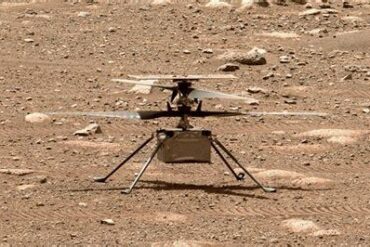
NASA’s Ingenuity helicopter changed the way scientists think about exploring Mars. What began as a technology demonstration designed for just five flights became an almost three-year mission that completed 72 flights and traveled nearly 11 miles across the Martian surface. Its final flight ended not because the helicopter ran out of power or suffered a catastrophic system failure, but because damaged rotor blades made further flying impossible.
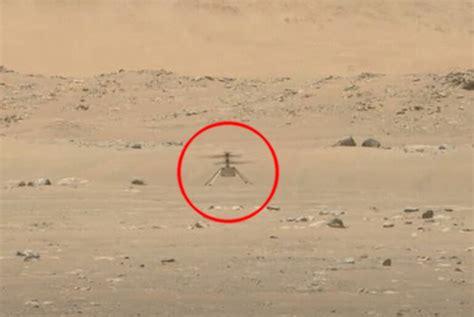
On April 19, 2021, Ingenuity made history by completing the first powered, controlled flight on another planet. The tiny helicopter rose from the surface of Mars near NASA’s Perseverance rover, demonstrating that controlled flight was possible despite Mars having an atmosphere only about 1% as dense as Earth’s. Engineers had expected the experiment to last only a few weeks, but Ingenuity repeatedly exceeded its original objectives.
When Did NASA’s Ingenuity Helicopter Stop Flying?
Ingenuity’s flying career effectively ended in January 2024, following its 72nd flight. During that flight, the helicopter experienced a problem that left its rotor blades damaged. NASA determined that the damage prevented Ingenuity from safely performing another airborne mission, bringing its extraordinary sequence of Martian flights to an end.
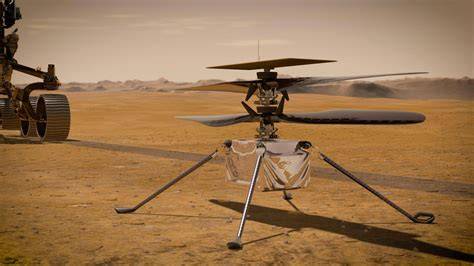
The helicopter had been designed as a lightweight demonstration vehicle, weighing about four pounds on Earth and roughly 1.5 pounds under Martian gravity. Its nearly four-foot rotor span and solar-powered lithium-ion battery system were specifically engineered for the demanding conditions of Mars. Every successful flight therefore provided valuable information about how aircraft behave in the planet’s extremely thin atmosphere.
Why Did Ingenuity Stop Flying on Mars?
The immediate reason was rotor-blade damage. Ingenuity depended on its rotor system to generate enough lift in Mars’ thin atmosphere, so damaged blades were not a minor cosmetic problem. Without a reliable rotor system, attempting another flight would have been unsafe and technically impractical.
Ingenuity’s retirement was particularly remarkable because NASA had originally planned only five experimental flights. Instead, it completed 72 flights and spent approximately 128 minutes airborne. Over nearly 1,000 Martian days, it traveled almost 11 miles—around 14 times farther than the distance originally expected.
What Happened to Ingenuity After Its Final Flight?
Although Ingenuity can no longer fly, its mission did not simply disappear. NASA sent a final software update instructing the helicopter to periodically activate its flight computers, examine its solar panel, batteries and electronics, record surface temperature information, and capture photographs.
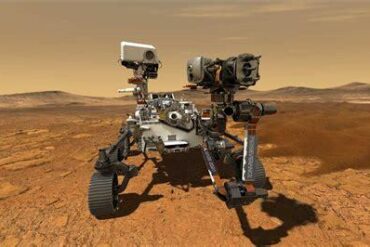
Communication with Ingenuity was routed through Perseverance, which eventually drove beyond the range required to maintain contact. Ingenuity therefore remains on Mars as a stationary piece of exploration hardware, while Perseverance continues searching for evidence of ancient environments and possible past life.
Ingenuity’s greatest achievement ultimately extends beyond its 72 flights. It demonstrated that aerial exploration on Mars is possible, giving NASA engineers practical experience that could influence future robotic missions. The little helicopter was supposed to prove that one flight could work. Instead, it delivered nearly three years of discoveries before its damaged rotors brought its airborne mission to an end.