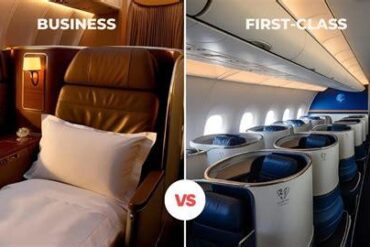
Business class has changed dramatically over the past decade. What was once a compromise between economy and first class has become a premium cabin capable of delivering private suites, restaurant-quality dining, direct aisle access, and, most importantly for long-haul travelers, a genuinely comfortable bed. As airlines continue to simplify their premium cabins, business class is increasingly becoming the top-tier experience available on many international routes.
That shift has also changed what passengers expect from an overnight flight. A seat that merely reclines is no longer enough. Travelers increasingly look for a spacious sleeping surface, quality bedding, privacy, sensible footwell design, and enough room to move without waking up feeling as though they have spent eight hours inside a very expensive drawer.
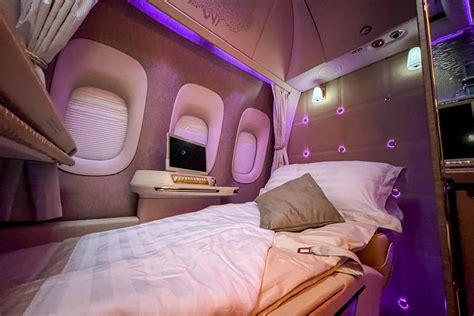
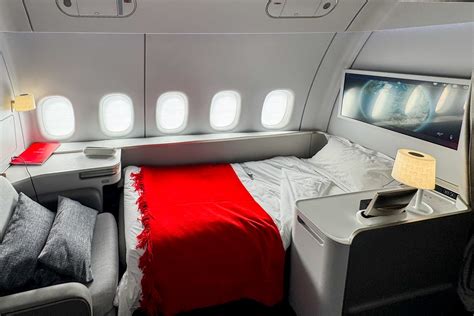
First class still has an advantage in this area on certain airlines. Carriers that retain first class generally justify the cabin through exclusivity rather than simply offering a slightly better seat. Air France’s La Première, for example, uses an exceptionally private suite and highly personalized service, while Emirates famously adds shower facilities to its Airbus A380 first-class experience. Yet the gap is narrowing because several airlines have invested heavily in business-class sleep.
The best examples demonstrate that a business-class passenger does not necessarily need to sit in the most expensive cabin to sleep at a first-class level. Some airlines have concentrated on the physical seat, while others have recognized that bedding can be just as important. A brilliant seat with a narrow footwell can become uncomfortable after several hours, whereas a thoughtfully designed mattress, pillow, duvet, and sleeping surface can transform an otherwise conventional business-class product.
Among the airlines leading this evolution are All Nippon Airways, Lufthansa, Riyadh Air, Qatar Airways, and United Airlines. Their approaches are different, but each demonstrates how business class can deliver an unusually refined overnight experience.
All Nippon Airways: The Room Goes Big on Space
All Nippon Airways, better known as ANA, has one of the most distinctive business-class seats in the world with The Room. Introduced in 2019, the product immediately stood apart because of its enormous width and unusual suite architecture. Rather than simply providing a wider version of a conventional staggered business-class seat, ANA created an environment that feels closer to a private room.
The Room is based on the Safran Fusio platform and uses the entire width of its individual suite. The alternating forward- and rear-facing arrangement allows ANA to create unusually broad spaces while maintaining direct aisle access. For passengers who value personal space, this remains one of the strongest arguments for choosing ANA business class.
The sleeping environment benefits from the same philosophy. The seat itself is remarkably wide, while the footwell is considerably more generous than what we find on many older direct-aisle-access business-class products. That matters because footwell dimensions can have a surprisingly large influence on how naturally we can sleep.
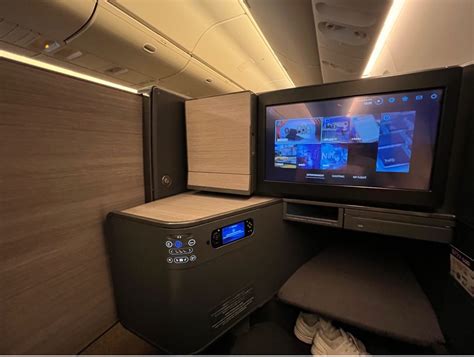
There is, however, one important limitation. The original The Room provides a bed length of approximately 72 inches, or 182.9 centimeters. That is perfectly workable for many travelers, but taller passengers may find it restrictive. The seat’s enormous width can therefore create an unusual trade-off: we gain space sideways but may lose some freedom lengthwise.
ANA’s bedding is comprehensive, featuring two pillows, a mattress pad, and a duvet, but it is not necessarily the strongest part of the product. The Room’s real advantage comes from its physical dimensions and sense of openness.
That changed with The Room FX, unveiled for ANA’s Boeing 787-9. The updated design introduces new technology and a sofa-like configuration, but the most important sleeping improvement is its longer bed. With a maximum length of approximately 76.5 inches, The Room FX is much more competitive for taller travelers.
For passengers choosing between ANA’s business-class products, aircraft selection therefore matters enormously. The original The Room remains spectacular when width and privacy are the priority, while The Room FX addresses one of its biggest weaknesses by creating a more accommodating sleeping surface.
Lufthansa: The Extra Long Bed Is the Star
Lufthansa has taken a different approach with its Allegris business class. Instead of offering one identical seat throughout the cabin, the German carrier created several seat types designed around different passenger priorities. This gives travelers more choice, but it also means that knowing the exact seat configuration can make a significant difference to an overnight journey.
The most interesting option for sleep is appropriately called the Extra Long Bed. Its bed measures approximately 86 inches, or 218.4 centimeters, making it one of the longest business-class sleeping surfaces available from any major airline.
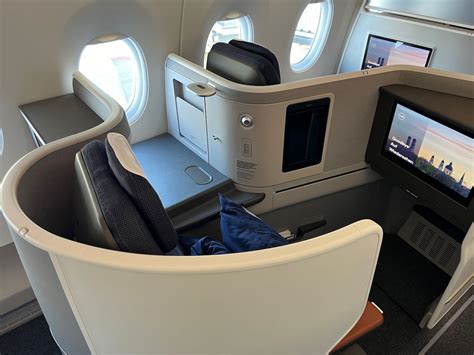
The secret is largely in the center section of the cabin. Some Allegris configurations alternate between pairs of seats and individual seats. Because an Extra Long Bed seat can use space that would otherwise be required for an entrance or neighboring footwell arrangement, Lufthansa can extend the sleeping surface substantially.
For tall travelers, this is an enormous advantage. A business-class seat can have excellent padding and privacy, but if our feet constantly touch the end of the footwell, the benefits become less meaningful. The 86-inch bed gives Lufthansa a compelling answer to that problem.
The airline does charge extra for seat selection on many Allegris options, and the Extra Long Bed is not simply a standard seat that every passenger receives automatically. This makes advance planning particularly important. We should check the aircraft and seat map before booking if sleeping comfort is a major priority.
Allegris is being introduced across several aircraft types, including the Airbus A350, Boeing 747-8, Boeing 787, and future Boeing 777-9. However, configurations are not identical across the fleet. Lufthansa’s 747-8, for example, does not appear to provide the same Extra Long Bed arrangement because its center seats use a different configuration.
The lesson is simple: Lufthansa business class can be exceptional for sleep, but the seat number matters almost as much as the airline name.
Riyadh Air: A New Airline Built Around Premium Sleep
Riyadh Air is approaching premium travel without the baggage of an established fleet and decades-old cabin designs. As Saudi Arabia’s new flagship airline, it is being positioned against premium Gulf competitors such as Emirates, Etihad Airways, and Qatar Airways. That creates enormous pressure to make its business class visually impressive as well as genuinely comfortable.
The airline selected the Safran Unity for its business-class cabin, a modern suite concept that combines direct aisle access with a more substantial personal space than many older staggered seats.
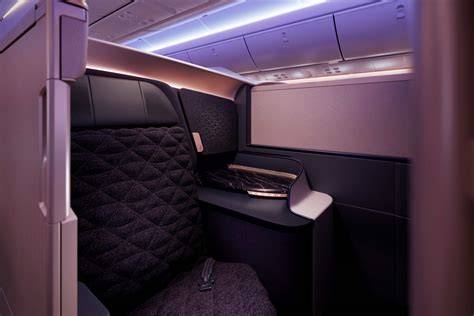
The seat itself is an important part of the sleeping equation. Its footwell is designed to be more accommodating, while the suite walls and doors provide a stronger sense of privacy. This matters overnight because a passenger’s ability to create a visually quiet environment can influence how easily they settle into sleep.
Yet Riyadh Air earns its place among these airlines because it has paid attention to the bedding, too. The business-class experience includes two pillows, a high-quality duvet, and a substantial mattress pad. Instead of treating bedding as an afterthought, the airline has made it part of the overall premium proposition.
That combination is particularly promising. The Safran Unity seat already represents a modern approach to business-class space, but pairing it with substantial bedding makes the experience more complete. Passengers receive both the physical environment and the soft products needed for a proper overnight rest.
Riyadh Air is therefore an interesting example of where business class may be heading. Rather than trying to recreate traditional first class through excessive service, the airline is emphasizing privacy, technology, materials, space, and sleep quality in one integrated product.
Qatar Airways: Qsuite Still Sets a High Bar
Qatar Airways has spent years establishing itself as one of the world’s leading premium airlines, and its Qsuite remains central to that reputation. Remarkably, the product is now approaching a decade old, yet it continues to compete with significantly newer designs.
The reason is that Qsuite solved several business-class problems at once. It provides direct aisle access, substantial privacy, a large personal space, and innovative configurations that can transform the center section into a shared environment.
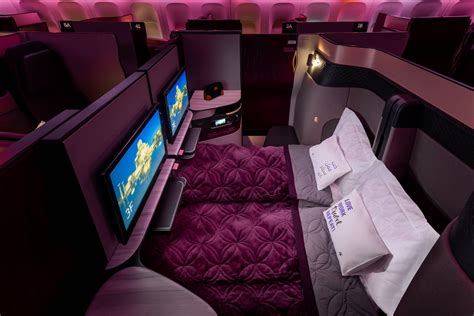
Its most famous innovation is the business-class double bed available in selected center suites. When the appropriate seats are combined, passengers can create a larger shared sleeping environment that was once associated almost exclusively with first class.
Qatar Airways also pays considerable attention to bedding. The airline provides a pillow, mattress pad, and duvet combination, but the quality and presentation of those items distinguish the product. The bedding feels more deliberately designed as part of the premium experience rather than simply being equipment handed to passengers before takeoff.
The challenge is consistency. Qatar Airways operates a large and diverse fleet, and Qsuite is not available on every aircraft. Its fleet contains multiple business-class seat products, including Qsuite, Collins Aerospace Super Diamond, Apex Suites, and other configurations. Consequently, the words “Qatar Airways business class” do not automatically tell us what kind of seat we will receive.
This makes aircraft selection critical. On a Qsuite-equipped aircraft, the sleeping experience can be extraordinary, especially for passengers traveling together who can use the center suites. On another aircraft, the experience can still be very comfortable, but it may not provide the same level of privacy or sleeping flexibility.
United Airlines: Bedding Makes Polaris Special
United Airlines proves that a spectacular business-class sleep experience does not always require the newest or most visually dramatic seat. United Polaris is the oldest product on this list, having been introduced in 2016, yet it remains highly competitive because United placed unusual emphasis on bedding.
The airline partnered with Saks Fifth Avenue to create the Polaris bedding collection, and the result is one of the most extensive bedding packages found in business class. Passengers can receive a plush pillow, cooling gel pillow, duvet, day blanket, and substantial mattress pad.
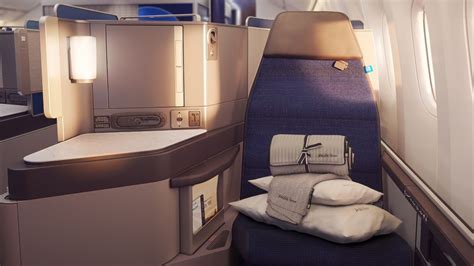
This approach highlights an important truth about premium aviation: sleep quality is not determined by the seat alone. A technically impressive suite can still produce a mediocre night if the mattress is thin, the bedding is poor, or the sleeping surface is uncomfortable. United’s strategy is to address the entire sleeping environment.
The Polaris seat itself is based largely on the Safran Optima platform. It does not have the dramatic privacy doors found on newer suites, and its design prioritizes efficient use of cabin space. Nevertheless, it offers a long sleeping surface and a relatively spacious footwell.
United is also introducing an updated Polaris seat on newer Boeing 787 aircraft. These newer suites feature doors for greater privacy, while the front-row Polaris Studio provides additional space and an ottoman-style arrangement rather than a conventional footwell.
The combination gives United a useful advantage. Even though its original Polaris seat is older, the airline has continued developing the product rather than abandoning it. For passengers who care primarily about getting a good night’s sleep, the extensive bedding package can be more valuable than a flashy suite door.
What Makes Business Class Sleep Feel Like First Class?
The five airlines demonstrate that there is no single formula for creating a first-class-level sleeping experience. ANA emphasizes width and personal space. Lufthansa focuses on bed length. Riyadh Air combines modern suite architecture with substantial bedding. Qatar Airways integrates privacy and an innovative double-bed concept. United concentrates heavily on the quality and quantity of its bedding.
The most important factor is often the relationship between the seat and the sleeping surface. A long bed is of limited value if the footwell is restrictive, while a huge suite loses some of its appeal if the mattress and duvet are inadequate.
Privacy also matters. Doors, high suite walls, and thoughtful cabin layouts can reduce visual distractions and make it easier to transition from an active flight environment to sleep. This is one reason newer business-class suites increasingly resemble miniature private rooms rather than traditional airline seats.
Aircraft selection is equally important. Airlines can operate several business-class products simultaneously, meaning the carrier’s name alone does not guarantee a particular experience. We should always check the exact aircraft, seat map, and product before assuming that a premium cabin will include the advertised flagship seat.
Which Airline Offers the Best Business-Class Sleep?
For maximum sleeping space, Lufthansa’s Extra Long Bed is difficult to overlook because its 86-inch sleeping surface is exceptionally generous. For passengers who prioritize width and a feeling of personal space, ANA’s The Room remains compelling, particularly with the newer Room FX addressing the original product’s shorter bed.
Riyadh Air is perhaps the most intriguing newcomer because it combines a modern suite with thoughtfully selected bedding. Qatar Airways remains one of the most complete options when Qsuite is available, especially for couples who can use the double-bed configuration. United, meanwhile, demonstrates that excellent bedding can compensate for an older seat design and remain one of the most important ingredients in premium sleep.
Ultimately, first-class-level sleep is no longer restricted to first class. The best modern business-class cabins have transformed the overnight flight into something much closer to a proper bedroom experience. The difference is that passengers now have to choose carefully. The right aircraft, the right seat, and the right bedding can turn eight hours in the sky into something surprisingly close to a good night’s sleep on the ground.