The scale of modern military aviation is often underestimated. While commercial giants like the Airbus A380 dominate civilian skies, the United States military operates aircraft that rival—and in some cases exceed—the size, weight, and raw presence of typical passenger jets. These machines are not designed for comfort or efficiency; they are engineered for global reach, overwhelming payload capacity, and strategic dominance.
To put things into perspective, the widely used Boeing 737 MAX 8 measures just under 130 feet in length. The aircraft featured here push far beyond that, redefining what “large” truly means in aviation. From Cold War bombers still flying today to next-generation presidential aircraft, these platforms showcase the sheer ambition of American aerospace engineering.
Boeing B-52H Stratofortress: The Enduring Giant Bomber
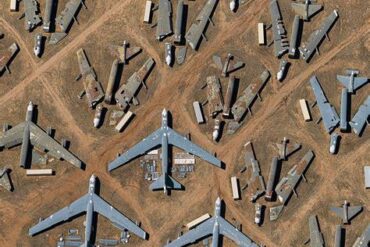
The Boeing B-52H Stratofortress is more than just a large aircraft—it is a living relic of the Cold War that refuses to retire. Measuring approximately 159 feet in length, this eight-engine bomber remains one of the most recognizable symbols of American airpower.
Originally introduced in the early 1950s, the B-52 has outlived multiple generations of aircraft. Its continued relevance lies not in stealth or agility, but in its payload capacity and adaptability. The aircraft is capable of carrying a wide array of munitions, from conventional bombs to nuclear weapons and even modern hypersonic missiles.
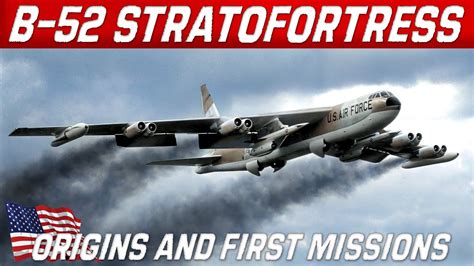
What makes the B-52 truly remarkable is its planned longevity. The U.S. Air Force intends to keep it operational into the 2050s, potentially giving it nearly a century of service life. This is made possible through continuous upgrades, including new Rolls-Royce F130 engines that dramatically improve efficiency and reliability.
Despite being lighter than some newer bombers, the B-52 compensates with its massive wingspan and eight-engine configuration, allowing it to operate as a “missile truck” in modern warfare. It no longer needs to penetrate enemy defenses directly—instead, it launches stand-off weapons from a safe distance, maintaining its strategic relevance in an era of advanced air defenses.
Boeing C-17 Globemaster III: The Backbone of Global Logistics
If the B-52 represents endurance, the Boeing C-17 Globemaster III represents global mobility at scale. At 174 feet long, the C-17 is significantly larger than most commercial jets and plays a critical role in transporting troops, vehicles, and humanitarian aid across continents.
Unlike older transport aircraft, the C-17 was designed with flexibility in mind. It can operate from short, austere runways, making it indispensable for rapid deployment in remote or hostile environments. This capability allows the U.S. military to project power—or deliver relief—virtually anywhere on Earth.
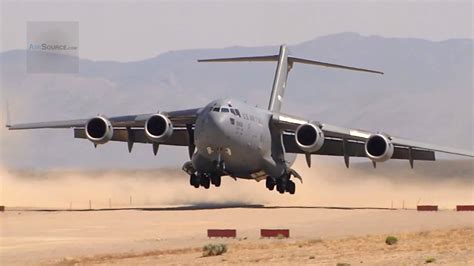
The aircraft’s payload capacity is immense. It can carry tanks, helicopters, and heavy equipment that would be impossible to transport using standard commercial aircraft. With a maximum takeoff weight of around 585,000 pounds, the C-17 bridges the gap between strategic airlift and tactical flexibility.
Its reliability is equally impressive. Modern engineering and operational practices have made catastrophic failures extremely rare, a stark contrast to earlier generations of military transports. Today, the C-17 stands as a global workhorse, forming the backbone of U.S. and allied airlift operations.
Boeing 747-200 (VC-25A & E-4B): Military Power Meets Civilian Design
Few aircraft blur the line between civilian luxury and military necessity quite like the Boeing 747-200. While most 747-200s have been retired, a handful remain in U.S. military service in highly specialized roles.
The most famous variant is the VC-25A, better known as Air Force One when carrying the President of the United States. Another variant, the E-4B “Nightwatch,” serves as a flying command center, designed to operate during nuclear conflict or national emergencies.
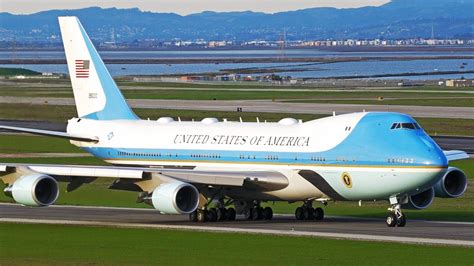
At over 231 feet long, the 747-200 dwarfs typical commercial jets and offers unparalleled internal volume. This space is transformed into secure communications suites, command facilities, and executive accommodations—turning the aircraft into a mobile headquarters capable of running the country.
Despite their age, these aircraft remain operational due to extensive upgrades and maintenance. However, their time is limited. Rising operational costs and aging systems have driven the need for replacement, paving the way for newer platforms.
Still, the legacy of the 747-200 in military service is undeniable. It represents a unique fusion of civilian engineering and strategic military adaptation, proving that sometimes the best solution is to build upon what already works.
Lockheed C-5M Super Galaxy: America’s Largest Military Airlifter
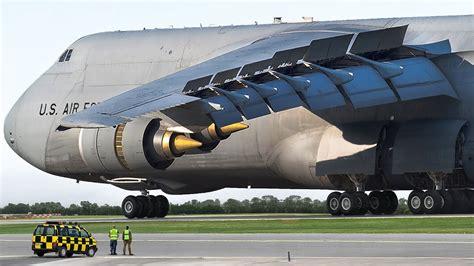
When it comes to sheer size and capability, few aircraft can rival the Lockheed C-5M Super Galaxy. Stretching over 247 feet in length, it is the largest aircraft in the U.S. Air Force inventory.
Designed during the Cold War, the C-5 was revolutionary for its time. It introduced high-bypass turbofan engines and a cavernous cargo hold capable of carrying outsized loads. The modernized C-5M variant builds on this legacy with upgraded engines, avionics, and reliability improvements.
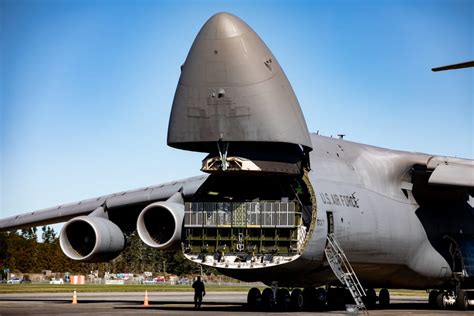
The aircraft’s defining feature is its enormous cargo capacity. It can transport entire helicopters, armored vehicles, and even multiple smaller aircraft in a single mission. Its nose and tail both open, allowing for efficient loading and unloading—a critical advantage in time-sensitive operations.
With a maximum takeoff weight of approximately 840,000 pounds, the C-5M operates at a scale that few aircraft can match. While it is not as frequently deployed as the C-17, its role is indispensable for heavy, strategic airlift missions that require moving massive equipment across the globe.
Despite its size, the C-5M is not the largest aircraft in the world. That title belongs to aircraft like the Antonov An-124 Ruslan, but within the U.S. military, the Super Galaxy reigns supreme—at least for now.
Boeing 747-8: The Future Giant of the US Air Force
The next evolution in military aviation size comes in the form of the Boeing 747-8. Measuring an astonishing 250 feet in length, this aircraft is set to become the largest in U.S. Air Force service.
Developed as an advanced version of the iconic 747, the 747-8 features a longer fuselage, extended wingspan, and more efficient engines. Its General Electric GEnx engines provide greater thrust while reducing fuel consumption, making it both more powerful and more economical than its predecessors.

The U.S. Air Force is acquiring these aircraft primarily to replace the aging VC-25A fleet. Once operational, they will serve as the next-generation Air Force One, offering enhanced communications, सुरक्षा systems, and operational capabilities.
Beyond presidential transport, additional 747-8 aircraft are being used for training and spare parts, ensuring long-term sustainability of the fleet. This transition marks a significant leap forward, not just in size but in technological sophistication and mission readiness.
With a maximum takeoff weight approaching 987,000 pounds, the 747-8 edges closer to the upper limits of what is possible in conventional aircraft design. It stands as a testament to decades of innovation and refinement in widebody aviation.
Why Military Aircraft Can Be Larger Than Commercial Jets
The reason these aircraft surpass typical commercial jets lies in their fundamentally different design priorities. Commercial aviation focuses on efficiency, passenger comfort, and cost-effectiveness. Military aviation, on the other hand, prioritizes:
- Payload capacity over passenger volume
- Range and endurance over fuel economy
- Mission adaptability over standardized design
This allows military aircraft to grow far larger than most commercial airliners, especially narrowbody jets like the Boeing 737 or Airbus A320. Even when compared to widebody aircraft, military platforms often feature reinforced structures, specialized systems, and expanded internal space that push their dimensions beyond civilian norms.
The Strategic Importance of Size in Military Aviation
Size in military aviation is not about prestige—it is about capability. Larger aircraft can carry more fuel, more cargo, and more advanced systems, enabling operations that smaller aircraft simply cannot perform.
For example, strategic bombers like the B-52 rely on size to carry vast payloads over intercontinental distances. Transport aircraft like the C-5M and C-17 use their volume to move entire units and equipment in a single sortie. Meanwhile, specialized platforms like the E-4B leverage their size to function as airborne command centers.
In essence, these aircraft act as force multipliers, amplifying the reach and effectiveness of military operations on a global scale.
Conclusion: Giants That Define Airpower
From the aging yet unstoppable B-52 to the cutting-edge 747-8, these aircraft represent the pinnacle of size, power, and strategic utility in military aviation. They are not merely larger than commercial jets—they are built for entirely different purposes, where scale directly translates into operational advantage.
As technology continues to evolve, future aircraft may push these boundaries even further. But for now, these five giants stand as undisputed titans of the sky, embodying the unmatched capability and ambition of the United States military.