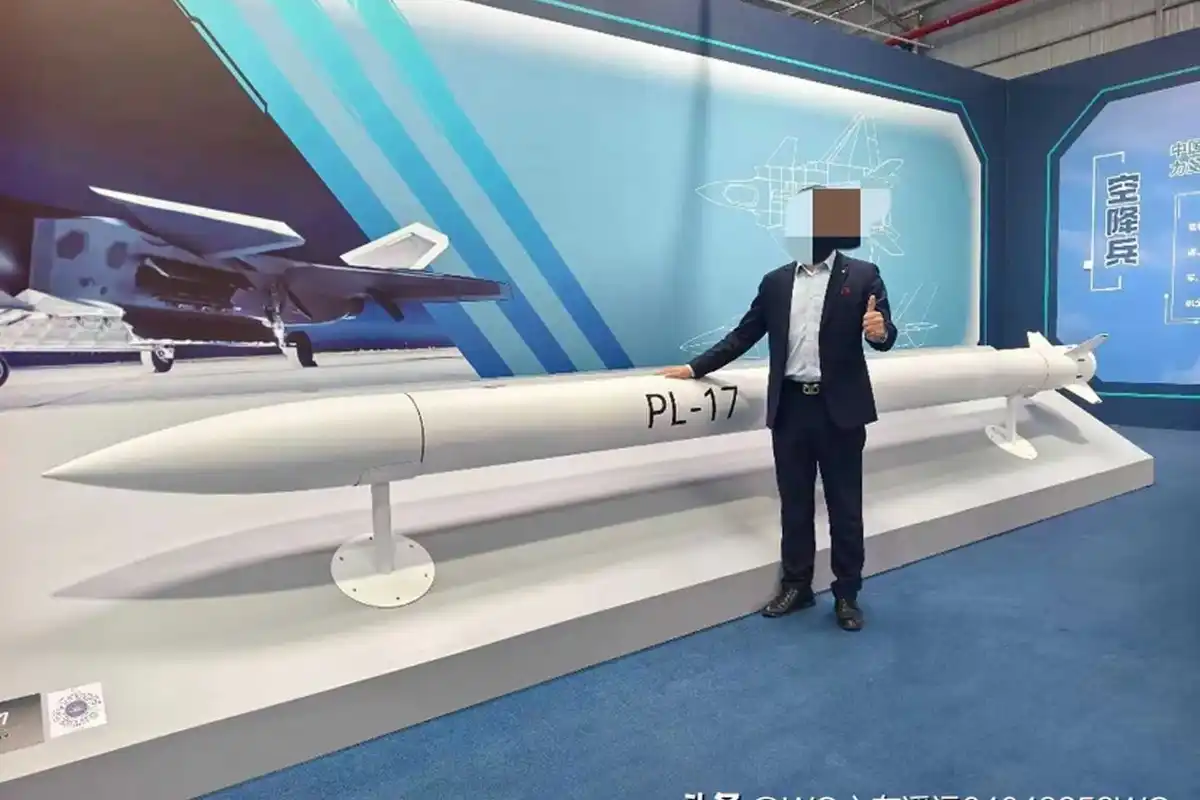
China’s long-rumored PL-17 long-range air-to-air missile has finally emerged from visual obscurity. A newly circulated close-up image, appearing publicly on January 27, 2026, offers the most detailed look yet at one of the People’s Liberation Army Air Force’s most consequential aerial weapons. For years, the PL-17 had existed largely as a silhouette—seen slung beneath fighter wings in distant photographs, its true configuration left to inference and educated guesswork. This single image changes that dynamic, transforming speculation into tangible assessment.
The photograph, first highlighted by defense analyst Rupprecht Deino, does not reveal where or under what circumstances the missile or its apparent full-scale mock-up was displayed. What it does reveal is far more important for military observers: proportions, surface features, and design cues that confirm the PL-17’s status as a purpose-built ultra-long-range interceptor rather than a scaled-up derivative of existing missiles. The image effectively validates years of analytical estimates and reinforces the missile’s role in reshaping regional airpower balances.
The PL-17 has reportedly been operational since at least 2023, with some Chinese sources indicating even earlier limited deployment. Range estimates consistently exceed 400 kilometers, placing it in a rare category of air-to-air weapons designed to strike far beyond the visual horizon and deep into an adversary’s support ecosystem. Until now, that capability was inferred from its size and employment patterns. The close-up view turns inference into confirmation.
The missile’s development history stretches back roughly a decade. In 2016, observers noted an unusually large missile carried by a Shenyang J-16, sparking widespread discussion under the informal label “PL-XX.” The absence of official confirmation fueled alternative designations, including PL-20, before PL-17 emerged as the accepted name, later accompanied by the NATO reporting name CH-AA-12 Auger. By October 2022, Chinese state media suggested the missile had entered service, a claim reinforced in 2023 by imagery of operational J-16 units carrying the weapon. Even so, close-range visuals remained conspicuously absent—until now.
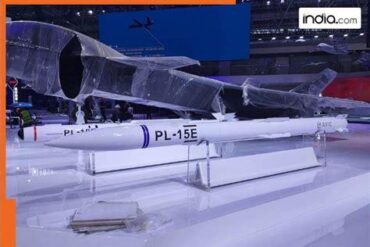
Physically, the PL-17’s dimensions are its most striking feature. Analysts estimate a length of roughly 5.7 to 6 meters, making it significantly longer than the PL-15 or the U.S. AIM-120 AMRAAM, both of which hover around four meters. This added length is not cosmetic. It allows for a substantially larger solid-fuel rocket motor, which in turn enables sustained high-speed flight and exceptional reach. The missile’s bulk signals a design philosophy centered on energy management and range dominance, rather than close-in maneuverability.
Design Characteristics That Signal Strategic Intent
The newly revealed details underscore how deliberately the PL-17 has been engineered for a specific operational niche. Its elongated fuselage, relatively modest control surfaces, and clean aerodynamic lines all suggest optimization for high-altitude, high-speed flight. Rather than relying on large fins for extreme agility, the missile appears designed to preserve energy over hundreds of kilometers, arriving in the terminal phase with sufficient speed to challenge even well-defended targets.
Reports consistently attribute the PL-17’s propulsion to a dual-pulse solid rocket motor, enabling sustained thrust during different phases of flight. Combined with a lofted trajectory—where the missile climbs to thinner air before descending on its target—this propulsion scheme maximizes range and minimizes energy loss. Speeds are believed to exceed Mach 4, a critical factor when engaging time-sensitive, high-value aircraft that may attempt to retreat once alerted.
Guidance and Seeker Architecture for Extreme-Range Combat
At ranges measured in hundreds of kilometers, guidance becomes as important as raw speed. The PL-17 is widely assessed to employ inertial navigation supported by satellite updates during midcourse flight, supplemented by a two-way datalink. This architecture allows the missile to receive updated targeting information long after launch, compensating for target maneuvering and extending effective engagement envelopes far beyond what a fighter’s onboard radar alone could support.
In the terminal phase, the missile is believed to activate a multimodal seeker, likely combining active radar homing with passive sensing elements. Such a configuration would allow it to lock onto large radar signatures or home in on emissions from targets such as airborne early warning aircraft. This dual approach increases resistance to electronic countermeasures and complicates defensive planning, especially for aircraft that rely heavily on active sensors to perform their missions.
The control philosophy implied by the missile’s design favors stability and predictability over extreme agility. Thrust vectoring and modest aerodynamic surfaces provide sufficient maneuver authority for terminal corrections, while avoiding the drag penalties associated with large fins. The result is a missile that trades dogfight agility for interception certainty at extreme distance.
Aircraft Integration and Platform Limitations
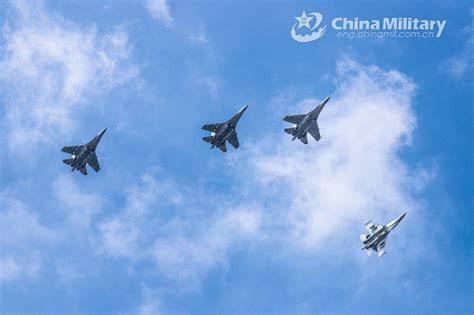
The PL-17’s sheer size imposes clear constraints on which aircraft can carry it. Stealth fighters optimized around internal weapon bays, such as the J-35, lack the internal volume to accommodate a missile of this length. External carriage is therefore mandatory, immediately increasing radar cross-section and aerodynamic drag. As a result, the PL-17 has been consistently observed on J-16 and J-10C fighters, platforms with the payload capacity and hardpoint flexibility to employ such a weapon without compromising mission viability.
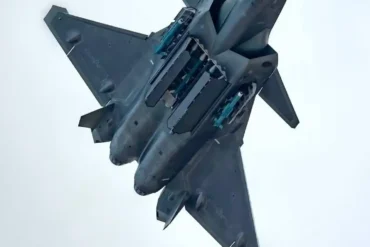
Compatibility is also believed to extend to heavier aircraft in China’s inventory, including the Su-30MKK and Su-35. Speculation persists regarding carriage on the J-20, but no confirmed imagery has yet shown this configuration. Looking ahead, attention is increasingly focused on the rumored J-36, expected to feature an expanded internal weapons bay capable of housing next-generation long-range missiles. If realized, this pairing would combine stealth with extreme reach, significantly complicating adversary air defense planning.
Operational Role and Targeting Philosophy
Despite its ability to engage fighter-sized targets, the PL-17’s true purpose lies elsewhere. Its range and guidance architecture strongly indicate a mission focus on high-value airborne assets operating well behind the front line. Likely targets include airborne early warning and control aircraft, aerial refueling tankers, and other command-and-control platforms that underpin modern air operations.
Engaging such targets at maximum range would rely heavily on offboard sensor fusion. Data from airborne early warning aircraft, other fighters, ground-based radars, and potentially space-based sensors would be fused to provide accurate targeting updates. The launching aircraft may never need to illuminate the target with its own radar, reducing exposure and enabling coordinated, network-centric strikes. In this role, the PL-17 mirrors the conceptual employment of Russia’s R-37M, while exceeding most Western air-to-air missiles in estimated reach.
Strategic Implications of the Close-Up Revelation
The appearance of a close-up image does not signal a new capability entering service; the PL-17 has already been operational for several years. What it does signal is a shift in transparency—intentional or otherwise—around one of China’s most strategically significant air-to-air weapons. By allowing a clearer view of the missile’s configuration, China effectively confirms its commitment to long-range air dominance and counter-support operations.
For regional air forces, the implications are stark. Aircraft once considered safely distant from the threat envelope may now fall within reach, forcing changes in basing, escort tactics, and defensive countermeasures. The PL-17 is not merely a missile; it is a statement about how future air battles may be shaped—less by close-range maneuver and more by who can see, target, and strike first across vast distances.
As more imagery and data inevitably emerge, the PL-17 will continue to draw scrutiny. For now, this single close-up image has done what years of speculation could not: it has brought one of the world’s most elusive air-to-air missiles sharply into focus.