Above the clouds, where commercial airliners quietly cross oceans and continents, aviation enters one of its most demanding environments. Passengers often associate high-altitude cruising with smooth skies and maximum efficiency, but for pilots, the airspace above 40,000 feet represents a region where performance margins become increasingly narrow. Here, aerodynamics, weather, aircraft systems, and human physiology converge in ways that leave little room for error. Among aviation professionals, few concepts illustrate this reality better than coffin corner, a phenomenon that highlights just how carefully modern aircraft must be operated at extreme altitudes.
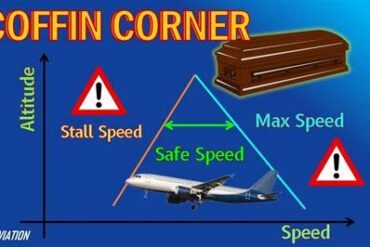
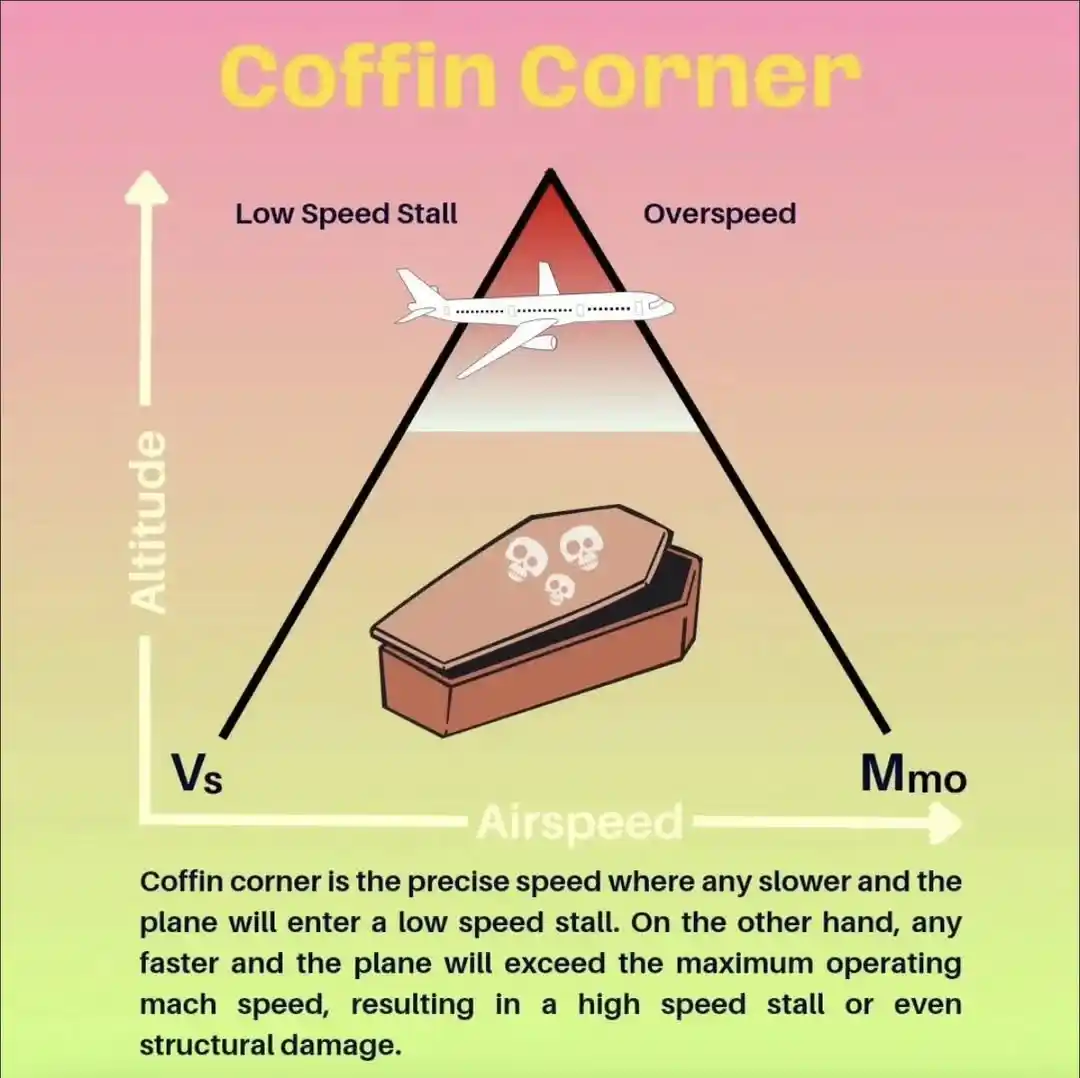
Far from being an aviation myth, coffin corner is a genuine aerodynamic limitation encountered near an aircraft’s operational ceiling. The term describes the point where the aircraft’s low-speed stall boundary and high-speed Mach boundary move dangerously close together. As altitude increases, the difference between flying too slowly and flying too fast shrinks dramatically. In some aircraft, that margin can become astonishingly small, turning routine flight management into an exercise in precision.
Understanding coffin corner reveals why pilots monitor speed so carefully at cruising altitude and why advanced aircraft systems, extensive training, and rigorous operational procedures are essential for safe flight above 40,000 feet.
The Thin-Air Challenge of High-Altitude Flight
Modern jet aircraft are designed to operate efficiently in the upper atmosphere. At cruising altitudes between 35,000 and 43,000 feet, thinner air reduces drag, allowing aircraft to travel faster while consuming less fuel. Airlines benefit from lower operating costs, longer range, and improved efficiency.
However, the same conditions that make high-altitude flight attractive also create significant aerodynamic challenges. Air density decreases rapidly as altitude increases. Because lift depends heavily on air density, aircraft must compensate by flying faster through the thinner atmosphere. The wings must continue generating enough lift to support the aircraft’s weight despite encountering far fewer air molecules.
At the same time, another limitation emerges. As aircraft accelerate at high altitude, portions of the airflow over the wing can approach the speed of sound even before the aircraft itself reaches Mach 1. This creates compressibility effects that can disrupt airflow and reduce aerodynamic stability.
The result is a narrowing operational envelope where both low-speed and high-speed aerodynamic limits begin moving toward one another.
What Exactly Is Coffin Corner?
Coffin corner, sometimes referred to as Q Corner, describes the altitude at which an aircraft’s stall speed nearly intersects with its critical Mach number limit. It represents one of the most restrictive flight regimes encountered in aviation.
At lower altitudes, the gap between these two boundaries is substantial. Pilots have considerable flexibility to adjust speed without approaching either danger zone. Climb higher, however, and the situation changes dramatically.
The stall boundary rises because the aircraft requires a greater angle of attack to generate sufficient lift in thinner air. Meanwhile, the Mach boundary effectively descends because colder temperatures reduce the speed of sound, bringing compressibility effects closer to normal operating speeds.
Eventually, these boundaries begin converging.
Fly too slowly and the wing risks entering an aerodynamic stall. Fly too quickly and shock waves begin forming across portions of the wing, creating Mach buffet and potentially severe handling issues.
When these two limits nearly meet, the aircraft is operating in coffin corner.
The phenomenon is not merely theoretical. Certain specialized high-altitude aircraft have experienced operating margins measured in only a few knots. Even though commercial airliners maintain larger margins, the underlying aerodynamic principles remain identical.
Why Air Density Changes Everything
To appreciate coffin corner, it is essential to understand how dramatically the atmosphere changes with altitude.
At sea level, dense air provides abundant lift. Control surfaces respond effectively, engines operate efficiently, and aircraft possess generous performance margins.
By 40,000 feet, atmospheric density has fallen to a fraction of sea-level conditions. Every aerodynamic surface becomes less effective because fewer air molecules are available to generate force.
This reduced density affects nearly every aspect of flight. Wings must operate at higher angles of attack to maintain lift. Control surfaces produce less authority. Engine performance declines. Recovery from unusual flight conditions becomes more challenging.
Pilots therefore operate within a much tighter performance envelope than many passengers realize.
Even small speed variations that would be insignificant at lower altitudes can become important near an aircraft’s ceiling. A deviation of only a few knots may significantly alter the margin available before reaching either stall buffet or Mach buffet.
The Invisible Threat of Mach Buffet
When discussing aerodynamic hazards, stalls often receive the most attention. Yet at extreme altitude, the opposite end of the speed spectrum can be equally concerning.
As aircraft accelerate toward their critical Mach number, localized airflow over portions of the wing can exceed the speed of sound. This creates shock waves that disturb the smooth airflow required for efficient lift generation.
The resulting phenomenon, known as Mach buffet, can produce vibrations, reduced control effectiveness, and changes in aircraft handling characteristics.
Unlike a conventional stall, which occurs because airflow separates at low speed and high angle of attack, Mach buffet develops because airflow behaves differently as compressibility effects increase.
Pilots operating near coffin corner must therefore monitor both ends of the performance envelope simultaneously. Avoiding a stall by accelerating excessively can simply exchange one aerodynamic hazard for another.
This balancing act becomes particularly important during long-haul operations at very high cruise levels.
Aircraft Weight Plays a Critical Role
One of the most important factors influencing coffin corner is aircraft weight.
A heavier aircraft requires more lift to remain airborne. Generating that additional lift demands a higher angle of attack, which increases stall speed.
As a result, heavier aircraft encounter coffin corner limitations at lower altitudes than lighter aircraft.
This reality explains why airlines frequently use step climbs during long-distance flights. Rather than immediately climbing to their highest planned cruising altitude after departure, aircraft gradually ascend throughout the flight as fuel burn reduces weight.
The strategy improves fuel efficiency while preserving safe aerodynamic margins.
Flight management systems continuously evaluate weight, atmospheric conditions, and aircraft performance to determine the optimum cruising altitude. These calculations help ensure the aircraft remains comfortably within certified operating limits.

Why Ordinary Turns Become More Demanding
One of the least understood aspects of extreme-altitude flight is how even routine maneuvers can become more challenging.
At lower altitudes, a modest turn creates little concern. The aircraft possesses sufficient aerodynamic margin to absorb the increased load factor without difficulty.
Near coffin corner, the situation changes considerably.
Every turn requires additional lift because part of the wing’s lift vector is redirected sideways. To generate this extra lift, the aircraft must increase its angle of attack.
That increased angle of attack raises stall speed and reduces the margin available before low-speed buffet occurs.
A maneuver that would feel entirely ordinary at 30,000 feet can therefore require significantly more attention at 43,000 feet.
Pilots are trained to recognize these limitations and manage aircraft energy carefully when operating near maximum cruising altitude.
Turbulence Becomes Far More Serious
Passengers often think of turbulence primarily as a comfort issue. At high altitude, however, turbulence can have far more significant aerodynamic consequences.
The greatest concern frequently comes from clear air turbulence (CAT). Unlike turbulence associated with thunderstorms, CAT occurs in clear skies and is often invisible.
Because it contains little or no moisture, conventional weather radar cannot detect it.
Clear air turbulence commonly develops near jet streams, mountain waves, and boundaries between contrasting air masses. Unfortunately, these regions frequently overlap with the altitudes favored by commercial jet traffic.
When an aircraft encounters a sudden vertical gust, the wing’s angle of attack can change almost instantaneously.
Near coffin corner, that abrupt change may push the aircraft closer to stall buffet or Mach buffet before pilots have time to react.
For this reason, flight crews continuously monitor turbulence forecasts, pilot reports, and atmospheric data throughout a flight. Strategic altitude changes are often used to avoid areas where turbulence could compromise performance margins.
Reduced Control Authority in Thin Air
Another challenge of extreme-altitude flight involves aircraft controllability.
Control surfaces such as elevators, ailerons, and rudders rely on airflow to produce force. As air density decreases, their effectiveness naturally diminishes.
This does not mean aircraft become uncontrollable. Modern jets remain fully capable of safe operation at cruising altitude. However, pilot inputs often require greater precision because the aircraft responds differently than it would in denser air.
Aggressive control movements can produce unintended consequences, particularly near performance limits.
For this reason, high-altitude upset recovery training emphasizes smooth, measured corrections rather than abrupt maneuvers.
The objective is to maintain control without introducing additional aerodynamic complications.
The Human Body Is Operating Near Its Limits Too
While aerodynamic concerns dominate discussions of coffin corner, physiological risks are equally important.
Human beings cannot survive unprotected at 40,000 feet. Atmospheric pressure is simply too low to support normal respiration.
Aircraft pressurization systems therefore function as essential life-support systems rather than mere comfort features.
Inside the cabin, pressure is maintained at levels equivalent to much lower altitudes. This allows passengers and crew to breathe normally despite cruising in an environment that would otherwise be lethal.
The importance of pressurization becomes clear during a decompression event.
At extreme altitude, useful consciousness after a sudden loss of cabin pressure can be alarmingly short. Pilots may have only seconds to recognize the problem and secure oxygen supplies.
Symptoms of hypoxia can include impaired judgment, reduced reaction time, confusion, fatigue, and loss of awareness. Because these symptoms often develop subtly, they present a particularly dangerous threat.
Airline pilots undergo extensive training to recognize hypoxia and respond rapidly during decompression emergencies.
Emergency Descents from Extreme Altitude
When pressurization problems occur, one priority overrides almost everything else: descending to breathable altitude.
Commercial aircraft are engineered to perform rapid emergency descents while remaining structurally sound and controllable.
Executing such a maneuver from above 40,000 feet is far from simple. Pilots must manage oxygen systems, communicate with air traffic control, monitor aircraft performance, and coordinate with cabin crew while descending thousands of feet in a relatively short period.
Despite the complexity, procedures are highly standardized and extensively practiced.
The aviation industry recognizes that maintaining crew effectiveness during such events is critical to overall safety.
How Technology Helps Pilots Stay Safe
Modern aviation relies heavily on technology to manage the challenges associated with coffin corner.
Advanced flight management systems continuously calculate optimum speeds, fuel burn rates, altitude profiles, and performance margins. Autothrottle systems maintain precise speed control, reducing the likelihood of unintended excursions toward aerodynamic limits.
Aircraft sensors monitor atmospheric conditions and provide crews with real-time performance information. Warning systems alert pilots whenever operational parameters approach predefined boundaries.
Automation significantly reduces workload, but it does not eliminate aerodynamic realities.
Even the most sophisticated aircraft remain subject to the same physical laws that govern lift, drag, airflow, and atmospheric pressure.
Technology serves as an aid rather than a substitute for aerodynamic discipline.
Why Coffin Corner Does Not Make High-Altitude Flight Unsafe
The term “coffin corner” sounds ominous, but it should not be interpreted as evidence that high-altitude flight is inherently dangerous.
Instead, it represents a well-understood operational limitation that has been extensively studied by engineers, regulators, manufacturers, and flight crews.
Commercial aviation maintains an extraordinary safety record precisely because these limitations are understood and respected.
Aircraft are certified only after demonstrating adequate maneuvering capability at maximum operating altitudes. Pilots receive specialized training. Airlines use sophisticated flight-planning tools. Dispatchers monitor weather and atmospheric conditions continuously.
Every layer of the system exists to ensure aircraft remain comfortably within safe operating margins.
The existence of coffin corner ultimately highlights the professionalism and precision that define modern aviation.
Final Thoughts
Coffin corner stands as one of aviation’s most fascinating demonstrations of the balance between technology and physics. Above 40,000 feet, aircraft operate in an environment where aerodynamic margins narrow, turbulence becomes more consequential, control authority decreases, and human physiology depends entirely on sophisticated life-support systems.
Pilots navigating these altitudes must carefully manage speed, altitude, aircraft weight, weather conditions, and system performance while remaining prepared for unexpected events. Every decision is guided by a deep understanding of aerodynamic limitations and operational discipline.
Yet rather than revealing a weakness in aviation, coffin corner showcases one of the industry’s greatest strengths: its ability to safely operate within some of the most demanding conditions humans routinely encounter. Through engineering excellence, advanced training, and meticulous planning, modern aircraft cross the upper atmosphere every day with remarkable reliability, proving that even the narrowest margins can be managed when knowledge, technology, and discipline work together.