For most airline passengers, the sky above the aircraft window is simply an endless field of blue. Even at 35,000 or 40,000 feet, the view remains familiar: a pale blue horizon, scattered clouds below, and a seemingly flat boundary between Earth and sky. But climb a highly capable private jet to 51,000 feet, and the visual experience begins to change dramatically. The atmosphere becomes noticeably thinner, the sky takes on a much deeper blue, and the horizon can appear subtly curved against the enormous scale of the planet.
At roughly 51,000 feet, or 15,545 meters, an aircraft is operating deep in the lower stratosphere rather than in the conventional cruising environment used by most commercial airliners. The difference is not simply a number on the altimeter. There is less atmospheric mass above the aircraft, less moisture, fewer aerosols and a substantially thinner layer of air through which sunlight must travel before reaching the cockpit windows. The result is a view that can feel remarkably different from anything seen from a typical airline seat.
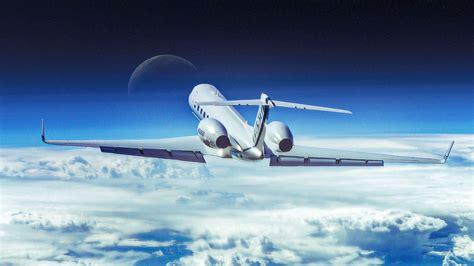
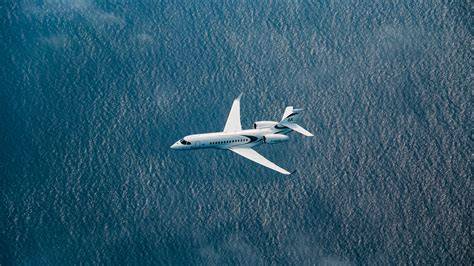
Modern ultra-long-range business jets are among the few civil aircraft capable of routinely operating at these altitudes. Aircraft such as the Gulfstream G650 family and Bombardier Global series are engineered for high-altitude performance, allowing them to climb well beyond the normal ceiling of large passenger aircraft. The advantage is not merely the spectacle outside the windshield. High-altitude operations can provide smoother air, favorable winds, reduced atmospheric drag and access to airspace with considerably less traffic.
What the Sky Looks Like at 51,000 Feet
The first major change a pilot notices is the color of the sky. At lower altitudes, sunlight encounters enormous numbers of molecules, aerosols and water droplets. Shorter blue wavelengths are scattered strongly in all directions, producing the familiar blue dome surrounding an aircraft. As an aircraft climbs, however, the amount of atmosphere above it becomes progressively smaller.
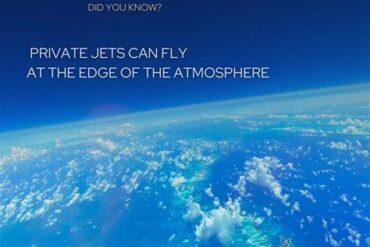
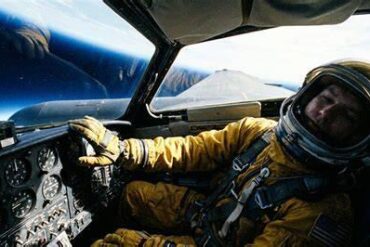
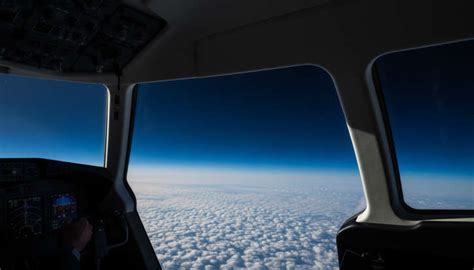
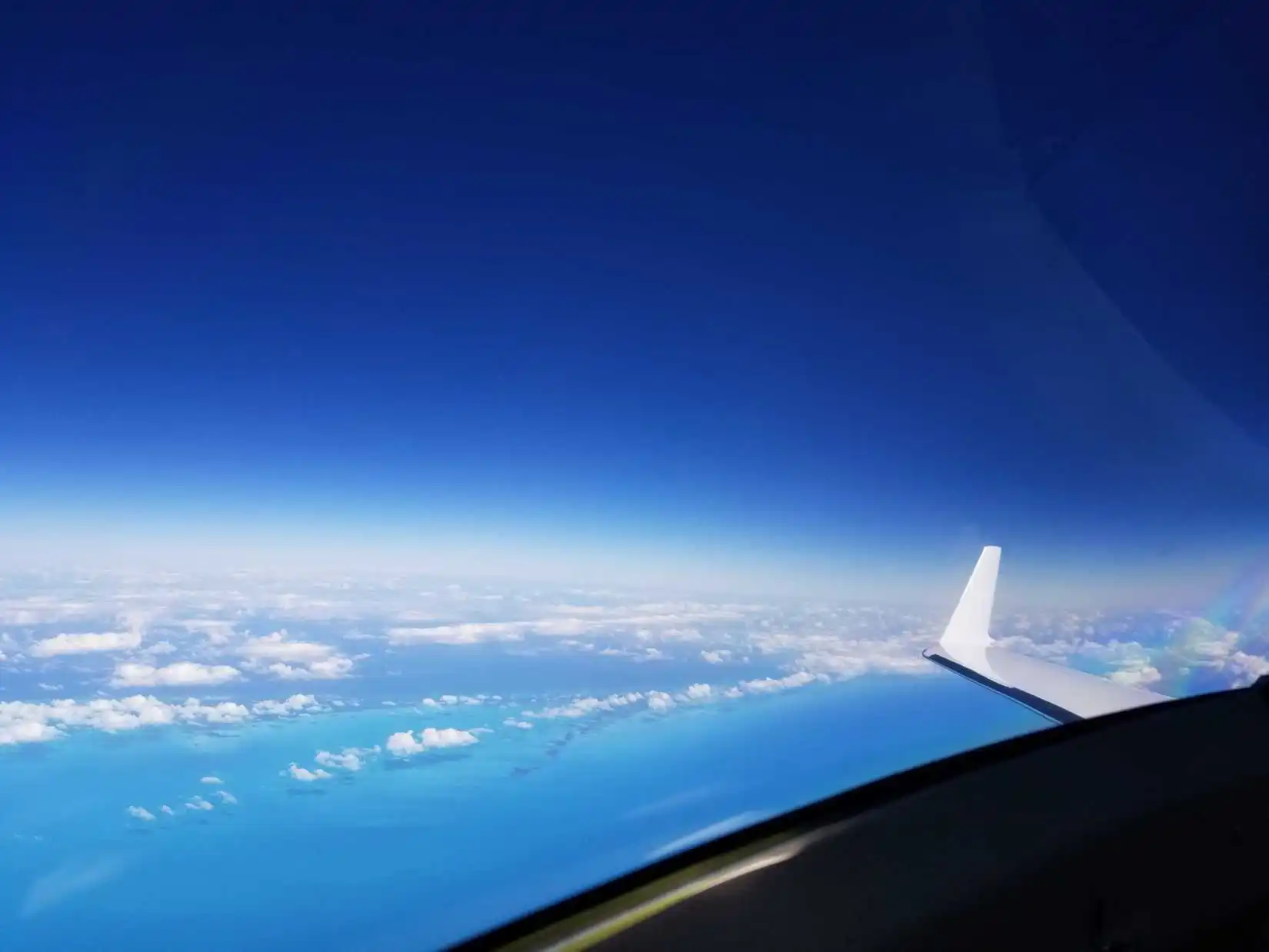
At 51,000 feet, the effect is unmistakable. Looking toward the zenith, the blue becomes much darker than it appears from a conventional airliner. Depending on atmospheric conditions, viewing angle, sunlight and camera exposure, the sky can progress toward a rich navy or deep indigo. Near the upper portions of the windshield, the background can look surprisingly close to the visual transition associated with space.
The reason is fundamentally atmospheric. Rayleigh scattering depends on the amount of atmosphere through which sunlight travels. With fewer molecules above the aircraft, there is less scattering available to fill the sky with diffuse blue light. The Sun itself also appears unusually stark against the dark background because there is less atmospheric scattering around it.
This does not mean a pilot at 51,000 feet sees a perfectly black sky during daylight. Earth still has a substantial atmosphere below the aircraft, and light continues to scatter within it. The transition is gradual rather than an artificial boundary. Yet compared with the bright blue seen from 30,000 to 40,000 feet, the visual difference can be dramatic.
Can Pilots Really See the Curvature of Earth?
The curvature of Earth is one of the most fascinating features of extremely high-altitude flight, although it deserves a more precise explanation than the dramatic photographs sometimes seen online. Earth is enormous, so its curvature is subtle even from 51,000 feet. The horizon does not suddenly bend like the edge of a globe in a textbook.
What changes is the geometric relationship between the aircraft, the horizon and the enormous surface beneath it. From this altitude, the horizon is many hundreds of kilometers away, and the surface visible from the cockpit represents a much larger section of the planet than a passenger can normally see from the ground.
At approximately 51,000 feet, the geometric horizon is roughly 277 miles, or about 446 kilometers, from the aircraft under idealized conditions. Atmospheric refraction can alter the apparent position of the horizon, while terrain and weather can change what is actually visible. Nevertheless, the scale of the view makes the spherical nature of Earth much easier to appreciate.
A pilot does not need to see an exaggerated bow-shaped line to understand the curvature. The horizon appears to fall away relative to the aircraft’s local horizontal reference, while the atmosphere itself can appear as a thin blue layer wrapped around the planet. The visual impression becomes particularly striking when the horizon is unobstructed and the cockpit provides a wide field of view.
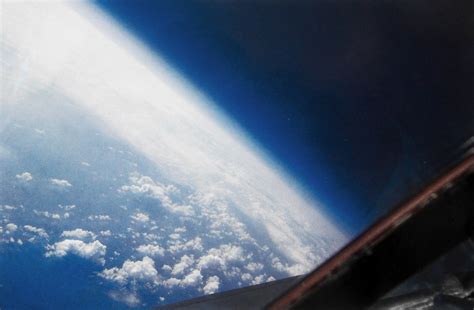
This is also why photographs taken from very high altitude can be misleading. Wide-angle lenses can exaggerate curvature, while narrow fields of view can make it difficult to perceive at all. Human vision is similarly influenced by perspective and atmospheric conditions. The strongest evidence is therefore not a dramatic photograph but the underlying geometry: Earth is curved, and the visible horizon changes position as the observer gains altitude.
Why 51,000 Feet Feels Like Another World
The difference becomes even more apparent when pilots look down. At typical airline cruise altitudes, clouds often occupy much of the visual field. At 51,000 feet, many of the clouds that dominate lower airspace are far beneath the aircraft.
The troposphere contains almost all of Earth’s atmospheric water vapor and most weather activity. Powerful thunderstorms can develop enormous vertical structures, with their tops sometimes reaching the lower stratosphere. A high-performance business jet cannot simply ignore severe weather, but an aircraft operating at 51,000 feet can often fly above large portions of the weather system that would be an operational concern at lower levels.
The result can be an unusually clean view of the surface. Mountain ranges can appear sharply defined, while coastlines, deserts, lakes and large metropolitan areas may remain visible at considerable distances when visibility is exceptional. There is less haze between the aircraft and the ground, although the atmosphere still introduces scattering and distortion.
This creates a strange visual contradiction. The world looks clearer but also smaller. Mountains that appear enormous from the ground become patterns across an immense surface. Cities become clusters of light or geometry. Clouds that seem towering from below can look like thin textures spread across the landscape.
The experience is particularly different during sunrise or sunset. From the cockpit, the aircraft can occupy a high vantage point above much of the atmospheric haze while the lower atmosphere catches warm sunlight. The boundary between the illuminated atmosphere and the darker sky can become visually spectacular, producing the impression of a thin luminous shell surrounding Earth.
Why Commercial Airliners Usually Stop Lower
Large commercial aircraft generally cruise in the high troposphere and lower stratosphere, commonly around 31,000 to 41,000 feet depending on the aircraft, route, weight and operating conditions. Some types can climb higher, but their normal economic operating environment is substantially below 51,000 feet.
That is not because commercial aircraft are incapable of climbing. The issue is a combination of aerodynamic performance, engine characteristics, weight, economics, certification and operational requirements.
An airliner carries a large number of passengers, substantial fuel loads, baggage and cargo. Its engines and wings are optimized around an operating envelope that must work efficiently across thousands of flights. Climbing another 10,000 feet is not automatically beneficial simply because the air is thinner.
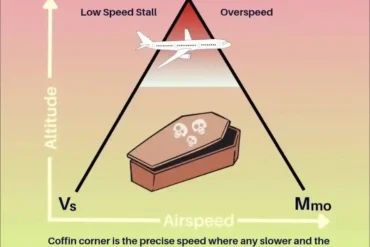
At very high altitude, the atmosphere provides less aerodynamic lift. The aircraft therefore needs to fly faster in terms of true airspeed to generate sufficient lift, while simultaneously remaining below its maximum operating Mach number. This creates a narrower performance envelope.
A purpose-built business jet has a different mission. It carries fewer people, can devote more of its design to long-range performance and can use a high thrust-to-weight ratio to reach altitudes that are impractical for much heavier passenger aircraft.
The High-Altitude Aerodynamic Challenge
At 51,000 feet, air density is dramatically lower than at sea level. This is one reason high-altitude flight is technically demanding. An aircraft’s wings still need to generate enough lift to support its weight, but the surrounding air contains far fewer molecules.
This creates an important distinction between indicated airspeed and true airspeed. Indicated airspeed reflects the aerodynamic pressure measured by the aircraft’s pitot-static system. True airspeed accounts for the actual speed through the air after considering atmospheric density.
At high altitude, an aircraft can therefore be traveling at a very high true airspeed while showing a comparatively modest indicated airspeed. Meanwhile, the aircraft must remain below its maximum operating Mach number because compressibility effects become increasingly important.
This is where the concept often called coffin corner enters the discussion. More technically, the aircraft is operating within a narrow region bounded by low-speed aerodynamic limits and high-speed Mach limitations. As altitude increases, those margins can converge.
Pilots operating at extreme flight levels therefore rely heavily on sophisticated flight-management systems, autopilot and autothrottle systems, accurate atmospheric data and disciplined energy management. The aircraft cannot simply be pointed upward indefinitely. There is a carefully defined ceiling above which aerodynamic margins become unacceptable.
Why the Air Can Be Smoother at 51,000 Feet
One of the biggest practical attractions of extreme altitude is the potential for a smoother ride. Most conventional weather is concentrated in the troposphere, and commercial aircraft spend much of their cruise time within or close to its upper boundary.
At 51,000 feet, a business jet can often operate above significant portions of the cloud and turbulence environment. That does not guarantee perfectly smooth air. Clear-air turbulence can occur without visible clouds, and strong jet streams and atmospheric boundaries can create disturbances at high altitude.
Still, the aircraft can sometimes escape the most active weather systems by climbing. For passengers, this can produce an almost surreal experience: the aircraft is moving at hundreds of knots while the cabin feels nearly motionless.
The absence of lower-level congestion can also provide operational benefits. High-altitude business aviation has access to a relatively specialized portion of the airspace system, although flight routes remain subject to air traffic control, regulations, weather and aircraft performance.
Engines Face a Different Environment
High-altitude performance also depends heavily on the engines. Jet engines require air for combustion, and as altitude increases, the available air mass decreases. That might appear to make extreme altitude inherently inefficient, but the relationship between engine efficiency, aerodynamic drag and atmospheric temperature is more complicated.
The cold stratospheric environment can be beneficial to turbofan engine operation in several ways. The lower temperature changes the thermodynamic conditions within the engine, while reduced aerodynamic drag can significantly improve the aircraft’s overall efficiency.
At the same time, the engine cannot simply generate unlimited thrust at altitude. Thrust generally decreases as air density falls. Aircraft designers therefore balance engine size, aircraft weight, wing design, fuel capacity and cruise altitude around a carefully engineered performance envelope.
This explains why the highest possible altitude is not necessarily the most economical altitude. A business jet may climb progressively during a long flight as fuel burns away and the aircraft becomes lighter. The optimal cruise level can therefore change throughout the journey.
The Cabin Is Still Designed to Feel Like Earth
Outside the aircraft, the environment at 51,000 feet is hostile to unprotected human life. Atmospheric pressure is extremely low, oxygen availability is insufficient, and exposure would rapidly become dangerous.
Inside the aircraft, however, passengers experience something entirely different. The cabin is a pressurized environment designed to maintain a much higher pressure than the surrounding atmosphere. Instead of experiencing the conditions outside, passengers typically experience an effective cabin altitude far below the aircraft’s actual flight level.
Modern long-range business jets place considerable emphasis on cabin pressurization. A lower cabin altitude can contribute to passenger comfort during long flights, while advanced environmental-control systems regulate temperature, humidity and air circulation.
The pressure differential also places enormous structural demands on the fuselage. Every flight subjects the pressure vessel to repeated cycles of expansion and contraction. At extreme cruise altitudes, the aircraft must maintain structural integrity while the pressure outside becomes exceptionally low.
For pilots, a rapid loss of cabin pressure is one of the most serious emergencies imaginable. High-altitude aircraft therefore incorporate warning systems, oxygen equipment and emergency descent procedures designed to bring the aircraft rapidly toward an altitude where normal atmospheric pressure can support human respiration.
Concorde Proved Commercial Aircraft Could Fly Even Higher
The idea of seeing Earth’s curvature from a civil aircraft is not entirely new. Concorde routinely cruised around 60,000 feet, substantially higher than today’s typical commercial airliners. Its passengers were among the few travelers who could regularly experience the darkening sky and expansive horizon from a scheduled commercial aircraft.
Concorde’s ability to fly so high was closely connected to its supersonic mission. The aircraft needed to operate at high Mach numbers, and its aerodynamic design was optimized around conditions very different from those faced by conventional subsonic airliners.
But speed came with enormous costs. The aircraft’s engines were demanding, its airframe experienced substantial thermal loads, and fuel consumption was high. Noise restrictions, particularly those associated with sonic booms over land, also severely constrained its route network.
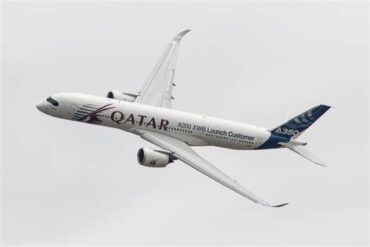
When Concorde retired, the commercial aviation industry returned almost entirely to a slower and more fuel-efficient model. Modern aircraft such as the Boeing 787, Airbus A350 and other long-range twinjets prioritize operating economics rather than extreme altitude and supersonic speed.
What Private Jet Pilots Actually Notice
For a pilot, the most remarkable aspect of 51,000 feet is not necessarily the dramatic horizon. It is the combination of visual clarity, aerodynamic sensitivity and enormous scale.
The aircraft feels separated from the weather and congestion below. The sky becomes darker. The horizon can appear lower and more distant. The ground stretches across an enormous field of view. Meanwhile, the cockpit instruments become increasingly important because the margin between different aerodynamic limits is narrower than at conventional cruise altitudes.
That combination makes the experience fundamentally different from simply flying higher in an ordinary airliner. At 51,000 feet, the pilot is operating in an environment where the atmosphere itself becomes a visible part of the experience.
The View From 51,000 Feet Puts Earth Into Perspective
The curved Earth at 51,000 feet is not a giant arc hanging dramatically across the windshield. Reality is subtler and, in many ways, more impressive. The horizon gradually reveals the geometry of a planet that is almost unimaginably large.
From this altitude, the atmosphere can appear as a thin layer rather than an endless ocean of air. The sky becomes darker because there is less atmosphere above the aircraft to scatter sunlight. The surface below appears unusually crisp when visibility is excellent, and the aircraft can move above weather systems that dominate lower levels.
The view is ultimately a product of physics rather than spectacle. Atmospheric scattering explains the changing sky. Spherical geometry explains the horizon. Aerodynamics explains the narrow high-altitude operating envelope. Thermodynamics explains the engine behavior. Pressurization explains how passengers can sit comfortably in a cabin while flying through an environment that would otherwise be unsurvivable.
That combination is what makes 51,000 feet such a remarkable frontier for private aviation. Commercial aircraft can travel farther, carry vastly more people and operate with extraordinary efficiency, but a small group of specialized business jets can climb into a different atmospheric world. At ten miles above the surface, Earth begins to look less like a flat landscape and more like what it has always been: a vast, curved planet wrapped in an extraordinarily thin atmosphere.