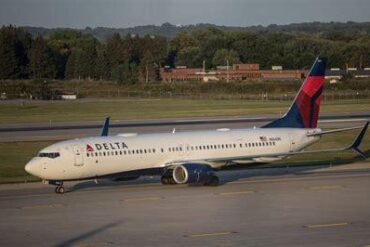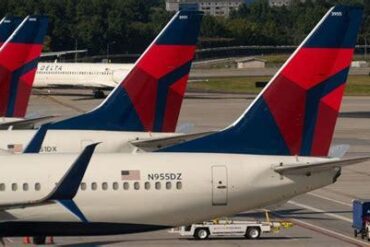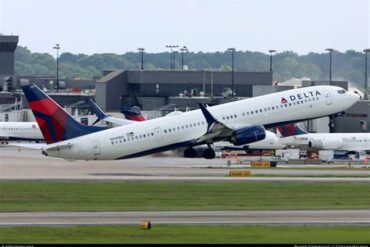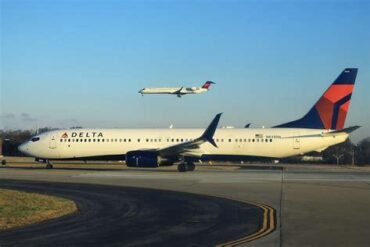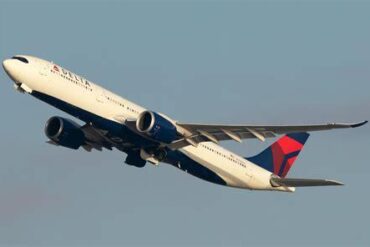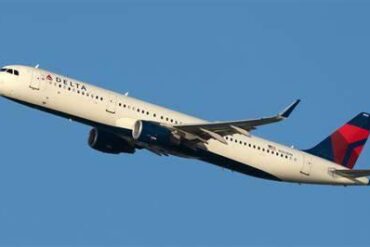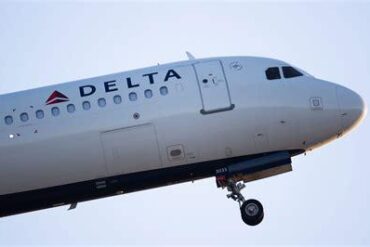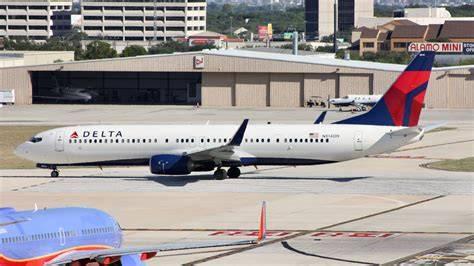
A Delta Air Lines Boeing 737-900ER was forced to return to Hartsfield-Jackson Atlanta International Airport (ATL) on Thursday, August 20, after experiencing a mechanical problem with its right engine shortly after departure. The aircraft was operating DL1518 from Atlanta to Raleigh-Durham International Airport (RDU) when the crew detected the issue and decided to return to the airline’s busy Georgia hub.
The aircraft, registered N938DZ, departed Atlanta at approximately 7:42 PM, around eight minutes later than scheduled. Rather than continuing toward North Carolina, the Boeing 737-900ER remained airborne for only about 20 minutes before turning back. The aircraft never climbed beyond approximately 4,000 feet, indicating how quickly the crew responded to the mechanical problem.
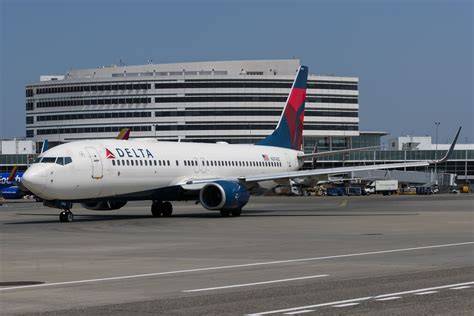
Delta Flight DL1518 Returns to Atlanta
Flight tracking data shows that N938DZ returned to ATL at around 8:00 PM. The aircraft landed safely, allowing the 173 passengers onboard to leave the aircraft while Delta arranged a replacement airplane. The incident caused a substantial delay, but the flight ultimately continued to Raleigh on another Boeing 737-900ER.
The replacement aircraft, N939DZ, departed Atlanta at approximately 10:53 PM and arrived in Raleigh at 11:54 PM. This put the passengers roughly three hours behind the original schedule. Delta apologized for the disruption while emphasizing that passenger and crew safety remained the airline’s highest priority.
The most significant detail was the nature of the problem. Delta confirmed that the aircraft experienced an issue involving its right engine, which resulted in a loss of power. The precise cause of the malfunction was not immediately disclosed, meaning it remains unclear whether the problem involved a specific engine component, an indication detected by the crew, or another mechanical condition requiring inspection.
N938DZ: The Boeing 737-900ER Involved
N938DZ is a 14.5-year-old Boeing 737-900ER with a history that predates its time at Delta. The aircraft completed its first flight on March 6, 2012, and was delivered to Indonesian low-cost carrier Lion Air later that month. It remained with Lion Air until September 2022, when Delta acquired the aircraft to strengthen its fleet of narrowbody jets.
The aircraft is identified as a Boeing 737-9GPER and carries manufacturer serial number 37291. In its current Delta configuration, N938DZ provides 173 seats, consisting of 12 First Class seats, 24 Delta Comfort+ seats, and 137 Main Cabin seats. Its propulsion system consists of two CFMI CFM56-7B27 engines, one of which was affected during the Atlanta-Raleigh flight.
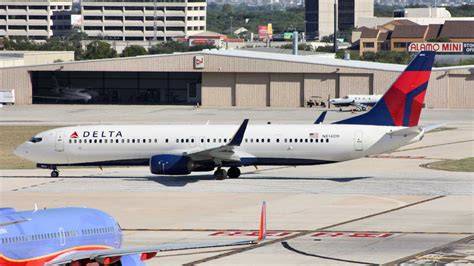
Aircraft Removed From Service for Repairs
Following its return to Atlanta, N938DZ was removed from service so maintenance personnel could investigate and repair the affected engine. The grounding illustrates an important distinction between an in-flight engine problem and a broader aircraft safety issue. A twin-engine aircraft such as the 737-900ER is designed to remain controllable following an engine malfunction, allowing pilots to return safely to an airport when circumstances require it.
In this case, the crew identified the problem quickly and returned to Atlanta rather than continuing toward Raleigh. The decision kept the aircraft close to its departure airport and provided access to Delta’s extensive maintenance infrastructure at its largest hub.
Delta subsequently planned to return N938DZ to scheduled operations on Saturday, August 22, suggesting that the airline expected the necessary inspection and corrective work to be completed within roughly two days.
Delta’s 737-900ER Fleet Remains Extensive
The incident affects only one aircraft within a much larger Delta 737-900ER fleet. Delta operates 163 Boeing 737-900ERs across three cabin configurations, with aircraft offering either 180 or 173 seats.
The type remains an important component of Delta’s domestic network, particularly on routes requiring more capacity than smaller narrowbody aircraft can provide. With Atlanta serving as Delta’s primary hub, the Boeing 737-900ER is frequently deployed across a broad range of domestic markets.
N938DZ Expected Back in Service
Despite the disruption to DL1518, the aircraft was expected to return to scheduled service on Saturday morning, operating a rotation involving Pensacola, New Orleans, and Charleston before attempting the Raleigh route again later in the day.
The Atlanta return ultimately ended without reported injuries, and passengers reached Raleigh after being transferred to another aircraft. For Delta, the immediate priority was removing N938DZ from service, determining why its right engine lost power, and completing the necessary repairs before allowing the Boeing 737-900ER back into regular operation.
The incident also highlights the operational importance of Atlanta, where Delta handles up to 1,000 daily departures to approximately 210 domestic and international destinations during peak periods. At a hub of that scale, the airline’s ability to quickly substitute aircraft can prevent a single mechanical problem from causing an even larger network disruption.