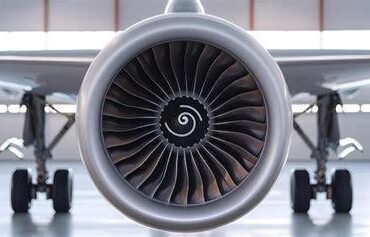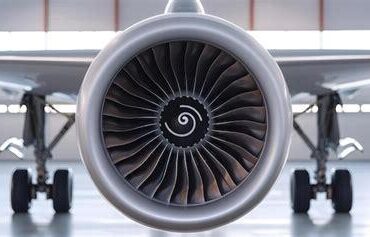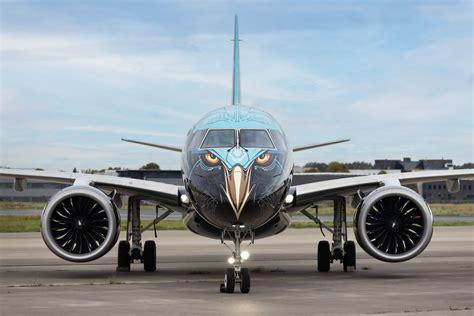
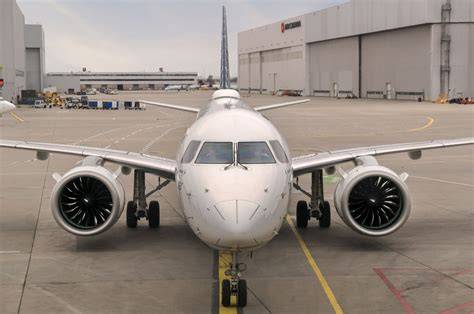
The Embraer E195-E2 looks familiar at first glance. It has the same basic low-wing regional jet configuration that has defined the E-Jet family, with two engines mounted beneath the wings and a conventional tail at the rear. But look more closely at the aircraft from the front and one unusual feature becomes obvious: the wing appears to rise around the engine mounting area. That subtle shape is the result of one of the E195-E2’s most important engineering challenges—fitting an exceptionally large modern turbofan beneath an aircraft that was originally designed around much smaller engines.
The E195-E2 uses two Pratt & Whitney PW1900G geared turbofan engines, each with a fan diameter of about 73 inches (190 cm). That is an enormous fan for an aircraft in the regional-jet category. The engine produces as much as 23,000 pounds (102 kN) of thrust, while its approximately 12:1 bypass ratio allows it to move a much larger mass of air at a lower velocity than the engines used on the first-generation E195. The result is substantially improved propulsive efficiency, lower noise and the fuel-saving characteristics Embraer wanted from its second-generation E-Jet.
The catch was physical rather than conceptual. The first-generation E195 used General Electric CF34-10E engines with a fan diameter of roughly 52 inches (132 cm), leaving ample space between the nacelles and the runway. Replacing those engines with fans roughly 21 inches (53 cm) wider was not a simple engine swap. The E195-E2 had to be designed around the PW1900G, forcing Embraer to rethink the wing, landing gear, pylons and gear-retraction system. What emerged is an aircraft whose distinctive engine placement is really the visible consequence of a much deeper aerodynamic and structural redesign.
Why the Embraer E195-E2 Needed Such Large Engines
The decision to use the PW1900G was closely connected to the E2 program’s efficiency ambitions. When Embraer launched the E2 family in 2013, the company selected the Pratt & Whitney geared turbofan as the sole engine family for the three E2 variants. Rather than simply increasing the size of the existing E-Jet’s engines, the program adopted a completely different propulsion philosophy centered on a very large fan and a geared architecture.
The first-generation E195’s CF34-10E was already well suited to the aircraft. Its approximately 52-inch fan could be installed beneath the relatively low wing without creating a major ground-clearance problem. Its bypass ratio was around 5.4:1, a respectable figure for its generation, but far below the 12:1 ratio targeted by the PW1900G. The new engine therefore promised a fundamentally different balance between airflow, thrust and efficiency.
A larger fan can generate thrust more efficiently because it accelerates a greater quantity of air by a smaller amount. Instead of forcing a relatively small airflow to leave the engine at extremely high velocity, a high-bypass turbofan moves a much larger mass of air more gently. That approach reduces the kinetic energy left behind in the exhaust and improves propulsive efficiency. It also tends to reduce the noise associated with very high exhaust velocities.
For the E195-E2, this mattered because Embraer designed the aircraft around significant improvements in operating economics. The company targeted 25% lower fuel consumption per seat compared with the previous generation, while also emphasizing a low external noise signature. Those goals could not be achieved simply by refining the existing CF34 installation. The propulsion system itself needed to make a major contribution.
The 73-Inch PW1900G Created a Major Ground-Clearance Problem
The fundamental difficulty was the E195’s relatively low stance. Regional jets are often designed with practical airport access in mind, and the first-generation E-Jets were no exception. Their landing gear and low-mounted wings worked perfectly well with the compact CF34 engines. The PW1900G changed the geometry dramatically.
At roughly 73 inches in diameter, the new fan was about 21 inches larger than that of the CF34-10E. If Embraer had mounted the engine in essentially the same position as the old powerplant, the bottom of the nacelle would have been dangerously close to the runway. The problem becomes even more important during takeoff rotation, when the aircraft’s nose rises and the geometry between the engines and the ground changes.
Simply moving the engine upward was not possible without affecting the wing structure. Raising the wing itself would have introduced consequences for the fuselage, passenger cabin and aerodynamic design. Moving the engines farther outward would have changed the loads imposed on the wing and potentially increased structural weight. Embraer therefore needed a solution that created vertical clearance without compromising the aircraft’s broader design.
That solution became one of the E195-E2’s most recognizable features: the gull-shaped inboard wing.
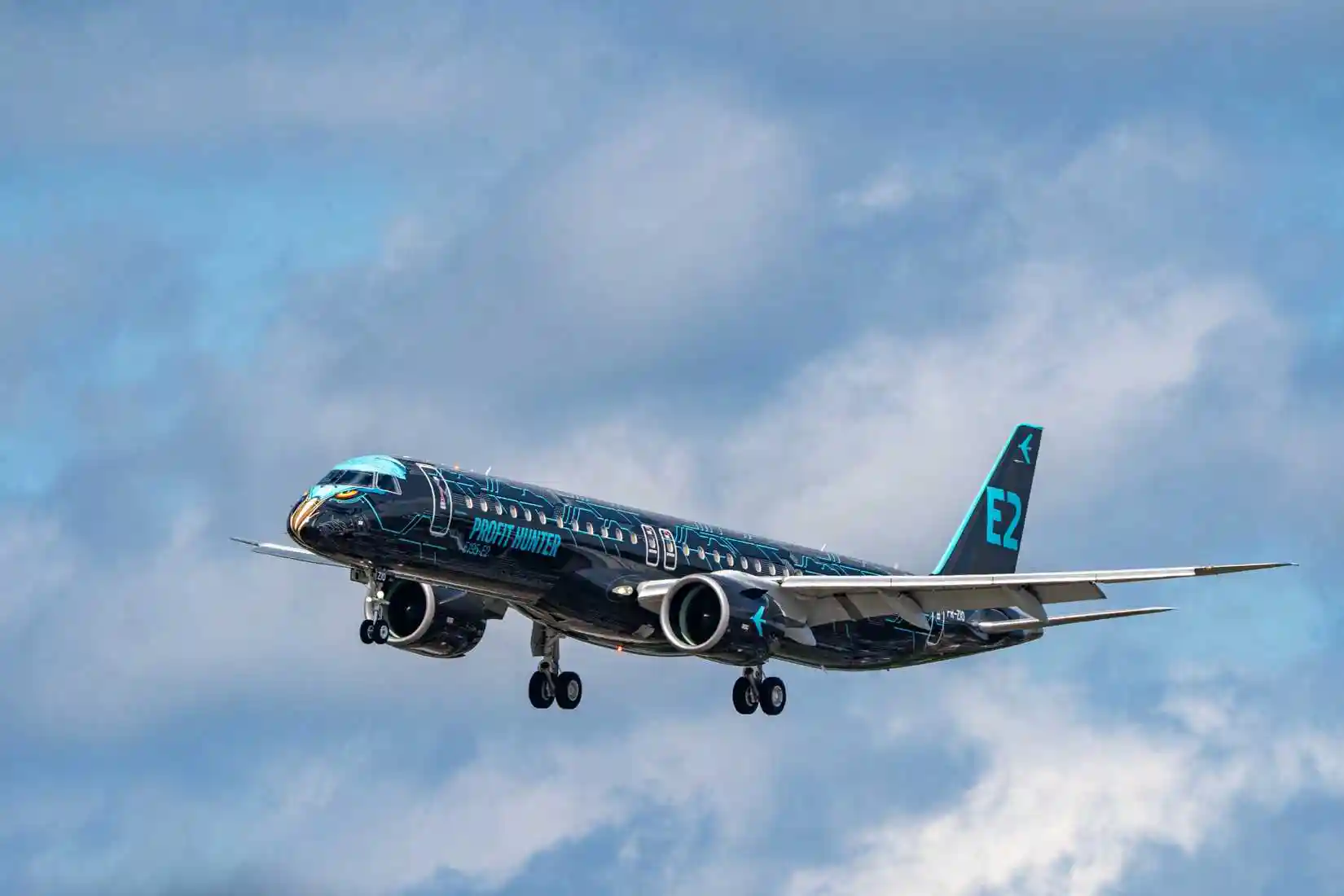
The E195-E2 Gull Wing Raises the Engine Pylons
The E195-E2’s wing does not simply extend outward from the fuselage in one continuous plane. Its inboard section bends upward before transitioning into the outer wing geometry. The resulting shape is subtle, but it raises the area where the engine pylon attaches to the wing.
This upward bend provides additional vertical space beneath the wing without requiring Embraer to dramatically alter the fuselage position. In other words, the aircraft effectively uses the wing itself to help lift the large engine away from the runway.
The arrangement is sometimes described as a gull-wing configuration. The term may recall much more dramatic aircraft designs such as the Vought F4U Corsair, but the E195-E2’s shape is considerably more restrained. The engineering principle, however, is similar: introduce a bend into the wing to create additional clearance for a component that needs more vertical space.
The decision was not merely cosmetic. Every millimeter of additional clearance matters when an engine this large is mounted beneath a relatively compact aircraft. The nacelle must remain safely away from the runway not only during normal taxiing but also during takeoff, landing and other changes in aircraft attitude.
The gull wing therefore became an elegant compromise. Instead of forcing the entire aircraft higher, Embraer modified the local wing geometry where the problem actually existed. From a passenger’s seat, the feature is easy to overlook. From the front of the aircraft, however, it reveals just how much engineering work was required to accommodate the PW1900G.
Embraer Also Made the E2’s Landing Gear 20 Inches Taller
The wing modification alone was not enough. Embraer also developed landing gear approximately 20 inches (51 cm) taller than that of the first-generation E195. Together, the taller gear and raised engine mounting position provide the ground clearance necessary for the large PW1900G nacelles.
This change produced a surprisingly broad set of engineering consequences. Increasing landing-gear length is not simply a matter of adding material to a strut. The gear has to absorb landing loads, retract reliably, fit within its available space and maintain appropriate geometry during taxi, takeoff and landing.
The E195-E2 retains a trailing-link landing-gear arrangement, in which the axle is mounted on a trailing arm that pivots during touchdown. This configuration helps provide a softer landing by allowing the landing energy to be absorbed over a useful range of movement. However, the E2’s taller gear had to be structurally redesigned to accommodate the altered geometry and loads.
The longer gear also affects the aircraft’s relationship with airport infrastructure. Jetbridge height, ground-service equipment and cargo-handling arrangements all have to remain practical. Airlines do not evaluate an aircraft only by how efficiently it flies at 35,000 feet. It must also function smoothly at every airport where it is expected to operate.
That is why the E195-E2’s engine-installation story extends far beyond the nacelle. Increasing the engine size ultimately influenced landing gear dimensions, retraction geometry, ground handling and airport compatibility.
The Geared Turbofan Makes the Huge Fan Practical
The size of the PW1900G would be much harder to exploit with a conventional direct-drive turbofan. The key technology is the geared turbofan architecture.
In a conventional turbofan, the fan and the low-pressure turbine are mechanically connected and rotate together. That arrangement creates a compromise because the large fan operates most efficiently at a lower rotational speed, while the turbine can extract energy more effectively at a substantially higher speed.
Pratt & Whitney’s solution is to place a reduction gearbox between them. In the PW1900G, the turbine can rotate at a higher optimal speed while the gearbox reduces the rotational speed delivered to the large front fan by approximately 3:1. The fan therefore does not have to spin as quickly as the turbine driving it.
That separation allows the engine’s major components to operate closer to their individual aerodynamic and mechanical sweet spots. The large fan can move a tremendous amount of air efficiently and relatively quietly, while the turbine operates at a speed more favorable for extracting energy from the hot gas flow.
This is the central reason the E195-E2 can carry such a large-diameter engine without sacrificing the efficiency advantages that motivated the design. The gearbox is not an incidental feature; it is fundamental to the propulsion concept.
What the 12:1 Bypass Ratio Means for the E195-E2
The 12:1 bypass ratio of the PW1900G is another important part of the story. Bypass ratio describes how much air travels around the engine’s core compared with the amount passing through the core itself. At 12:1, approximately twelve units of air flow through the bypass stream for every unit entering the core.
That arrangement is especially valuable on a modern passenger aircraft because thrust can be produced by accelerating a large amount of air by a relatively small velocity increase. The physics favor this approach because extremely high exhaust velocities carry more energy away from the aircraft without contributing proportionally to useful forward motion.
The high bypass ratio also contributes to the engine’s lower noise characteristics. The fan moves a large volume of air without requiring the same extremely high velocities associated with smaller, faster-moving airflow streams. For an aircraft operating frequently from airports close to populated areas, that acoustic benefit can be nearly as important as fuel economy.
This helps explain why Embraer was willing to redesign so much of the E195-E2 around the PW1900G. The engine was physically inconvenient, but its performance characteristics were valuable enough to justify changing the aircraft around it.
The E195-E2’s Wing Became a Major Part of Its Efficiency Strategy
The engine installation cannot be separated from the E195-E2’s new wing. Embraer did not merely strengthen the existing E195 wing to carry a larger engine. The company developed three separate bespoke wings for the three E2 variants, allowing each aircraft to receive geometry appropriate to its size and mission.
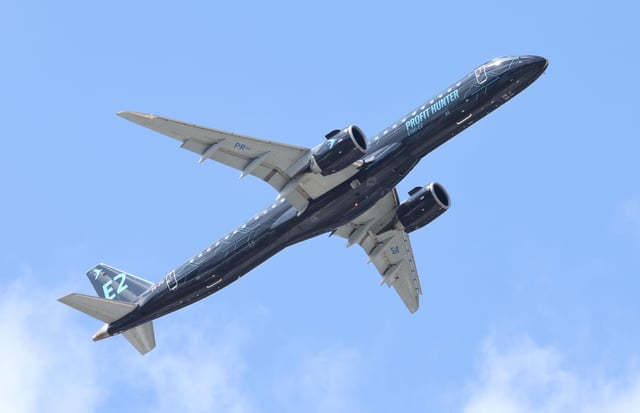
The E195-E2 wing has an exceptionally high aspect ratio for an aircraft in its class. Its wingspan reaches approximately 115 feet (35.1 meters), remarkably close to the span of a much larger Airbus A320neo, which is only about 2.3 feet (0.7 meters) wider.
The wing also uses raked wingtips rather than conventional winglets. The long, slender planform reduces induced drag and contributes to the aircraft’s overall aerodynamic efficiency. This means the engine’s fuel-saving capability works alongside an airframe designed to reduce the amount of thrust required in the first place.
The result is an aircraft in which propulsion and aerodynamics are tightly interconnected. The large PW1900G demanded a redesigned wing, but that redesigned wing also became an important contributor to the E2’s efficiency. The challenge created by the engine ultimately encouraged a broader rethinking of the aircraft.
Why Embraer Could Not Simply Put a Bigger Engine on the E195
The E195-E2 demonstrates why modern aircraft development is rarely a matter of replacing one component with a newer version. A larger, more efficient engine can offer enormous benefits, but its physical dimensions can force changes throughout the airframe.
For the E195-E2, the 73-inch fan created a clearance problem. Solving that problem required a gull-shaped wing and taller landing gear. The taller gear required structural and retraction changes. The new wing had to accommodate different aerodynamic and structural requirements. Ground-service compatibility had to be considered. Even the aircraft’s overall stance and gate interface were affected.
This chain of consequences is what makes the E195-E2 particularly interesting among regional jets. Its engine placement is not an isolated design curiosity. It is the visible result of an aircraft being redesigned around a propulsion system that was substantially larger than what its predecessor carried.
The E195-E2’s Engine Placement Is a Signature of Its Generation
The E195-E2 ultimately illustrates a broader transition in commercial aviation. Modern regional and small narrowbody aircraft are being pushed toward larger fans, higher bypass ratios and greater propulsive efficiency, but airport-friendly dimensions place strict limits on how large an engine can become.
Embraer’s answer was to reshape the aircraft rather than compromise on the engine. The PW1900G’s enormous fan sits beneath a wing whose inboard section rises to create additional clearance, while taller landing gear raises the aircraft further from the ground. At the same time, the E2 receives a highly efficient high-aspect-ratio wing with raked tips.
That combination gives the E195-E2 its distinctive appearance, but more importantly, it reveals the engineering philosophy behind the aircraft. The engines were not simply attached to an existing regional jet. The wing, landing gear and surrounding airframe were redesigned to make those engines possible.
From a distance, the E195-E2 may look like another twin-engine regional jet. Up close, its unusual engine placement tells a different story. The raised inboard wing, tall landing gear and oversized PW1900G nacelles are physical evidence of how far Embraer was willing to reshape the aircraft to extract the benefits of modern turbofan technology.