The F-15 Eagle, a mainstay in the United States Air Force (USAF) for over four decades, is one of the most iconic and advanced fighter aircraft ever produced. Known for its unparalleled air superiority and versatile capabilities, the F-15 has earned a reputation that extends beyond its official designation. Over the years, various nicknames have been assigned to different versions and configurations of the F-15, each one reflecting the aircraft’s unique characteristics, roles, or modifications.
In this comprehensive guide, we will explore the official and informal nicknames associated with the F-15, examine their meanings, and delve into the culture and significance behind each moniker. Whether you’re an aviation enthusiast, military historian, or simply curious about the legacy of the F-15, this article offers an in-depth look at the nicknames that have become synonymous with this legendary aircraft.
Official Nicknames of the F-15 Eagle
“Eagle” – The Iconic Air Superiority Fighter
The Eagle is the official NATO designation for the F-15, symbolizing its dominance in the skies. As one of the premier air superiority fighters in the world, the F-15 was designed with a single mission in mind: to achieve air dominance. Since its introduction in 1974, the Eagle has been instrumental in ensuring U.S. and allied control over the skies in numerous conflicts.
The F-15 Eagle’s legacy is defined by its ability to engage in air-to-air combat with unmatched agility, speed, and firepower. It has amassed an astounding combat record, maintaining a 104:0 kill-to-loss ratio, an achievement that underscores its unmatched superiority in aerial combat. This impressive statistic remains one of the most formidable in modern aviation history.
“Strike Eagle” – The Ground-Attack Variant
The F-15E Strike Eagle is a specialized version of the original F-15 designed for ground-attack missions. Featuring advanced avionics, a digital cockpit, and a remarkable weapons payload, the Strike Eagle is built to deliver precision strikes on ground targets in all-weather conditions. With its added capability for deep strike missions, it has proven to be an invaluable asset to the U.S. Air Force and its allies.
Unlike the original F-15, which is primarily an air-to-air fighter, the Strike Eagle can carry a wide range of bombs, missiles, and guided munitions, making it a true multirole fighter. This adaptation has earned the F-15E its “Strike Eagle” moniker, emphasizing its lethal efficiency in ground-attack operations.
“Silent Eagle” – The Stealth-Enhanced F-15SE
The Silent Eagle is a stealth-modified version of the F-15, designed to reduce radar cross-section and enhance survivability in contested airspace. The F-15SE incorporates stealth technologies such as internal weapons bays, advanced radar-absorbing coatings, and redesigned airframe features that minimize its radar visibility.
Although it never entered mass production, the Silent Eagle served as a proof of concept, demonstrating the potential for F-15 variants to evolve with the changing demands of modern aerial warfare. The name “Silent Eagle” reflects the aircraft’s quieter, more inconspicuous profile in comparison to its predecessors.
“Eagle II” – The F-15EX Evolution
The F-15EX, often referred to as the Eagle II, is the latest variant in the F-15 family. Building upon the aircraft’s legacy of air superiority, the F-15EX features cutting-edge avionics, an advanced radar system, and the ability to carry the latest smart weapons. With the introduction of the F-15EX, the Eagle II promises to be an integral part of the U.S. Air Force’s fleet well into the middle of this century.
The Eagle II is designed to complement newer stealth fighters such as the F-22 Raptor and F-35 Lightning II, but it maintains the F-15’s proven capabilities in air superiority and multirole missions. It also brings a digital cockpit, advanced flight controls, and improved operational efficiency, ensuring that the F-15 remains relevant in the modern era.
“Beagle” – The Informal Nickname of the F-15E
The nickname “Beagle” is an informal moniker used by F-15E Strike Eagle crews. This name is a playful blend of the terms “Bomber” and “Eagle”, reflecting the aircraft’s role as a fighter-bomber. The Beagle is particularly known for its ability to deliver devastating precision strikes while maintaining the superior air-to-air combat capabilities that the F-15 is known for.
“Mud Hen” – A Nickname for the F-15E Strike Eagle
Another popular nickname for the F-15E is “Mud Hen”. This term refers to the aircraft’s proficiency in ground-attack missions, where it is tasked with delivering a wide range of ordnance to enemy positions. The “Mud Hen” nickname highlights the aircraft’s ability to operate in close air support and strike missions, making it a versatile and essential asset for the U.S. military.
Specialized Modifications and Their Nicknames
“Streak Eagle” – The Record-Breaking F-15
The Streak Eagle was a special modification of the original F-15A (serial number 72-119) created specifically to break records. Stripped of its weapons, external paint, and non-essential equipment, the aircraft’s thrust-to-weight ratio was increased to an astonishing 1.6:1. This made the Streak Eagle one of the fastest and most agile aircraft of its time.
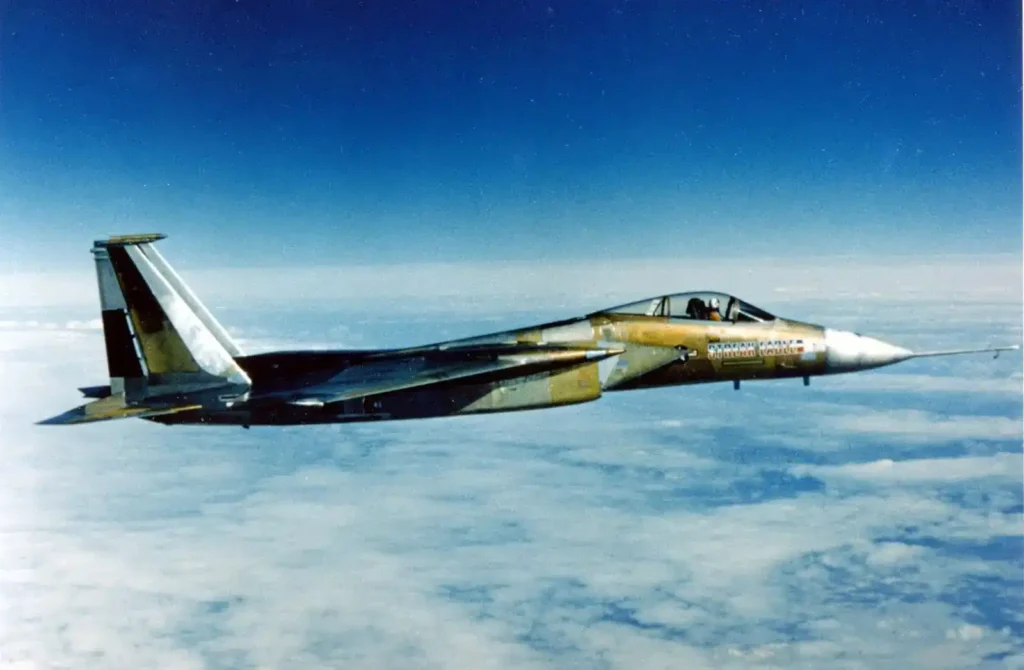
In 1975, the Streak Eagle set eight world records for vertical climb times, including a remarkable 3 minutes and 45 seconds to reach an altitude of 30,000 meters. These records solidified the F-15’s reputation as not just a superior fighter but also a formidable force in speed and performance.
“Stripe Eagle” – The Modified F-15’s Unique Appearance
The Stripe Eagle is another nickname associated with the same aircraft as the Streak Eagle. After the aircraft’s special modifications were complete, the removal of its external paint revealed metallic stripes formed by different alloys on the aircraft’s surface. These distinctive stripes led to the aircraft’s alternate nickname, “Stripe Eagle”.
Unofficial Nicknames and Cultural Significance
“Hangar Queen” – The Early F-15A/B Models
The early variants of the F-15, particularly the F-15A/B models, earned the affectionate yet mocking nickname “Hangar Queen” due to their low operational readiness rates early in their service life. The term was used by critics who cited engine reliability issues and maintenance difficulties that resulted in the aircraft spending significant time on the ground rather than in the air. Over time, these issues were resolved, and the aircraft’s reliability greatly improved with later versions such as the F-15C/D.
“Foxbat Killer” – The F-15’s Role in the Cold War
The nickname “Foxbat Killer” refers to the F-15’s famous role in neutralizing the Soviet MiG-25 Foxbat during the Cold War. The MiG-25 was one of the Soviet Union’s most advanced interceptors at the time, but the F-15 proved to be its superior in combat. The Foxbat Killer moniker speaks to the F-15’s ability to outmaneuver and outgun enemy aircraft in high-stakes confrontations, further cementing its status as the world’s leading air superiority fighter.
“Fast Fifteen” – A Casual Nickname for the F-15
The nickname “Fast Fifteen” emphasizes the F-15’s exceptional speed and acceleration capabilities. With a top speed of over 2,600 kilometers per hour (Mach 2.5), the F-15 can quickly close the distance between itself and an enemy target, making it a formidable adversary in air combat. This nickname underscores the aircraft’s dominance in speed, agility, and overall performance.
“McDonnell Douglas Lawn Dart” – A Humorous Nickname
Occasionally, the F-15 has been humorously referred to as the “McDonnell Douglas Lawn Dart”. This name is a lighthearted reference to the aircraft’s tapered, dart-like appearance and is sometimes used by detractors or in jest. Despite its playful nature, the Lawn Dart nickname is rarely used in professional or military settings.
The Legacy of the F-15 Eagle
The F-15 Eagle remains a symbol of air superiority, combat effectiveness, and adaptability. Over the course of its service life, the F-15 has undergone numerous upgrades and modifications, ensuring that it stays at the cutting edge of military aviation. From its iconic status as the Eagle to its various nicknames like the “Strike Eagle” and “Silent Eagle”, the F-15’s journey through history reflects the ongoing evolution of modern air combat.
Whether in the form of a multirole fighter, a stealth-enhanced variant, or a record-breaking aircraft, the F-15 has proven to be more than just a fighter jet – it is a true legend of the skies, capable of both maintaining air dominance and adapting to new challenges in an ever-changing world.
The F-15’s extensive list of nicknames not only highlights its operational versatility but also reveals the deep respect and camaraderie among those who fly and maintain it. From the Beagle to the Silent Eagle, each nickname adds a unique layer to the aircraft’s storied legacy, ensuring that the F-15 will continue to be remembered as one of the greatest combat aircraft ever built.