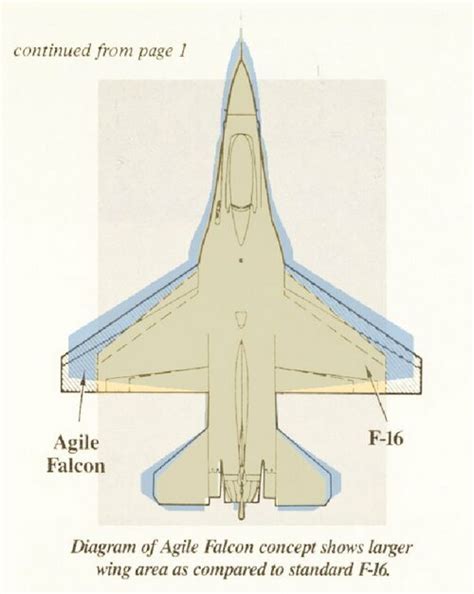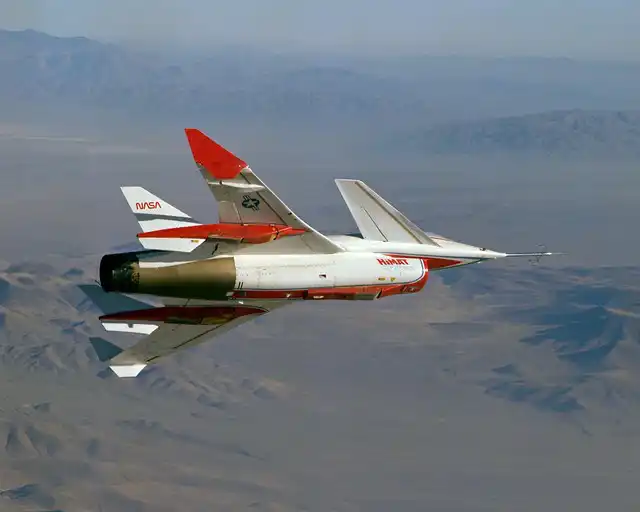
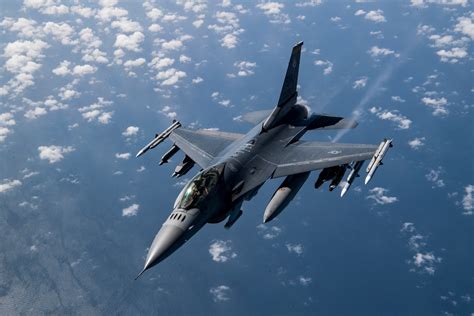
The F-16 Agile Falcon represents a significant aerodynamic enhancement of the F-16 Fighting Falcon, designed to push the boundaries of maneuverability, mission adaptability, and combat effectiveness. This modification introduced a 25% increase in wing area, fundamentally altering its flight characteristics and combat capabilities. Though it never entered full-scale production, the Agile Falcon concept paved the way for subsequent fighter innovations.
Aerodynamic Enhancements: A New Wing Design
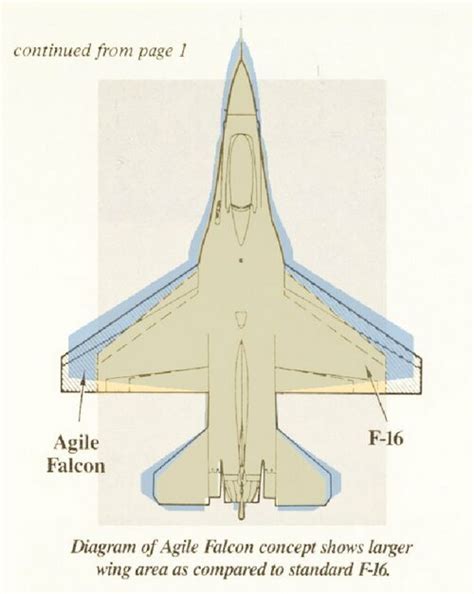
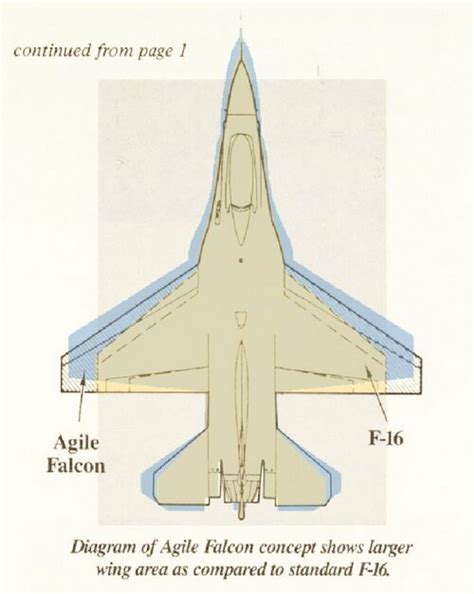
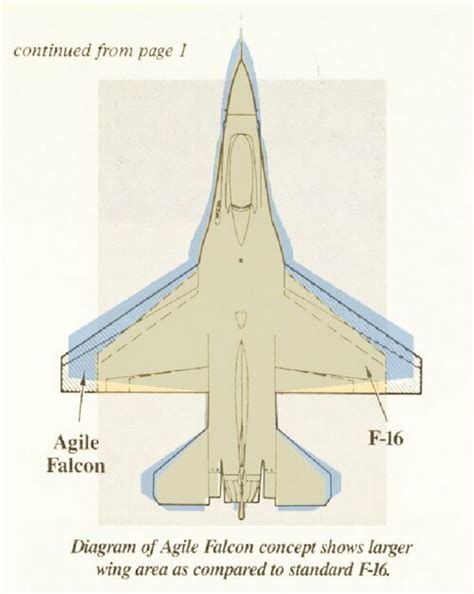
Increased Wing Area
The most notable change in the Agile Falcon was its enlarged wing surface, expanding by 25% compared to the standard F-16A/B. This adjustment aimed to improve several key performance aspects:
- Enhanced lift generation, allowing for superior high-angle-of-attack performance.
- Improved fuel capacity, extending operational range.
- Greater payload capability, accommodating a broader array of weapon systems.
The Agile Falcon’s wing retained the overall delta shape, but with modifications ensuring optimized aerodynamics. This differed significantly from other fighter aircraft that also experimented with larger wing designs, such as the Mitsubishi F-2, which, despite similar enhancements, featured an entirely different fuselage and aerodynamic structure.
Maneuverability and Flight Dynamics
Expanding the wing area of the Agile Falcon had a direct impact on its maneuverability, making it even more agile than the original F-16, which was already renowned for its dogfighting capabilities. The improvements contributed to:
- Superior sustained turn rates, crucial for close-range aerial combat.
- Increased energy retention, enhancing combat endurance during engagements.
- Greater stability at lower speeds, beneficial for precision strike missions.
These advantages aligned with the original F-16 design philosophy, which focused on energy maneuverability theory (EMT). The Agile Falcon further extended this by optimizing wing loading and aerodynamic efficiency.
Comparative Analysis with Other Variants
F-16 Agile Falcon vs. Standard F-16
| Feature | Standard F-16 | F-16 Agile Falcon |
|---|---|---|
| Wing Area | Standard | 25% increase |
| Maneuverability | High | Enhanced |
| Combat Range | Moderate | Extended |
| Payload Capacity | Standard | Increased |
| Production Status | Mass Production | Experimental Only |
While the original F-16 emphasized lightweight agility, the Agile Falcon sought to retain these characteristics while improving versatility in mission profiles. The changes suggested an evolution toward a multi-role fighter with extended payload and endurance capabilities.
Influence on Future Fighter Designs
Although the Agile Falcon did not enter full production, its concepts influenced later aircraft developments. Notably:
- The F-16 Block 60/70 variants, which integrated advanced avionics, increased range, and better payload management.
- The Mitsubishi F-2, which also adopted a larger wing area but with a completely different structural framework.
- The Joint Strike Fighter (F-35), which carried forward lessons in multi-role adaptability and aerodynamic efficiency.
Technical Evolution and Development Context
The F-16’s Modular Upgrade Philosophy
The F-16 series has been known for its cost-effective incremental upgrades, including:
- Enhanced avionics suites (APG-83 AESA radar, upgraded cockpit displays).
- Expanded weapon integration, allowing for diverse strike capabilities.
- Structural reinforcements, improving longevity and operational resilience.
The Agile Falcon was an early attempt to introduce more aggressive airframe modifications rather than just internal upgrades. However, its enhancements were not pursued on a large scale, likely due to cost considerations and shifting military priorities.
Why the Agile Falcon Was Never Mass-Produced
Despite its promising improvements, several factors contributed to the lack of mass production:
- Budget Constraints: The U.S. military prioritized other programs such as the F-22 Raptor.
- Operational Needs: The standard F-16 remained highly effective, fulfilling combat roles without requiring extensive redesign.
- Allied Partnerships: International customers found the existing F-16 variants sufficient, reducing the demand for an expensive redesign.
Conclusion: A Legacy of Innovation
The F-16 Agile Falcon remains an important yet underappreciated chapter in fighter aircraft evolution. Its expanded wing design showcased the potential for enhanced maneuverability, endurance, and payload capacity while maintaining the F-16’s core strengths. Although it never reached mass production, its aerodynamic advancements influenced later fighter developments, proving that even experimental concepts can leave a lasting impact on modern air combat strategy.
Frequently Asked Questions
1. How did the F-16 Agile Falcon improve upon the standard F-16?
The Agile Falcon featured a 25% increase in wing area, leading to better maneuverability, increased fuel capacity, and a higher payload limit. These modifications enhanced its performance while retaining the agility that made the F-16 famous.
2. Why wasn’t the Agile Falcon adopted into mass production?
The U.S. Air Force and allied customers found that the existing F-16 models met operational needs without requiring a complete redesign. Additionally, military budgets prioritized next-generation fighters like the F-22 and F-35.
3. Did the Agile Falcon influence other aircraft designs?
Yes. Elements of the Agile Falcon’s design influenced later F-16 upgrades, the Mitsubishi F-2, and concepts integrated into fifth-generation fighters such as the F-35 Lightning II.