The F-22 Raptor is one of the most advanced air superiority fighters in the world, and its nose design plays a crucial role in its stealth, sensor integration, and aerodynamics. The F-22’s nose section is engineered for low observability, housing cutting-edge radar systems while contributing to the aircraft’s superior maneuverability. This article provides an in-depth analysis of the F-22 nose, covering its radar systems, sensor integration, aerodynamic features, and stealth capabilities.
Advanced Radar System and Stealth Integration
The F-22’s nose houses the AN/APG-77(V)1 Active Electronically Scanned Array (AESA) radar, a key element of its situational awareness and combat effectiveness. This radar provides exceptional detection, tracking, and jamming capabilities, enabling beyond-visual-range (BVR) engagement with unmatched precision.
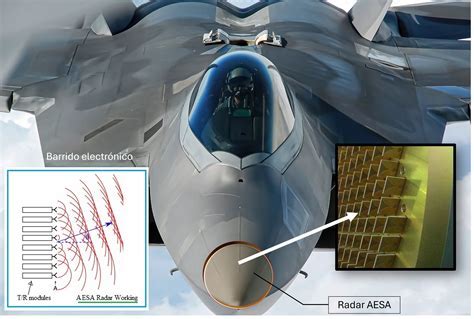
Features of the AN/APG-77(V)1 Radar:
- Stealth Optimization: The radar antenna is tilted within the nose cone to minimize radar cross-section (RCS), reducing the aircraft’s detectability.
- Low Probability of Intercept (LPI): It operates in a way that makes it difficult for enemy sensors to detect its emissions.
- High-Resolution Targeting: The AESA radar provides precise targeting data for air-to-air and air-to-ground engagements.
- Electronic Warfare Capabilities: It can perform jamming and deception against enemy radar systems.
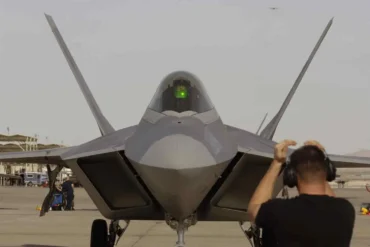
The stealth characteristics of the nose are further enhanced by its trapezoidal shape and sharp edges, which work in conjunction with the rest of the aircraft’s design to deflect radar waves.
Sensor Integration and Tactical Enhancements
Over the years, the F-22 Raptor has received several sensor upgrades, significantly improving its passive detection capabilities.
Infrared Search and Track (IRST) Systems
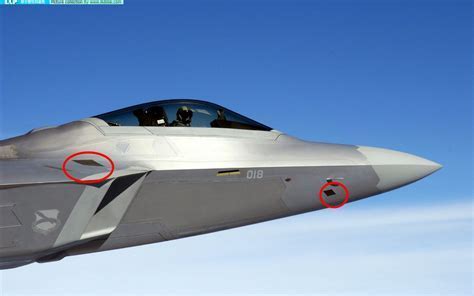
The IRST system enables the F-22 to detect enemy aircraft without using radar, improving its stealth and survivability. While traditional IRST pods are mounted externally—potentially affecting stealth performance—some modifications suggest that distributed sensors could be integrated within the nose or fuselage.
Distributed Aperture Sensor (DAS) Enhancements
Unlike the F-35, which has a full Electro-Optical Distributed Aperture System (EODAS), the F-22 lacks a built-in DAS. However, future upgrades may integrate additional infrared and optical sensors around the nose section to improve detection capabilities.
Canopy and Pilot Vision Optimization
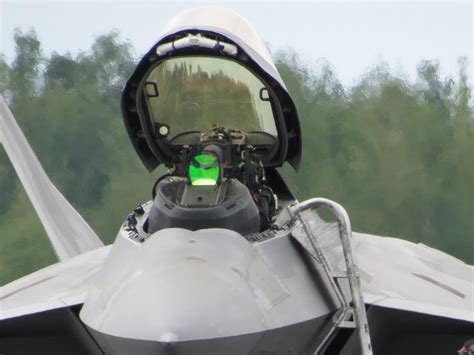
The F-22’s bubble canopy, which extends into the nose section, provides unobstructed visibility for the pilot, a critical factor in dogfighting and situational awareness.
Key Features of the Canopy Design:
- 360-Degree Field of View: Enhances the pilot’s ability to track multiple threats.
- Radar-Absorbing Coating: Reduces the aircraft’s overall radar signature.
- Integration with Helmet-Mounted Displays (HMD): Although the Raptor initially lacked a Helmet-Mounted Display (HMD) due to stealth constraints, recent upgrades have incorporated the Scorpion HMD, which improves target tracking and engagement.
Aerodynamic Structure and Air Intake Design
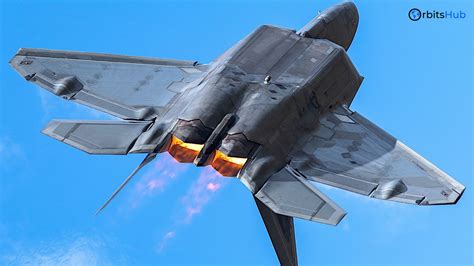
The F-22 nose is aerodynamically optimized to complement its high-speed maneuvering capabilities. The air intakes, located beneath the nose section, contribute to engine performance and stealth characteristics.
Features of the F-22’s Air Intake System:
- Stealth-Optimized Serrated Edges: Reduces infrared and radar signature.
- Curved Duct Design: Shields engine fan blades from radar detection.
- Integrated Airflow Control: Enhances stability at supersonic speeds.
Limitations and Upgrade Challenges
Despite its advanced design, the F-22’s nose section presents several limitations in terms of sensor integration and upgradability:
Space Constraints
Unlike newer designs such as the F-35 or J-20, the F-22’s nose lacks sufficient internal space to accommodate additional sensor systems such as an integrated EODAS. This limitation forces reliance on external pods, which may compromise stealth performance.
Radar System Upgrade Challenges
The AN/APG-77(V)1 radar remains highly capable, but its closed architecture limits flexibility in incorporating next-generation radar technologies. Upgrading the radar requires extensive structural modifications, which the US Air Force has been evaluating for future improvement programs.
Conclusion
The F-22’s nose design represents a sophisticated balance of stealth, aerodynamics, and sensor integration. With its low RCS shaping, AN/APG-77 radar, advanced IR sensors, and optimized aerodynamics, it remains a key factor in the Raptor’s air superiority. However, space limitations and upgrade challenges indicate that while the F-22 remains a dominant force, future fighter designs may offer greater modularity for evolving threats.
FAQ
1. How does the F-22 nose contribute to stealth?
The trapezoidal shape, radar-absorbing coatings, and tilted radar antenna work together to reduce the radar cross-section (RCS). Additionally, the hidden engine fan blades and serrated air intake edges further decrease detectability by enemy radars.
2. What is the role of the AN/APG-77 radar in the F-22’s nose?
The AN/APG-77 radar provides the F-22 with beyond-visual-range targeting, electronic warfare capabilities, and low-probability-of-intercept (LPI) features. It enhances situational awareness and combat effectiveness while maintaining stealth.
3. Can the F-22’s nose be upgraded with new sensors?
While the F-22 has received sensor upgrades, space limitations prevent it from integrating a fully distributed aperture system (DAS) like the F-35. However, advancements in IRST pods and external sensor networks continue to improve its detection capabilities.