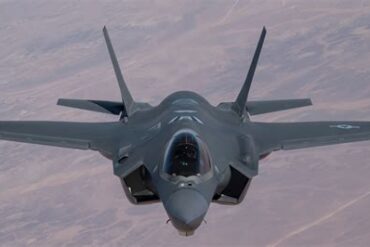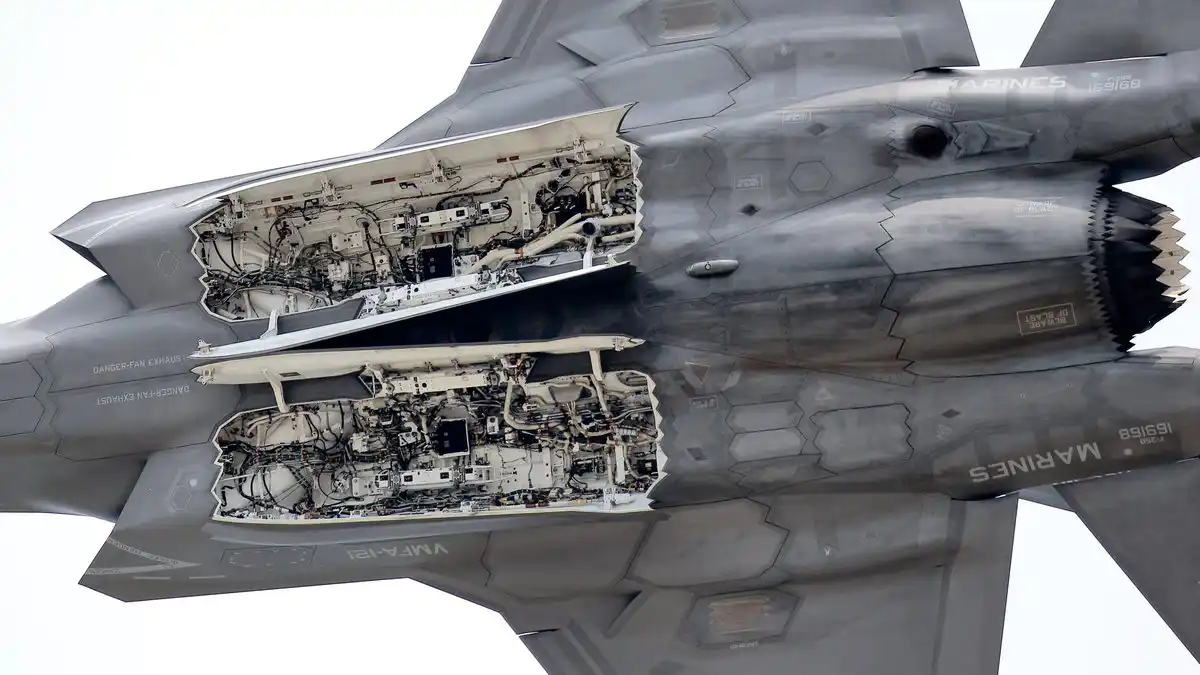
The F-35 Lightning II, developed by Lockheed Martin, represents the pinnacle of modern multi-role stealth fighter design, with a clear emphasis on low observability, lethality, and mission versatility. Central to its combat capability is the internal weapons bay system, a feature critical for maintaining stealth profiles while delivering substantial firepower. However, the weapons bay capacity varies across the three main F-35 variants—F-35A (CTOL), F-35B (STOVL), and F-35C (CV)—due to differing operational requirements, physical configurations, and mission roles.
Strategic Purpose of Internal Weapon Bays
The primary function of the internal weapons bays is to allow the F-35 to operate in high-threat environments while minimizing radar cross-section (RCS). By carrying weapons internally, the aircraft preserves its fifth-generation stealth capabilities, allowing it to strike targets without compromising survivability. The design is centered around two internal bays, each outfitted with two weapon stations—one inboard station for air-to-air munitions, and one outboard station for air-to-ground ordnance.
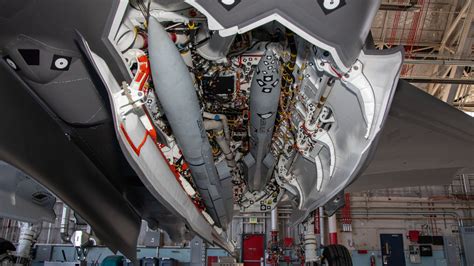
This configuration ensures that the aircraft remains both lethal and undetectable during initial stages of an air campaign. However, each variant’s ability to exploit these bays fully depends on its design constraints and combat role, necessitating a closer examination of their respective configurations and limitations.
F-35A (CTOL) and F-35C (CV) Internal Bay Capabilities
The F-35A and F-35C share nearly identical internal bay structures, benefiting from larger fuselages and fewer spatial compromises compared to the STOVL variant. Each bay on these two variants can handle up to 2,500 pounds (1,100 kg) on the outboard station, providing ample capacity for large-diameter munitions and advanced precision-guided weapons.
Air-to-Ground Loadouts
The outboard station of each internal bay on the F-35A and F-35C supports a diverse set of air-to-ground munitions, including:
- GBU-31 JDAM (2,000 lb)
- GBU-32 JDAM (1,000 lb)
- AGM-154 JSOW
- GBU-39 Small Diameter Bombs (SDB), up to four per station
- Paveway IV, a 500 lb laser-guided bomb
Such versatility allows these variants to adapt to varying mission requirements, from deep-strike operations to close air support and suppression of enemy air defenses (SEAD).
Air-to-Air Loadouts
The inboard stations primarily house AIM-120 AMRAAM missiles, standard across all F-35 variants. In default configuration, the F-35A and F-35C carry two AIM-120s internally—one in each bay. However, the advent of the Sidekick adapter allows this number to increase to six AIM-120 missiles, greatly enhancing the aircraft’s air superiority profile without compromising stealth.
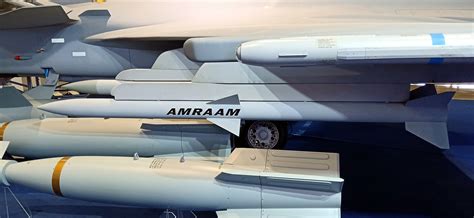
This modular upgrade has become a key feature in extending the aircraft’s magazine depth and maintaining tactical superiority, especially in engagements requiring sustained beyond-visual-range (BVR) capabilities.
F-35B (STOVL) Weapons Bay Constraints
In contrast, the F-35B—designed for short takeoff and vertical landing—sacrifices some internal volume to accommodate the lift fan system, crucial for STOVL operations. As a result, its internal bays are approximately 14 inches shorter and slightly narrower, significantly affecting maximum weapon size and capacity.
Air-to-Ground Loadouts
Due to these dimensional limitations, the F-35B cannot carry larger munitions like the GBU-31 or JSOW. Instead, it is optimized for lighter, precision-guided weapons, such as:
- GBU-32 JDAM (1,000 lb)
- GBU-39 SDBs, up to three per outboard station
- Paveway IV (500 lb)
Although still effective in precision strike roles, the reduction in bay capacity limits the STOVL variant’s operational payload in high-intensity conflict zones where larger bomb loads are advantageous.
Air-to-Air Loadouts
Despite the bay size reduction, the F-35B retains capacity for two AIM-120 AMRAAM missiles, identical to the baseline configuration of the A and C variants. However, Sidekick compatibility appears to be limited or nonexistent on the B model, due to space constraints and structural differences.
Mission-Oriented Load Configuration Examples
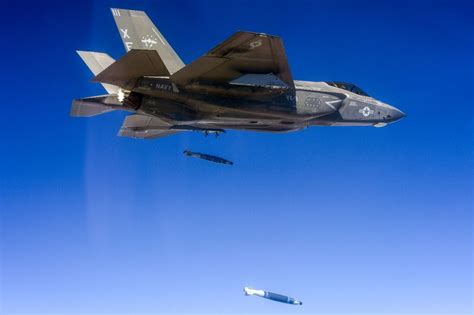
To fully understand the operational impact of these internal bay differences, we must analyze the practical combinations of weapons that each variant can carry while preserving stealth characteristics:
- F-35A/C (Strike Mission): Two GBU-31 JDAMs and two AIM-120 AMRAAMs
- F-35A/C (Air Superiority): Six AIM-120s using Sidekick adapters
- F-35B (Close Air Support): Two GBU-32 JDAMs and two AIM-120s
- F-35B (Light Strike): Six GBU-39 SDBs and two AIM-120s
These examples demonstrate how internal carriage limitations and upgrades like Sidekick alter tactical doctrine and mission planning. While the F-35A and C can fully exploit the depth and flexibility of their internal bays, the F-35B must operate within more confined parameters, balancing payload with vertical lift capability.
Impact of Stealth and External Payload Options
While internal bay usage ensures minimal radar signature, the F-35 is also equipped with external hardpoints, allowing up to 18,000 lb of total ordnance for F-35A/C and 15,000 lb for F-35B in non-stealth configurations. This approach is often used in permissive airspace or second-phase strike operations, where stealth is not prioritized.
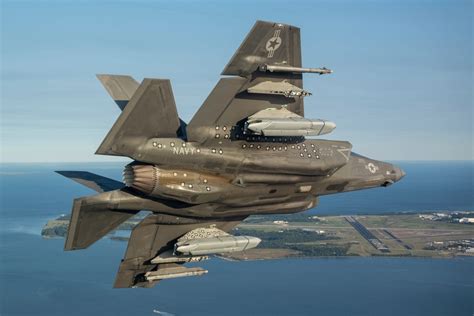
However, such configurations compromise the aircraft’s radar profile and are thus inappropriate for first-day-of-war missions or penetrating strike roles, where stealth remains paramount.
Comparative Capacity Table
| Variant | Max Outboard Station Capacity | Standard A2A Load | Max GBU-39 (SDB) Capacity/Station | Large Ordnance Capability |
|---|---|---|---|---|
| F-35A (CTOL) | 2,500 lb | 2 (upgradable to 6) | 4 | Yes (GBU-31, JSOW) |
| F-35B (STOVL) | 1,500 lb | 2 | 3 | No (limited to GBU-32) |
| F-35C (CV) | 2,500 lb | 2 (upgradable to 6) | 4 | Yes (GBU-31, JSOW) |
This table underscores the payload disparity between the STOVL and conventional/carrier-based variants, with the F-35B limited by its compact internal bay design and propulsion system integration.
Technological Evolution and Block Upgrades
The evolution of the F-35’s internal bay capacity is not static. The introduction of Block 4 upgrades, including Sidekick, reflects ongoing efforts to expand internal lethality without compromising stealth. Future software and hardware adaptations may also introduce new weapon integration, such as advanced SDB variants, hypersonic standoff weapons, or miniature air-launched decoys (MALD).
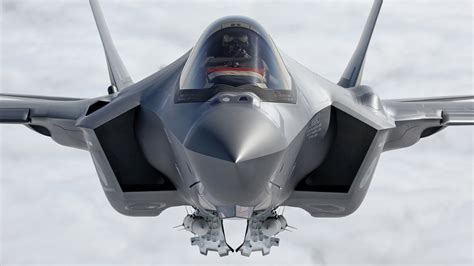
Such developments are essential for ensuring that the F-35 remains dominant in contested environments, particularly as adversaries field advanced integrated air defense systems (IADS) and fifth-generation fighters of their own.
Conclusion
The internal weapons bay capacity of the F-35 Lightning II is a reflection of its stealth-first design philosophy, tailored uniquely across each variant to meet distinct operational roles. While the F-35A and F-35C offer superior internal payload options with 2,500 lb per outboard station and the flexibility of Sidekick-enhanced missile capacity, the F-35B trades off internal volume to fulfill STOVL mission parameters, accepting a reduced capacity of 1,500 lb per outboard station.
The ongoing integration of advanced munitions and modular upgrade paths ensures that the F-35 will continue to adapt to emerging threats and battlefield dynamics, preserving its status as the backbone of next-generation air dominance.
FAQs
What is the maximum internal weapons capacity of the F-35A and F-35C?
Both the F-35A and F-35C can carry up to 2,500 pounds per outboard station in the internal bays, enabling the carriage of GBU-31 JDAMs or multiple smaller precision weapons like the GBU-39 SDB. With the Sidekick adapter, they can carry up to six AIM-120 missiles for air-to-air missions.
Why does the F-35B have a lower internal weapons capacity?
The F-35B includes a lift fan system for vertical landing, which reduces available internal space. As a result, the weapons bays are smaller, limiting each outboard station to 1,500 pounds, and excluding compatibility with larger weapons like the GBU-31 or JSOW.
Can the F-35 carry more weapons externally?
Yes, in non-stealth operations, the F-35 can carry external weapons on underwing pylons. The F-35A and C can handle up to 18,000 pounds, and the F-35B up to 15,000 pounds of total ordnance. However, external carriage compromises the aircraft’s stealth profile.