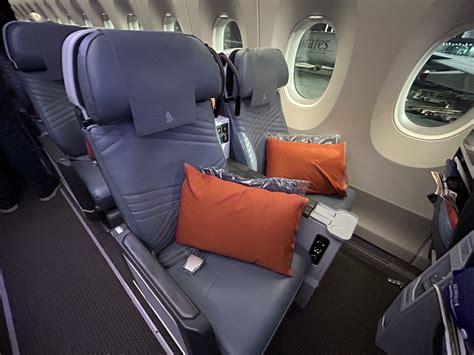
For years, Singapore Airlines premium economy occupied an unusually attractive position in the airline’s long-haul cabin hierarchy. It was expensive enough to feel like a meaningful upgrade from economy, but generally far cheaper than business class, creating a pricing gap that made it difficult for many self-funded travelers to justify paying for the lie-flat seat. On ordinary long-haul flights, that arithmetic can make premium economy the rational choice. On an almost 19-hour flight, however, the calculation becomes considerably more complicated.
Singapore Airlines is now quietly changing that equation on the aircraft where the difference matters most. The carrier plans to reconfigure its Airbus A350-900ULR fleet, removing 36 premium economy seats while adding three business class seats and four first class suites. The result is a dramatically different cabin balance: fewer seats overall, more premium capacity, and a smaller supply of the very cabin that has traditionally provided a compelling middle ground between economy and business class.
The move says something important about how Singapore Airlines sees demand for its ultra-long-haul services. Premium economy may be popular because it offers a substantial improvement without the enormous price of business class, but the airline apparently believes that a larger premium cabin at the very top of the market can generate better financial returns. On flights lasting almost an entire day, passengers may also be much more willing to pay for a bed rather than simply a better reclining seat.
The Premium Economy Price Gap Makes Business Class Difficult to Justify
The basic economics of premium economy are remarkably straightforward. Air Fares data cited in the reference material shows that Singapore Airlines premium economy commonly costs around 1.5 to 2.5 times the price of economy, while business class can cost only 0.3 to 0.5 times the business-class fare when expressed relative to its much higher price point. That creates a particularly large gap between the two premium cabins.
For a traveler paying personally, this can be decisive. If an economy ticket costs S$1,000 and premium economy costs S$1,700, the additional S$700 buys a wider seat, more recline, improved service and additional comfort. But if business class costs S$4,500, the additional S$2,800 can be difficult to justify unless the traveler places a very high value on sleeping properly or arriving rested.
This is where premium economy becomes more than simply a better version of economy. It can also act as a trade-down from business class. A traveler who sees a S$4,000-plus business fare may decide that paying around S$1,200 or less for premium economy represents a reasonable compromise. At the same time, passengers originally shopping for economy may look at the relatively modest premium and decide to move upward.
That two-directional demand is one of the reasons premium economy can be such a powerful cabin. It captures passengers who want more than economy without demanding the enormous financial commitment associated with business class. Singapore Airlines, however, appears increasingly interested in extracting more value from the other side of that equation.
The A350-900ULR Changes the Entire Cabin Economics
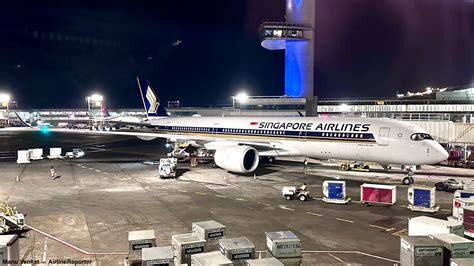
The problem with applying normal premium-cabin fare logic to the A350-900ULR is that these aircraft operate flights of extraordinary duration. Singapore Airlines uses the type for some of the world’s longest scheduled passenger services, including the Singapore–New York JFK route.
The aircraft has an impressive range of approximately 9,700 nautical miles, achieved in part through an architecture optimized around its enormous fuel requirement. The A350-900ULR carries approximately 24,000 liters of additional fuel compared with the standard A350-900 configuration. That capability allows it to remain airborne for close to 19 hours on the longest missions.
At that point, the difference between a reclining premium economy seat and a lie-flat business-class seat becomes much more consequential. A passenger can tolerate an eight-hour overnight flight in a reclining seat and arrive tired but functional. Spending nearly 19 hours in the same basic position is an entirely different proposition.
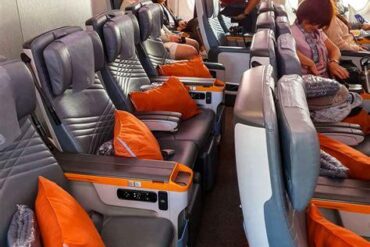
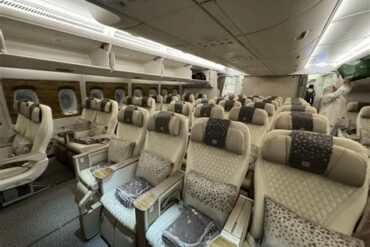
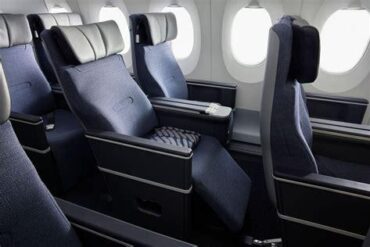
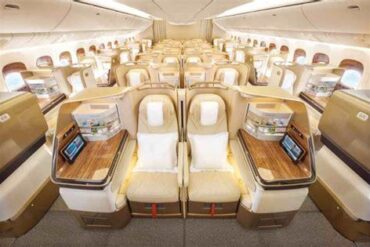
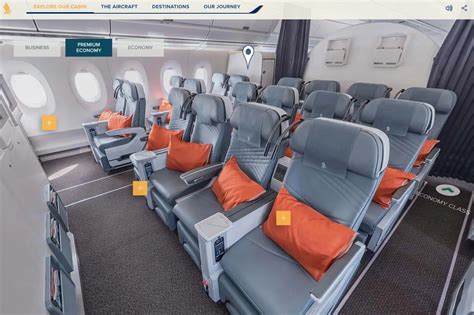
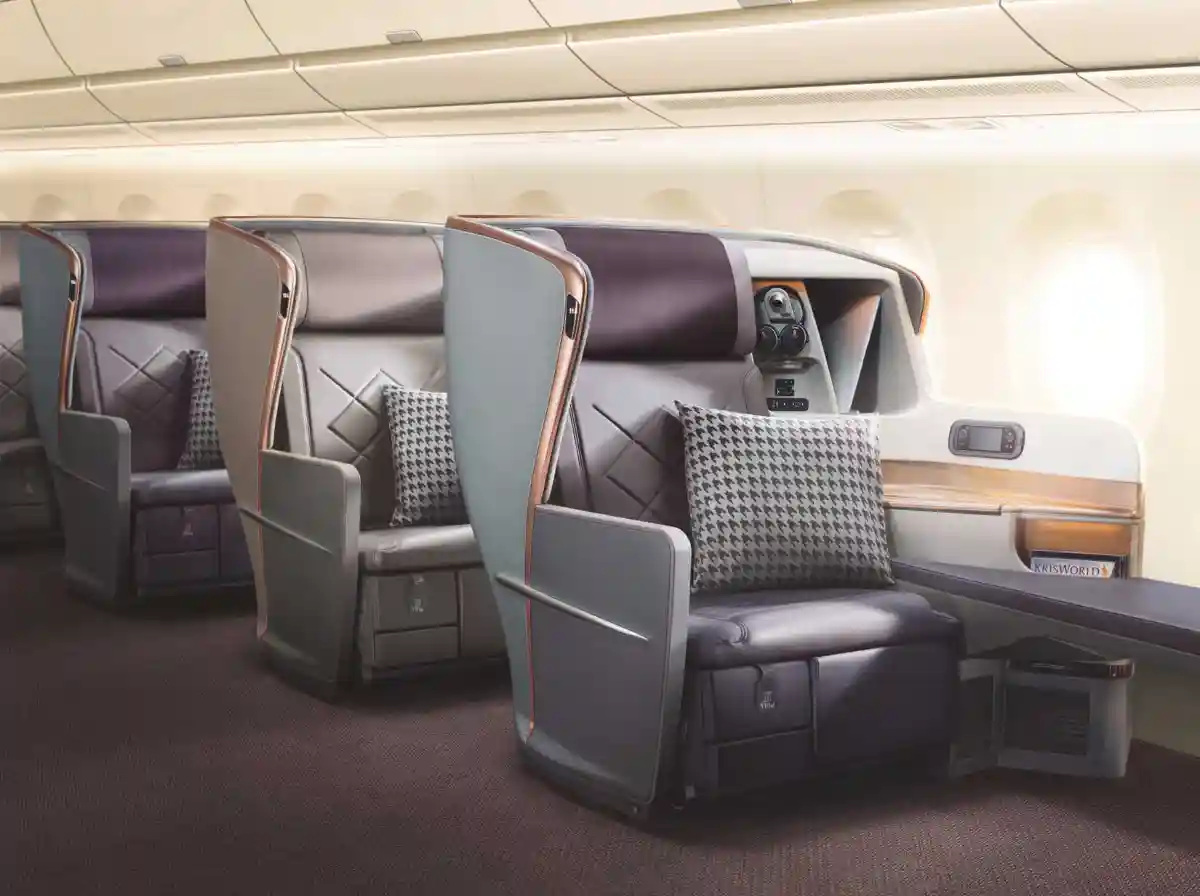
The current A350-900ULR premium economy seat is approximately 19 inches wide, with around 38 inches of pitch and roughly eight inches of recline. Business class, by contrast, provides a much larger personal space with approximately 28 inches of seat width and a bed that extends to around 78 inches when converted to a lie-flat position.
The entertainment screen is similar in size, but that is almost irrelevant to the central issue. Watching a movie for 18 hours does not solve the fundamental problem of spending most of a day inside an aircraft. Sleep, movement, privacy and the ability to change position become far more important.
That makes the conventional premium economy value proposition less obvious on ultra-long-haul routes. The fare difference can still be enormous, but the product difference is no longer merely about having a wider seat and better food. Business class becomes a fundamentally different way of spending the flight.
Singapore Airlines Is Removing 36 Premium Economy Seats
The planned reconfiguration makes this shift particularly clear. The current A350-900ULR configuration contains 67 business class seats and 94 premium economy seats, for a total of 161 seats. There is no economy cabin, which is itself an unusual feature for a commercial aircraft.
After the retrofit, the aircraft is expected to have 70 business class seats, 58 premium economy seats and four first class suites. That produces a total of 132 seats.
In other words, Singapore Airlines will remove 36 premium economy seats while adding seven seats at the top of the cabin hierarchy. The overall aircraft will carry 29 fewer passengers, but the mix will become considerably more premium.
This is an important distinction. The airline is not simply adding business class capacity while keeping the existing premium economy market intact. It is deliberately reducing the availability of the intermediate product that many passengers might otherwise choose.
From the airline’s perspective, fewer seats can also make sense if those seats generate higher yields. A 132-seat aircraft does not need to sell as many tickets as a 161-seat aircraft to produce an attractive result, particularly if a greater proportion of passengers are paying premium fares.
The strategy also reduces the pressure to fill every seat. Ultra-long-haul aircraft have exceptionally high operating costs, and a cabin that consistently requires aggressive discounting to achieve high load factors may not be as attractive as a smaller cabin with stronger average fares.
The New A350 Cabin Will Put First Class Back Into the Picture
The premium reshuffle does not stop with business class. Singapore Airlines is also preparing to introduce first class on its A350 aircraft, marking a significant expansion of the carrier’s top-tier product.
The airline has historically concentrated first class on aircraft such as the Airbus A380 and Boeing 777-300ER. Meanwhile, the quality of modern business class has steadily improved, with private suites and closing doors narrowing the practical distinction between business and first class.
Singapore Airlines’ forthcoming A350 first-class product is therefore entering an increasingly sophisticated market. Details remain limited, but reporting around the project has suggested that the suites could include configurations designed for both individual travelers and couples.
That matters because the economics of a first-class seat are completely different from those of premium economy. A first-class suite occupies substantially more physical space, yet it can command a much higher fare. If sufficient passengers are willing to pay for that privacy, the loss of several premium economy rows can potentially be offset by a relatively small number of high-value passengers.
The wider A350 cabin modernization program is expected to involve 41 aircraft, including seven A350-900ULRs. Singapore Airlines announced a major investment of approximately S$1.1 billion across its A350 interiors, with the rollout delayed from its original schedule and now expected to begin with the new products being revealed in November 2026 and entering service from the first quarter of 2027.
Why Premium Economy Still Matters to Singapore Airlines
Reducing premium economy capacity does not mean the cabin has become irrelevant. Quite the opposite may be true. The fact that Singapore Airlines is cutting seats rather than eliminating premium economy suggests that the airline still sees value in having a middle product.
The challenge is one of capacity allocation. On a conventional long-haul flight, 94 premium economy seats can capture a broad range of customers. On a flight lasting almost 19 hours, however, the passenger willing to pay thousands of dollars for a seat may be disproportionately interested in business class.
The airline therefore appears to be adjusting the supply rather than abandoning the concept. Premium economy remains available, but its share of the aircraft becomes smaller.
That creates an interesting consequence for travelers. When premium economy fares are heavily discounted, the cabin could become even more attractive because there will be fewer seats available relative to the current configuration. During promotional periods, a traveler might still find a substantial difference between premium economy and business class, making the lower cabin financially compelling.
But when business class prices fall or premium economy rises, the decision becomes much less straightforward. On an ultra-long-haul flight, the value of a bed increases with every additional hour in the air.
Qantas Shows Where Ultra-Long-Haul Cabins Could Be Going
Singapore Airlines is not operating in isolation. Qantas Project Sunrise illustrates another approach to the same problem: how to keep passengers comfortable during flights that can approach or exceed 20 hours.
Qantas plans to operate Sydney–London services lasting up to around 22 hours, with a four-class configuration consisting of first class, business class, premium economy and economy. Unlike Singapore Airlines’ A350-900ULR, the aircraft will retain a large economy cabin.
But Qantas is also introducing a Wellbeing Zone, giving passengers a dedicated area away from their seats where they can access refreshments, hydrate, stretch and perform guided movements.
That feature highlights an important limitation of traditional cabin economics. On extremely long flights, passengers do not simply need a better seat. They need opportunities to escape the seat.
Singapore Airlines has chosen a different strategy on its ultra-long-haul A350s. Rather than retaining a large economy cabin and creating a communal space, it has already removed economy entirely and is now reallocating more of the aircraft toward business and first class.
The Irrational Business Class Buy May Become More Rational
There is an irony at the heart of Singapore Airlines’ decision. Premium economy can be the financially rational cabin precisely because business class is so expensive. Yet the airline’s A350-900ULR operation is one of the few environments where paying that enormous premium can become easier to justify.
On a short or medium-length flight, the difference between reclining and lie-flat seating can be inconvenient but manageable. On an 18-hour-plus flight, it can determine whether a passenger spends the journey sleeping comfortably or repeatedly trying to find a tolerable position.
Singapore Airlines appears to understand that distinction. Its reconfiguration reduces the number of passengers who can buy the middle-ground product while increasing the number who can purchase business and first class.
The result is not simply a smaller premium economy cabin. It is a subtle change in the philosophy of the aircraft itself. The A350-900ULR is becoming less about giving passengers several premium choices and more about maximizing the value of the passengers who are willing to pay for the highest levels of comfort.
For travelers, the fare math will therefore remain essential. A premium economy ticket under S$1,200 can still represent compelling value when business class rises above S$4,000. But on a journey approaching 19 hours, the question is no longer purely financial. The value of a lie-flat bed grows as the clock keeps running.
Singapore Airlines is betting that enough passengers will reach the same conclusion. And by shrinking the cabin that once made business class look irrational, the airline may be quietly making its most expensive seats look considerably more reasonable.