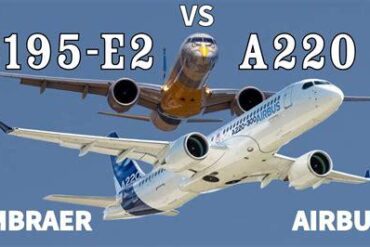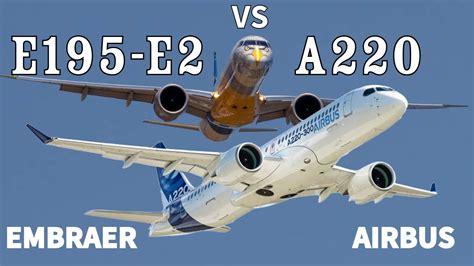
For airlines choosing a small narrowbody aircraft, the most important number is not always the number of seats, the published range, or even the fuel burn per hour. Sometimes, the economics are hidden in something much less glamorous: what the airport charges every time the aircraft lands. That is where the Embraer E195-E2 can gain an advantage over the Airbus A220-300, despite the two aircraft being close enough in market positioning to compete directly for airline orders.
At first glance, the Airbus A220-300 appears to justify its higher operating costs. It carries more passengers, has greater payload capability, and offers more range than the E195-E2. It is also a substantially larger aircraft, with a higher maximum takeoff weight and maximum landing weight. Those characteristics give airlines additional commercial flexibility, but they also affect the costs associated with every flight. Airport charges are often linked to aircraft weight, meaning a larger aircraft can face a larger bill before it has carried a single passenger.
That distinction becomes particularly important on short and medium-haul routes where the aircraft does not need the A220-300’s full capability. An airline flying a 500- to 1,500-mile route may not need an aircraft capable of carrying nearly 150 passengers over 3,400 nautical miles. If demand is better matched to the E195-E2’s smaller cabin, the Embraer can spread lower fuel, ownership, and airport costs across a passenger load that is more appropriate for the route. The result is an economic equation that goes well beyond the sticker price of either aircraft.
How Aircraft Weight Changes Landing Fees
Landing charges vary considerably from one airport to another. There is no single global formula that determines what an airline pays whenever an aircraft touches down. Airports, airport authorities, and governments can use different systems, but aircraft weight is one of the most important variables in many landing-fee structures. Depending on the airport, charges can be based on maximum takeoff weight, maximum landing weight, certified weight bands, or other measures established by the operator.
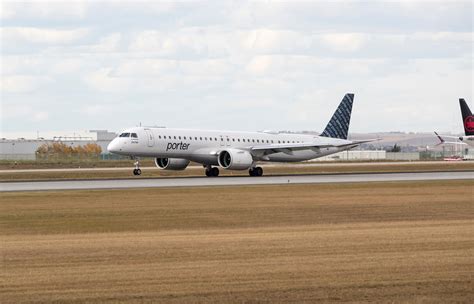
This creates an interesting advantage for the E195-E2. The aircraft can be certified with a maximum takeoff weight of up to 62.5 metric tons and a maximum landing weight of up to 54 metric tons. The Airbus A220-300, by contrast, can reach an MTOW of approximately 70.9 metric tons and an MLW of around 61 metric tons. Those differences may appear relatively modest when looking at an aircraft specification sheet, but they become meaningful when an airport applies a weight-based fee to thousands of annual movements.
An airline does not necessarily pay a fee based on how heavy the aircraft happens to be on every individual landing. In many cases, the relevant certified weight is what determines the charge. This is why an aircraft’s structural size can continue influencing its economics even when it is not operating at maximum payload. An A220-300 flying a lightly loaded sector may still belong to a higher weight category than an E195-E2, creating a cost difference that passengers will never see on their boarding passes.
The effect is especially relevant for airlines operating high-frequency networks. If an aircraft makes six or seven sectors in a day, even a relatively small difference in airport charges can accumulate rapidly. Over a month, a year, and an entire aircraft’s operating life, these recurring costs become part of the aircraft’s fundamental economics.
The E195-E2’s Size Is More Than a Capacity Difference
The central issue is therefore not simply that the E195-E2 is cheaper. It is that the aircraft is smaller in ways that affect several different parts of the airline’s cost structure simultaneously.
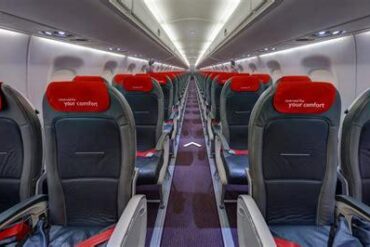
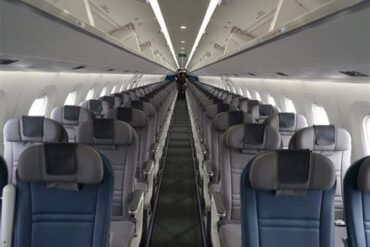
The E195-E2 is designed around a lower passenger capacity than the A220-300. In an all-economy configuration, the Embraer can accommodate roughly 130 to 140 passengers, while a high-density A220-300 can approach 150 seats. The certified exit limit is also different, with the E195-E2 at 146 passengers and the A220-300 at 160.
That capacity difference is a disadvantage when an airline can consistently fill the additional seats. However, it becomes an advantage when the route does not generate enough demand to support the larger aircraft. Flying an A220-300 with 110 passengers instead of an E195-E2 carrying a similar number can leave the Airbus paying for additional aircraft capability that the airline is not monetizing.
The same principle applies to structure. The A220-300 has a larger fuselage, larger overall airframe, greater payload capability, and a larger wingspan. Those features help explain why it can carry more passengers farther, but they also contribute to the aircraft’s higher weight. More aircraft capability inevitably has an economic cost, and that cost is worthwhile only when the airline actually needs the capability.
Fuel Burn Adds Another Layer to the Trip-Cost Equation
Landing fees are only one part of the story. The E195-E2’s lower weight also contributes to its fuel economics, although fuel consumption depends on numerous factors including payload, flight distance, altitude, weather, engine performance, and operating procedures.
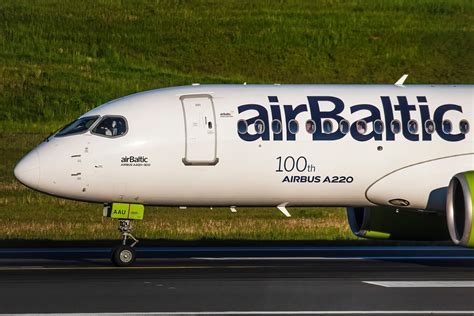
The E195-E2 uses the Pratt & Whitney PW1900G, while the A220 family uses the PW1500G. Both engines belong to Pratt & Whitney’s geared turbofan family and were developed to provide substantial improvements in fuel efficiency compared with older-generation engines. The key difference is that the engines are installed on aircraft of different sizes.
A heavier aircraft generally requires more energy to accelerate, climb, cruise, and land. The A220-300 has the structural capacity to transport more passengers and cargo over longer distances, so its higher fuel consumption is partly the price of that capability. The E195-E2, meanwhile, can exploit its smaller size on missions where the additional seats and range of the Airbus are unnecessary.
This is why trip cost and seat cost are not the same thing. A larger aircraft can have an attractive cost per available seat while still costing more to operate on an individual flight. If demand is strong enough to fill those extra seats, the A220-300 can turn its larger capacity into greater revenue and potentially superior economics. If demand is weaker, the smaller E195-E2 can avoid carrying empty capacity.
For airlines, that distinction is critical. An aircraft does not generate revenue simply because its seats exist. Revenue comes from passengers, cargo, and other commercial activity that actually uses the available capacity.
Why Landing Fees Matter More on Smaller Aircraft
There is another subtle part of the equation. Landing charges are often treated as relatively minor compared with fuel, labor, maintenance, and aircraft financing. But their importance can increase when the aircraft has fewer seats.
Imagine two aircraft paying different landing charges while carrying roughly the same number of passengers. The difference in airport fees is then divided among a smaller number of travelers. A weight-based charge that looks insignificant at the aircraft level can become meaningful when converted into a cost per passenger or cost per trip.
This is one reason the E195-E2’s lower weight can be more valuable than its specification sheet suggests. The advantage does not come from one dramatic saving. Instead, it can emerge from several recurring differences: airport fees, fuel consumption, ownership costs, and in some airline operations, crew expenses.
The E195-E2 can therefore be particularly attractive on routes where frequency matters more than maximum capacity. An airline might prefer to operate several smaller aircraft rather than fewer larger aircraft if passenger demand is distributed throughout the day. That strategy can also provide passengers with more departure choices while allowing the carrier to match capacity more closely with demand.
The A220-300 Has a Powerful Economic Counterargument
The E195-E2’s lower trip cost should not be interpreted as meaning that the A220-300 is economically inferior in every operation. The larger Airbus exists for a reason. Its additional capacity, payload, and range are commercial assets that can produce more revenue when the market supports them.
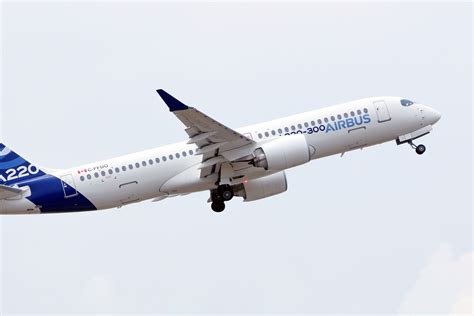
The E195-E2 has a brochure range of approximately 3,000 nautical miles, or 5,600 kilometers. The A220-300 is listed at around 3,400 nautical miles, or 6,300 kilometers. That additional 400 nautical miles can open routes that are difficult or impossible for the Embraer, particularly when the airline also needs meaningful payload reserves.
The Airbus can also carry more passengers. In a market with consistently strong demand, those additional seats can offset the higher fuel and airport costs. A carrier that can fill the A220-300 may therefore generate more revenue per departure than an E195-E2, even if the Embraer remains cheaper to operate on an individual trip.
This is the fundamental trade-off between the two aircraft. The E195-E2 is optimized around avoiding unnecessary capacity, while the A220-300 provides more capacity for airlines that can use it.
Purchase Price Makes the Difference Even Wider
Airport charges and fuel are recurring operating expenses, but the E195-E2 also benefits from a lower capital requirement in many deals. Purchase prices are rarely straightforward because manufacturers negotiate individual contracts involving discounts, financing, maintenance support, training, spare parts, and other services. Nevertheless, the E2 has generally occupied a lower-cost position than the A220-300.
Leasing economics can also reflect the different market values and demand for each aircraft. The A220-300 has attracted more than 1,000 orders on its own and has established a strong position in the small narrowbody market. That scale demonstrates how many airlines value its additional capability.
The E195-E2, however, has accumulated hundreds of orders and has established a distinct market niche. Its appeal is strongest among carriers that do not need an A220-300’s additional range and capacity. For those airlines, paying more for the larger aircraft can amount to buying performance that is difficult to monetize.
This is also why aircraft utilization and route structure matter as much as aircraft specifications. A high-frequency regional network with moderate demand can favor the E195-E2, while a long-range network with stronger passenger volumes can favor the A220-300.
Engine Reliability Has Also Changed the Recent Equation
Another factor has affected the operating economics of both aircraft families: the durability problems experienced by Pratt & Whitney’s geared turbofan engines. The PW1500G on the A220 has been particularly affected by premature component wear and the resulting inspections, repairs, and engine removals.
These issues have contributed to aircraft groundings and significant disruption for some A220 operators. Several carriers have altered their fleet plans in response to engine availability and maintenance requirements. The E2 has not been completely insulated from PW1900G issues, but the scale of disruption has generally been lower.
That difference matters because an aircraft only earns money when it is available to fly. A theoretical fuel saving is of little value if an aircraft is unavailable for an extended maintenance event. Similarly, a low landing fee does not help an airline if the aircraft cannot complete its scheduled rotation.
Pratt & Whitney has been implementing improvements intended to address the durability problems, so the present situation should not necessarily be treated as a permanent difference between the two aircraft. As engine modifications and maintenance programs mature, the reliability gap could narrow.
Why the A220-300 Has Sold So Much Better
The A220’s sales success provides an important counterpoint to the E195-E2’s lower trip-cost proposition. The A220-300 occupies a particularly attractive part of the market because it combines relatively low operating costs with mainline-airliner capacity and range.
It is roughly comparable in capacity to aircraft such as the Airbus A319 and Boeing 737-700 while offering modern-generation engines, a modern cabin, and a clean-sheet airframe. The E195-E2 is smaller and remains closer to the regional-jet end of the market in terms of capacity.
That makes the A220-300 useful for airlines planning network growth. A carrier can replace smaller aircraft while still gaining additional seats and range. It can also use the aircraft on routes that would be too demanding for the E195-E2.
The sales numbers therefore do not contradict the E195-E2’s cost advantage. Instead, they show that airlines are willing to pay more when the extra capability creates additional revenue opportunities.
The Real Question Is Whether an Airline Needs the Extra Aircraft
Ultimately, the hidden landing-fee math is part of a much larger question: how much aircraft does an airline actually need?
The E195-E2 can be cheaper per trip because it is lighter, carries fewer passengers, burns less fuel in many missions, and can face lower airport charges. Its acquisition and leasing economics can also be attractive. When route demand fits its capacity, these savings can create a compelling overall business case.
The A220-300 takes the opposite approach. It accepts higher costs in exchange for more seats, more payload, and more range. Those capabilities allow it to generate additional revenue and serve markets that the Embraer cannot address as effectively.
That is why the two aircraft continue to compete despite their differences. They are not identical airplanes, but they overlap in enough of the market to make the decision meaningful. For an airline that needs maximum flexibility and additional capacity, the A220-300 can justify its higher trip costs. For an airline focused on matching aircraft size to actual demand, the E195-E2’s smaller footprint can become a major financial advantage.
The most revealing number may therefore not be the purchase price or even the fuel burn. It is the total cost of completing one flight. Once landing charges, fuel, ownership, maintenance, crew, and passenger demand are combined, the E195-E2 can look surprisingly efficient. Its smaller size is not merely a limitation. In the right network, it is the reason the aircraft can cost less every time it leaves the gate and lands again.