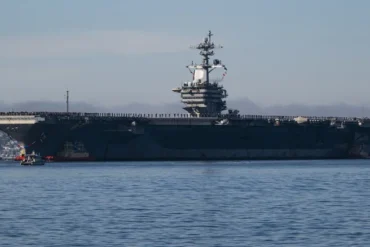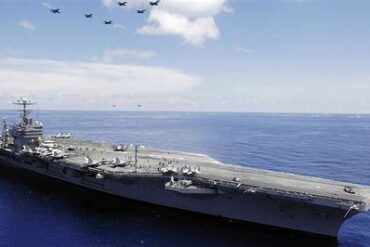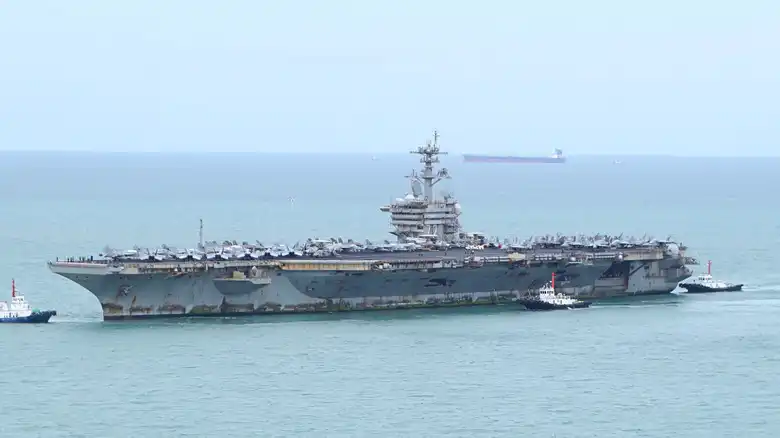
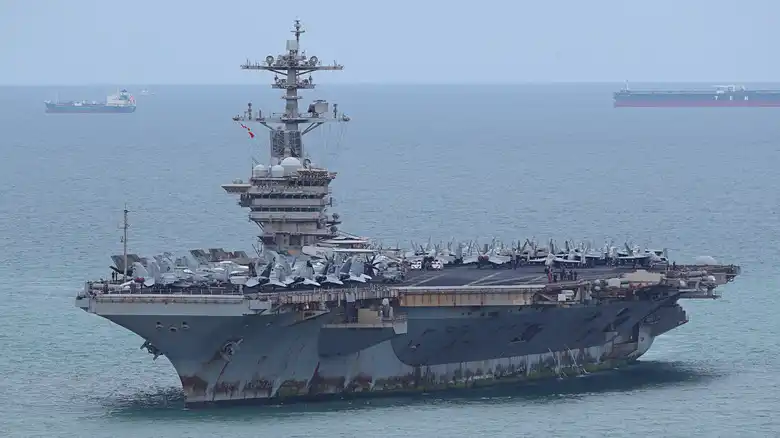
The USS Abraham Lincoln (CVN-72) returned to its home port in September 2026 after an extraordinary 286-day deployment, and photographs of the Nimitz-class aircraft carrier attracted attention for extensive rust staining along the hull. For a vessel representing one of the U.S. Navy’s most powerful warships, the weathered appearance looked dramatic. Yet the rust does not necessarily indicate serious neglect or structural failure. After such a prolonged period at sea, much of what observers saw was the visible consequence of operating in an environment that relentlessly attacks exposed steel.
The Lincoln’s unusually long deployment left little opportunity for normal maintenance. The carrier spent extended periods away from shore, where sailors could not bring the ship alongside a pier and carry out hull preservation. This was particularly important around the waterline, where waves continuously wash over the steel and make maintenance difficult while underway.
Saltwater is the central reason the USS Abraham Lincoln developed such conspicuous rust. Seawater contains salts and other compounds that accelerate corrosion, while the constant movement of a carrier through waves exposes vulnerable areas to repeated wetting and drying. The forward sections of the hull can receive especially heavy punishment because they encounter choppy water as the ship moves ahead. Over time, small areas of corrosion can become large, highly visible patches, particularly when routine cleaning and protective coating work has been postponed.
Why the USS Abraham Lincoln’s Waterline Rust Looks So Severe
The most obvious rust appeared around the waterline, precisely where maintenance is hardest to perform during an active deployment. Sailors can address some preservation tasks while a carrier is operating at sea, but safely treating the hull at the waterline requires the ship to be in port and protected from constant wave action. Once the Lincoln returned home, crews could access these areas, remove corrosion, prepare the affected steel, and restore protective coatings.
Retired U.S. Navy Capt. Carl Shuster told CNN that rust along the waterline is not unusual after ships spend 60 days or more continuously at sea. He estimated that, based on images of the Lincoln, preservation and rust removal could potentially be completed in roughly 30 days. That assessment helps put the carrier’s appearance into perspective: a rusty hull can look alarming without necessarily meaning the ship has suffered catastrophic damage.
Rust Is a Maintenance Problem, Not a Sign the Carrier Is Finished
Corrosion still matters because rust can progressively weaken steel if it is allowed to continue unchecked. That is why naval maintenance crews do not simply ignore visible corrosion. Removing rust and restoring protective coatings helps prevent relatively manageable surface deterioration from becoming a larger structural problem.
In the Lincoln’s case, the 286-day deployment limited normal preservation opportunities, especially along the waterline. Returning to port provided the time, access, equipment, and stable conditions needed for thorough hull maintenance. The dramatic rust seen on the USS Abraham Lincoln is ultimately a reminder that even a nuclear-powered aircraft carrier must regularly battle the ocean’s corrosive effects.