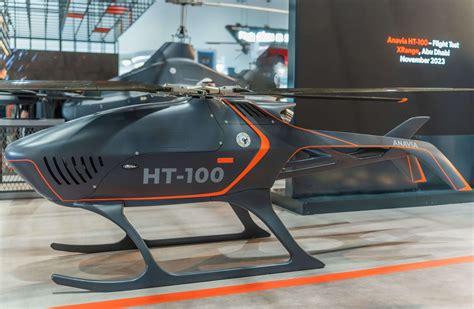
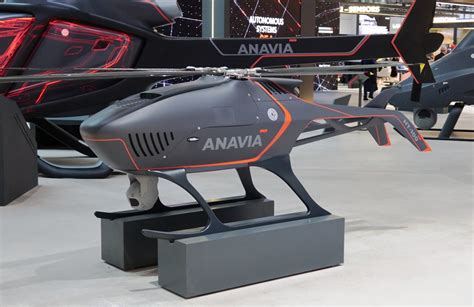
The United Arab Emirates has taken a decisive step toward reshaping modern military aviation with the confirmed order of 168 unmanned helicopters, signaling a doctrinal shift from experimental drone use to fleet-scale autonomous rotary-wing operations. Announced by EDGE Group on January 22, 2026, the procurement for the UAE Ministry of Defence covers two distinct platforms produced by its subsidiary ANAVIA: the HT-100 for intelligence, surveillance, and reconnaissance missions, and the larger HT-750, purpose-built for autonomous logistics and lift. Unveiled during UMEX and SimTEX 2026 in Abu Dhabi, the deal stands as one of the most substantial global investments ever made in unmanned helicopter technology.
This order is not about novelty. It reflects a strategic calculation that unmanned helicopters solve operational problems that neither fixed-wing drones nor manned rotorcraft can efficiently address at scale. Hovering persistence, vertical resupply to austere locations, shipboard operations, and risk reduction in contested environments are all baked into this procurement. By committing to 76 HT-100 ISR platforms and 92 HT-750 logistics systems, Abu Dhabi is formalizing unmanned rotary aviation as a core component of national defense, not a supplementary capability.
The scale alone is revealing. While many militaries operate unmanned helicopters in small numbers for trials or niche maritime roles, the UAE is building a distributed, daily-use fleet capable of sustaining autonomous operations across land, sea, and infrastructure nodes. This move aligns with the country’s broader defense-industrial strategy: sovereign capability, rapid deployment, and technological leverage in complex operating environments.
Strategic Logic Behind the UAE’s Unmanned Helicopter Investment
The operational geography of the UAE explains much of the logic. Long coastlines, offshore energy infrastructure, vast desert expanses, and forward island facilities all demand persistent aerial presence. Fixed-wing drones excel at wide-area surveillance but struggle with point persistence and vertical logistics. Manned helicopters, while flexible, expose crews to unnecessary risk and impose high operational costs when used for routine resupply or overwatch.
Unmanned helicopters occupy the middle ground. They hover where fixed-wing drones cannot, land where runways do not exist, and operate without risking pilots in environments where threats may be ambiguous or escalating. For Abu Dhabi, this translates into round-the-clock ISR over borders and maritime approaches, autonomous resupply to remote outposts, and ship-to-shore logistics without pulling manned assets away from high-end combat readiness.
The procurement also reflects confidence in domestic defense manufacturing. EDGE Group’s emphasis on indigenous platforms reduces reliance on foreign suppliers while allowing tighter integration with UAE command, control, and data architectures. The result is not just hardware acquisition, but doctrine, industry, and autonomy evolving in parallel.
HT-100: Compact ISR Platform Built for Persistent Presence
The ANAVIA HT-100 is designed as a tactical ISR workhorse, optimized for endurance, sensor flexibility, and operations close to the battlespace. Its most distinctive feature is the Flettner dual intermeshing rotor system, which eliminates the tail rotor entirely. This configuration reduces mechanical complexity, improves stability in gusty coastal winds, and enables operations in confined landing zones such as ship decks or urban rooftops.
With a maximum take-off weight of 120 kilograms and a combined payload-and-fuel capacity of 65 kilograms, the HT-100 is engineered for efficiency rather than brute force. Powered by a 15 kW shaft-turbine engine running on Jet A-1, JP-8, or JP-5 fuel, it consumes approximately 9 liters per hour, making extended patrol cycles economically viable. Endurance reaches six hours, with a top speed of 120 km/h, well-suited for loitering missions rather than rapid transit.
What elevates the HT-100 from a simple drone to a battlefield sensor node is its communications and payload architecture. The platform supports fully encrypted mesh IP data links, LTE connectivity, and SATCOM options, with terrestrial line-of-sight ranges cited up to 200 kilometers depending on terrain and regulatory constraints. ANAVIA markets a maximum mission range of 600 kilometers while carrying a meaningful payload, enabling sensors to be pushed forward without placing manned aircraft inside contested airspace.
Payload options define its operational relevance. Electro-optical and infrared gimbals, LIDAR, and specialized intelligence packages such as COMINT, SIGINT, and ELINT are explicitly supported. For the UAE, this means continuous monitoring of borders, coastlines, and offshore infrastructure, with the ability to cue naval patrol craft or ground reaction forces in near real time.
HT-750: Autonomous Heavy Lift Redefining Military Logistics
If the HT-100 represents persistence, the HT-750 represents disruption. This unmanned helicopter pushes rotary-wing autonomy into a domain traditionally reserved for manned aircraft: medium-lift logistics. With a maximum take-off weight of 1,150 kilograms and up to 750 kilograms allocated to payload and fuel, the HT-750 is not an experimental platform—it is a logistical instrument.
Endurance figures underscore that ambition. ANAVIA cites 15 hours of flight time and a top speed of 222 km/h, supported by 900-liter fuel tanks and a turbine engine consuming roughly 60 liters per hour. Even when carrying a 50-kilogram payload, the platform is advertised with a 2,500-kilometer mission distance, enabling long-range autonomous transport between dispersed operating locations.
Safety and redundancy have been prioritized. The HT-750 incorporates a Hybrid Assistant System capable of providing autonomous electric rotor power in the event of turbine failure, reducing the risk of catastrophic loss over land or sea. Maritime operations are central to the design, with autonomous deck landing, NATO-compatible harpoon securing, and optional emergency flotation systems for overwater missions.
Payload modularity is where the HT-750 quietly changes the logistics equation. The aircraft supports a plug-and-play avionics bus, accommodating ISR sensors such as Wescam MX10 and Trakka systems, as well as logistics-specific modules including cooled cargo containers, skyhook systems with 70-meter lines, and remote drop mechanisms. In practical terms, this enables unmanned resupply of ammunition, fuel, medical supplies, or critical spares to desert outposts, island bases, and naval vessels—without exposing aircrews to small-arms fire or surface-to-air threats.
How the UAE’s Fleet Compares Regionally and Globally
Placed in a regional and global context, the UAE’s unmanned helicopter fleet stands out for both scale and capability mix. Israel’s Steadicopter Black Eagle 50H, for example, is a capable light unmanned helicopter with payload capacity around 12 kilograms and endurance near five hours, ideal for tactical ISR but unsuitable for logistics. Turkey’s Titra ALPiN pushes further, with endurance exceeding nine hours in some configurations, yet still operates well below the HT-750’s payload class.
Even established naval systems such as the U.S. Navy’s MQ-8C Fire Scout, which offers significant ISR capability and a payload exceeding 700 pounds, focus primarily on sensing and targeting rather than sustained autonomous lift. By contrast, the UAE’s HT-750 fleet is explicitly designed to replace routine manned logistics sorties, not merely supplement them.
This distinction matters. It suggests Abu Dhabi is planning for unmanned helicopters to absorb daily operational burdens, preserving manned aviation for high-risk, high-complexity missions. In doing so, the UAE gains endurance, resilience, and political flexibility in environments where escalation dynamics are unpredictable.
A Signal of Future Warfare Doctrine
The order for 168 unmanned helicopters is ultimately less about airframes and more about how the UAE intends to fight and sustain operations in the coming decade. Persistent ISR, autonomous logistics, and distributed aviation networks point toward a battlefield where presence is constant and risk to personnel is minimized by design.
By moving unmanned helicopters from trial units to fleet-scale deployment, the UAE is betting that autonomy, when combined with rotary-wing flexibility, offers decisive advantages in modern conflict and peacetime security operations alike. It is a bet grounded not in speculation, but in a clear-eyed assessment of geography, threat environments, and the economics of sustained military presence.