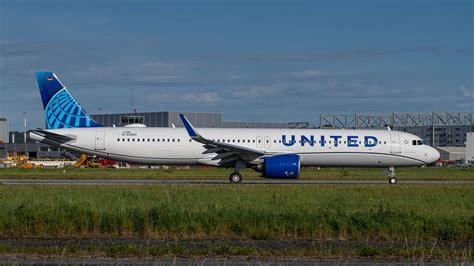
United Airlines is taking a deliberately cautious approach to the Airbus A321XLR, reducing the scope of its initial international schedule after concluding that the aircraft’s practical range may not match the figures presented during its marketing campaign. The decision highlights a crucial distinction in commercial aviation: an aircraft’s advertised maximum range is not necessarily the same as the range an airline can depend on when carrying passengers, baggage, cargo, fuel reserves, and operating through changing weather conditions.
The issue is particularly important for United Airlines, which selected the A321XLR as a key replacement for its aging Boeing 757 fleet. The carrier envisioned the aircraft as a tool for opening thinner transatlantic markets that could not reliably support a larger widebody. However, executives have acknowledged that United cannot deploy the aircraft as broadly as originally anticipated. Instead, the airline is building its first international network around routes that provide a substantial operational margin.
United Airlines Takes a Conservative View of A321XLR Range
Patrick Quayle, United’s Senior Vice President of Global Network Planning and Alliances, has described the airline as “very conservative with the range of the aircraft.” His comments underline why the carrier has adjusted its expectations. Airbus’s original range projections represented an important selling point for the A321XLR, but United’s assessment is based on how the aircraft performs in an actual airline environment rather than under idealized conditions.
For a long-haul narrowbody, range is affected by far more than the distance between two airports. Passenger loads, baggage, cargo requirements, fuel reserves, winds, temperatures, routing restrictions, alternate-airport requirements, and air-traffic conditions can all influence how much usable range remains. A route that appears comfortably achievable on paper can therefore become much more demanding when realistic operational requirements are included.

United’s initial schedule reflects that philosophy. The A321XLR will begin international operations from Washington Dulles International Airport on December 1, with Amsterdam and Dublin among its first destinations. The network will subsequently expand to Toulouse from Dulles, while Newark will receive services to destinations including Ibiza, Luxembourg, and Marseille.
Western Europe Provides United With More Operating Margin
The concentration of the first routes in Western Europe is not accidental. United is keeping the A321XLR within a relatively conservative operating envelope, with its initial destinations located within roughly a 3,400-nautical-mile circle around the aircraft’s launch airports.
Marseille is expected to become the longest of the initial European routes, at approximately 3,402 nautical miles from Newark. That is considerably below the A321XLR’s published maximum range of about 4,700 nautical miles. The difference gives United valuable flexibility when operational conditions are less favorable than expected.
The strategy also preserves the economic reason for choosing the A321XLR in the first place. The aircraft carries substantially fewer passengers than a typical widebody, allowing United to connect smaller European markets with the United States without assuming the financial risk of deploying a much larger aircraft. Its range may prove more limited in real-world service than initially hoped, but it still offers a significant improvement over the Boeing 757-200, whose published maximum range is approximately 3,915 nautical miles.

Range Uncertainty Comes During a Complicated Fleet Transition
Range is not the only challenge confronting United’s A321XLR program. The airline has also described the aircraft as experiencing “teething issues,” while deliveries across the wider A321XLR program have faced difficulties. These problems arrive at an inconvenient moment because United is attempting to coordinate several major fleet transitions simultaneously.
The carrier needs to retire older Boeing 757 aircraft, introduce A321XLRs, and manage delays involving its A321neo Coastliner aircraft. The Coastliner is intended for premium-heavy transcontinental operations, giving United another important fleet project to coordinate alongside the introduction of its new long-range narrowbody.
Other airlines have encountered similar delivery complications. Air Canada has reported significant A321XLR delivery setbacks, while India’s IndiGo has also warned about potential delays to planned deliveries. These difficulties demonstrate that the aircraft’s commercial impact will depend not only on its technical capabilities but also on how quickly manufacturers can deliver reliable aircraft in sufficient numbers.
United Still Sees Long-Term Value in the A321XLR
Despite the more conservative schedule, United has not abandoned its A321XLR strategy. The aircraft remains an important part of the carrier’s plans to replace older narrowbodies while creating new opportunities across the Atlantic. The immediate priority, however, appears to be reliability rather than maximum range.
That approach makes practical sense. A route operated close to an aircraft’s real-world limits can be vulnerable to payload restrictions, unfavorable winds, fuel requirements, and irregular operations. By starting with shorter European missions, United can gain operational experience before deciding whether longer routes are commercially and operationally sustainable.
The A321XLR therefore enters United’s fleet with enormous potential but also a dose of realism. Its published range remains impressive, yet United’s early deployment demonstrates that airline range is about more than a number in a specification sheet. For passengers and network planners alike, dependable performance matters more than theoretical capability.