The U.S. Navy is developing a new long-range air-to-air missile designed to dramatically extend the distance at which its carrier-based fighters can engage airborne threats. Known as the AIM-424 Long Range Air-to-Air Missile (LRAAM), or Malice, the weapon reportedly has a range of 288 miles, putting it well beyond the reach of many existing air-to-air missiles in the American arsenal.
The Navy publicly revealed the AIM-424 on August 22, 2026, although the weapon has reportedly been under development for more than a decade. Its emergence reflects a fundamental shift in naval air combat, where the ability to detect, track, and attack an opponent from far outside traditional engagement distances is becoming increasingly important.
AIM-424 Malice Brings a 288-Mile Air-to-Air Range
The most striking feature of the AIM-424 is its reported 288-mile range. That figure would make Malice the longest-range air-to-air missile currently in the U.S. arsenal, exceeding even the Navy’s existing AIM-174B Gunslinger, whose estimated range is more than 186 miles.
For perspective, the widely used AIM-120 AMRAAM has a range generally described as exceeding 20 miles. The enormous difference illustrates why the AIM-424 represents more than simply another incremental missile upgrade. It is intended to give naval aviation the ability to threaten targets at distances measured in hundreds of miles.

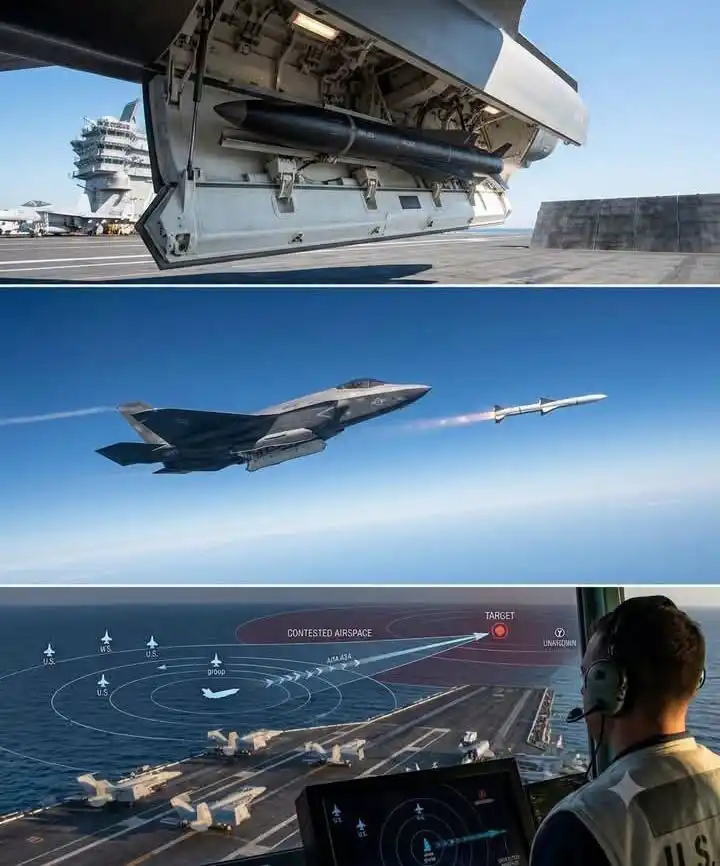
The weapon is being developed for the F/A-18 Super Hornet, F-35C Lightning II, and the Navy’s future F/A-XX sixth-generation fighter program. That combination is significant because it links Malice to both today’s carrier air wing and the next generation of naval aviation.
Why the U.S. Navy Wants Longer-Range Missiles
The AIM-424’s development is closely connected to the changing strategic environment in the Indo-Pacific. The Navy increasingly needs to operate against opponents equipped with weapons capable of threatening aircraft carriers from extreme distances.
China has developed air-launched cruise missiles and anti-ship ballistic missiles with reported ranges exceeding 1,151 miles. Such weapons can create enormous danger for carrier strike groups, forcing American aircraft to consider how they can operate without unnecessarily exposing their ships to enemy missile systems.
Malice offers part of that answer. By extending the reach of naval fighters, the Navy can potentially engage hostile aircraft farther away while maintaining greater separation between its own carrier forces and the threat environment. The missile therefore supports a broader concept of standoff warfare, in which distance itself becomes an important layer of protection.
Two-Stage Design and Compact Carrier Compatibility
Although the Navy has disclosed relatively few technical details, available information indicates that the AIM-424 is a two-stage missile powered by a solid-propellant rocket motor. Raytheon is reportedly responsible for its development.
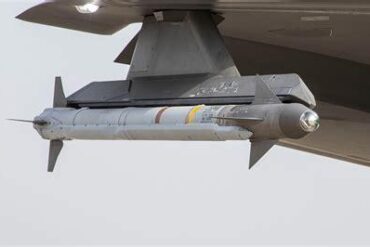
The missile measures approximately 13.5 feet long, has a 13.5-inch diameter, a 26.2-inch wingspan, and weighs around 1,500 pounds. Those dimensions place it in a substantially larger class than the AIM-120, while keeping it close in overall size to the AIM-174B.
That size presents an interesting engineering challenge. Carrier aircraft must balance weapons capacity, aerodynamic performance, stealth requirements, and fuel. The F-35C adds another constraint because its weapons must fit within its internal bays when maintaining a low-observable configuration is important.
The Navy has shown imagery of the AIM-424 loaded inside an F-35C’s internal weapons bay, suggesting that integration with the stealth fighter has been an important consideration from the outset.
A New Layer of Naval Air Defense
The missile’s undisclosed warhead is described as a blast-fragmentation design, a common approach for air-to-air weapons because the missile does not necessarily need a perfect direct hit to damage its target.
More importantly, the AIM-424 appears to be part of a larger transformation in naval aviation. Future carrier aircraft will increasingly depend on long-range sensors, networking, stealth, and weapons capable of exploiting information generated far beyond the individual fighter’s own radar horizon.
That means Malice’s importance cannot be judged solely by its 288-mile maximum range. Its real battlefield value will depend on how effectively it can receive targeting information, maintain a track, resist countermeasures, and reach its target under realistic combat conditions.
When Will the AIM-424 Enter Service?
Despite the public reveal, the AIM-424 is not yet an operational weapon. New military missiles typically undergo extensive developmental testing, flight testing, integration work, and operational evaluation before they can be deployed aboard frontline aircraft.
The Navy has been working on Malice for more than a decade, indicating that the program has already passed through a substantial development period. However, an exact service-entry date remains unclear.
If testing and integration proceed successfully, the AIM-424 could eventually give U.S. naval aviation an extraordinary new capability: engaging airborne targets hundreds of miles away while helping carrier forces remain farther from danger. In an era increasingly defined by long-range missiles and contested airspace, that ability could become one of the most important advantages a carrier air wing possesses.