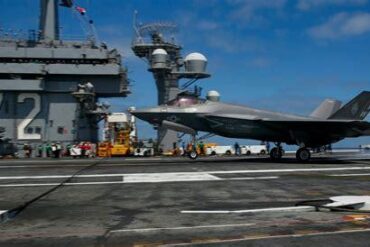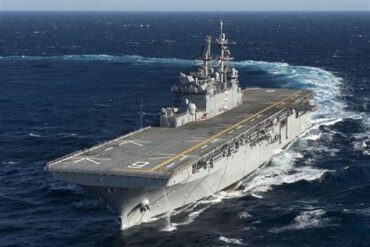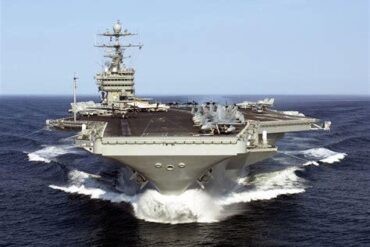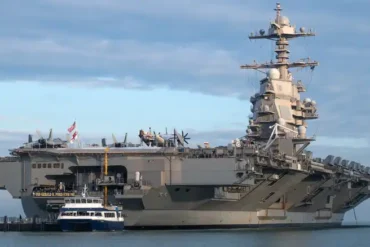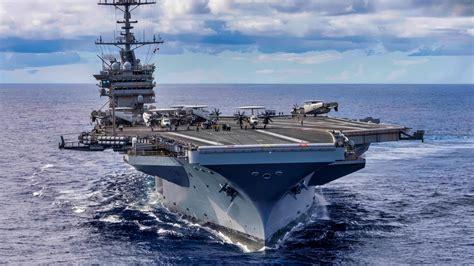
Scattered across the United States, preserved warships attract millions of visitors each year. Historic carriers such as the USS Midway, USS Intrepid, and USS Lexington offer civilians a rare chance to walk flight decks once crowded with fighters, sailors, and Cold War machinery. Yet one category of American supercarrier will almost certainly never join them: the U.S. Navy’s nuclear aircraft carriers.
The reason is not lack of historical value. It is the overwhelming technical, environmental, and financial burden created by naval nuclear propulsion.
Unlike older conventionally powered carriers, every active American aircraft carrier operates with nuclear reactors embedded deep within the ship’s structure. These reactors provide extraordinary endurance, allowing carriers to sail for years without traditional refueling. However, the same engineering that makes them formidable military assets also makes them nearly impossible to preserve after retirement.
The clearest example is the USS Enterprise (CVN-65), the world’s first nuclear-powered aircraft carrier. Commissioned in 1961 and retired in 2012 after more than five decades of service, Enterprise represented one of the most ambitious warships ever built. But retirement did not lead to museum discussions or preservation campaigns.
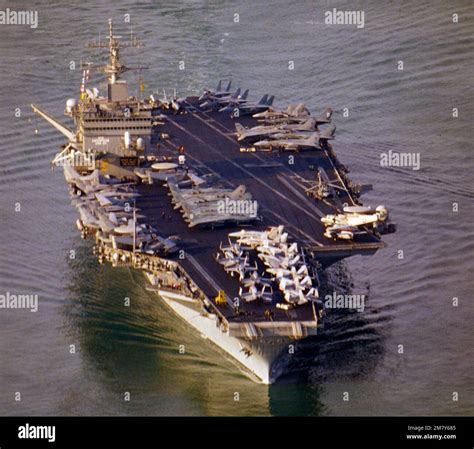
Instead, the ship entered a prolonged dismantlement process that has stretched across years. Even after defueling, Enterprise remained tied up in Virginia awaiting disposal actions, legal reviews, and contracting complications. Its fate illustrates a difficult truth: removing nuclear systems from a carrier is not comparable to stripping equipment from a conventional ship.
Why Nuclear Aircraft Carriers Cannot Be Easily Preserved
Modern nuclear carriers are designed around their reactors. The propulsion plants are buried inside heavily shielded compartments protected by layers of steel, structural framing, and radiation barriers. Accessing them requires extensive destruction of the surrounding vessel.
Former Navy officials have explained that dismantling nuclear carriers demands removal of major ship sections simply to reach the reactor compartments. By the time crews cut through decks, bulkheads, machinery spaces, and reinforced shielding, the original warship effectively ceases to exist as an intact vessel.
What remains is not a ready-made museum candidate but a fragmented industrial project requiring reconstruction costs so enormous that preservation becomes economically unrealistic.
That challenge alone would discourage museum conversion. Radiation control requirements make the situation far more restrictive.
The Nuclear Waste Problem Behind Decommissioned Carriers
Even after reactor shutdown and fuel removal, nuclear-powered naval vessels still contain radiological materials requiring regulated handling. Reactor compartments, contaminated components, shielding materials, and associated waste streams must be processed according to strict federal rules.
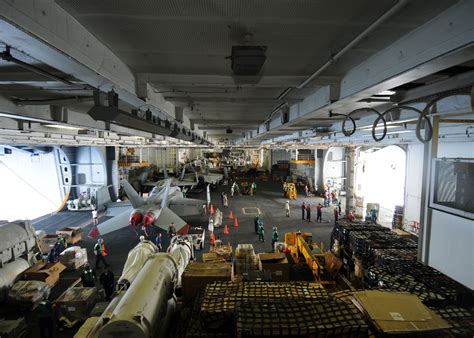
The Navy cannot simply mothball these ships indefinitely, sink them in training exercises, or anchor them permanently as tourist attractions. Reactor-related materials must be extracted, sealed, transported under Department of Transportation oversight, and routed to approved disposal or storage facilities.
Different materials follow different pathways. Nuclear fuel is processed through specialized naval reactor programs, while other waste components may be directed to federal storage and disposal infrastructure. Remaining sections are managed through controlled shipyard systems equipped to handle nuclear dismantlement operations.
These procedures are extraordinarily expensive, logistically demanding, and legally sensitive.
Why No Nuclear Carrier Museum Is Likely to Exist
Public fascination with giant American carriers is understandable. A preserved nuclear supercarrier would be an unmatched historical attraction. Yet practical reality overwhelms nostalgia.
The same reactors that allowed these ships to dominate oceans for decades prevent them from enjoying a peaceful second life as floating museums. Environmental regulations, reactor compartment removal, radioactive material management, and reconstruction costs create barriers that no preservation organization is realistically positioned to overcome.
For America’s nuclear carriers, retirement does not end with ribbon-cutting ceremonies and tourist crowds. It ends in controlled dismantlement yards, where engineering necessity overrides historical sentiment.