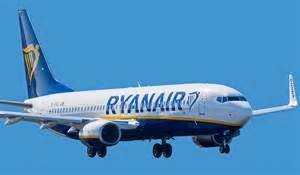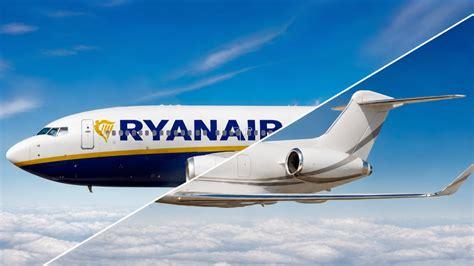
At first glance, Ryanair and private jets appear to belong to completely different worlds. Europe’s ultra-low-cost giant is famous for squeezing every possible efficiency from its Boeing 737 fleet, keeping fares low, maximizing aircraft utilization, and charging separately for services that traditional airlines often bundle into the ticket price. Yet behind that highly standardized operation sits an unusual aviation asset: a small fleet of business jets capable of flying mechanics, spare parts, and other essential personnel around Europe at very short notice.
The contrast is striking. Ryanair passengers may associate the airline with dense seating, limited onboard service, and strict operating procedures, while its maintenance operation has access to aircraft designed for executive travel. These jets are not intended to provide luxury transportation for wealthy customers. Their real purpose is far more practical. Ryanair uses private jets as an operational recovery tool, helping the airline prevent relatively small technical problems from becoming expensive disruptions across its enormous network.
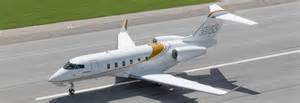
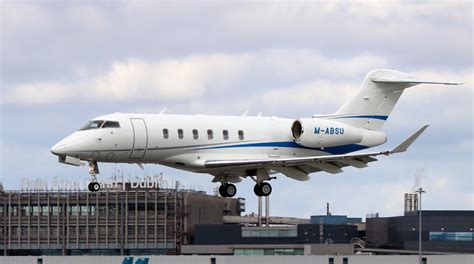
The airline’s newer private-jet fleet consists of Bombardier Challenger 3500 aircraft, with four examples acquired between March 2025 and April 2026 according to the supplied reference material. Registrations associated with the aircraft include M-ABSU, M-ABTE, M-ACOR, and M-ASBA. Ryanair also retains a Learjet 45XR from its earlier business-jet operation, registered M-ABGV. For aviation enthusiasts, these aircraft can be particularly interesting because they may appear on the ground at airports where a conventional Ryanair passenger aircraft would be expected, but their missions are very different.
Why Ryanair Needs Private Jets
The key to understanding Ryanair’s unusual fleet is not luxury. It is time.
Ryanair operates a vast point-to-point network rather than relying entirely on a handful of traditional connecting hubs. That structure is central to its business model, but it also creates a particular operational challenge. Aircraft, pilots, cabin crew, engineers, and spare parts can be distributed across dozens of airports at any given moment. When something goes wrong, the required person or component may be hundreds or even thousands of miles away.
Imagine a Boeing 737 experiencing a technical problem at an airport where a specialized engineer is not available. The aircraft itself may be perfectly capable of returning to service once the right mechanic arrives, but waiting for normal commercial transportation could consume valuable hours. A similar problem can occur when a replacement component is sitting at another location. In a high-utilization airline operation, those hours can quickly spread through the schedule.
A private jet changes the equation. Instead of waiting for a scheduled commercial flight with suitable timings, Ryanair can dispatch a business jet directly toward the location where it is needed. Mechanics, engineers, spare parts, or even repositioned flight crew can be moved rapidly and with much greater scheduling flexibility.
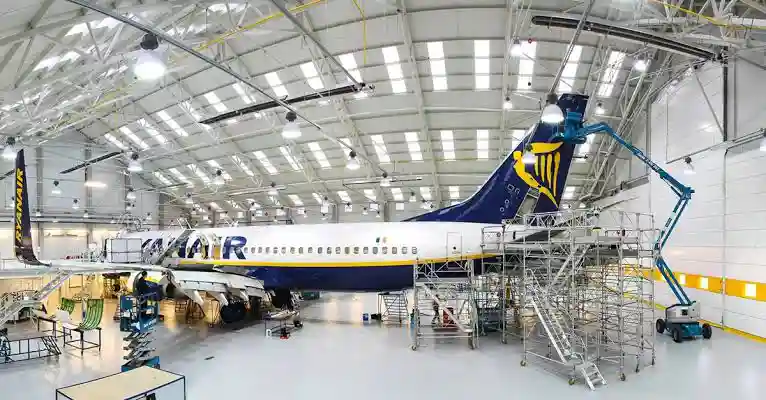
That may sound expensive until the alternative is considered. Under EU261 passenger-protection regulations, qualifying cancellations and long delays can create substantial financial obligations for airlines. Depending on the circumstances, passengers may be entitled to compensation as well as assistance involving meals, accommodation, communication, and alternative transportation.
The direct compensation is only part of the potential cost. A disrupted aircraft can affect subsequent flights, crew schedules, airport operations, aircraft rotations, and passenger connections. The resulting disruption can therefore become much more expensive than the original technical problem.
The Private Jet Can Be Cheaper Than a Major Delay
The economics explain why an airline known for cost control would spend millions of dollars on business jets.
The supplied reference material cites estimates suggesting that the total cost of a serious disruption can exceed €100,000, while operating a private business-jet recovery flight may cost roughly €10,000 to €20,000. Those figures vary according to the situation, but the underlying calculation is straightforward: if a relatively small expenditure can prevent a much larger operational failure, the business jet becomes an insurance policy with wings.
This is especially relevant for Ryanair because the airline operates at enormous scale. Its fleet includes hundreds of Boeing 737 aircraft, and the supplied material puts the figure at approximately 340 aircraft. When an airline has that many aircraft moving through a geographically dispersed network, even a small percentage of technical disruptions can create a steady stream of recovery requirements.
The private jets therefore do not need to fly constantly to justify their existence. In fact, the opposite can be true. Their value comes from being available when the airline needs them most.
A Challenger sitting on the ground is not necessarily an underused asset. It is a reserve capability. When a technical issue suddenly threatens a commercial flight, having an aircraft immediately available can be considerably more valuable than having one flying continuously for revenue.
Ryanair’s Bombardier Challenger 3500 Fleet
The choice of the Bombardier Challenger 3500 also makes sense when viewed from an operational perspective.
The aircraft offers a published range of approximately 3,400 nautical miles (6,300 kilometers) and can normally accommodate around 10 passengers. Its high-speed cruise is listed at Mach 0.82, while its typical cruise speed is approximately Mach 0.80. It can operate as high as 45,000 feet, giving it the performance and range needed to move personnel and equipment across a large European network.
Two Honeywell HTF7350 turbofans provide propulsion, with each engine producing approximately 7,323 pounds of thrust. The aircraft has a wingspan of about 69 feet and a length of approximately 68 feet 8 inches.
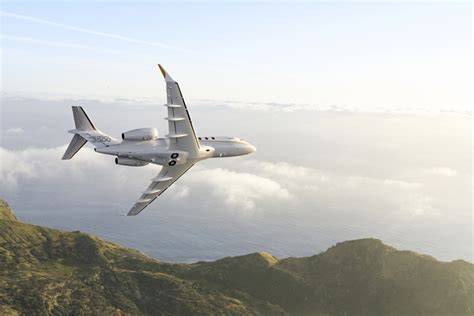
These specifications are excessive if the mission is simply to move a few people between nearby European airports. But that is precisely what gives the aircraft flexibility. Ryanair does not know in advance where a serious maintenance requirement will emerge. A longer-range business jet can respond to a much wider range of situations without requiring intermediate stops.
The first Challenger 3500 reportedly arrived in March 2025, with the aircraft flying from Montréal-Pierre Elliott Trudeau International Airport to Dublin before continuing to London Stansted. A second aircraft arrived the following month, followed by a third. The fourth joined the fleet in April 2026.
The aircraft were acquired new, consistent with Ryanair’s broader preference for acquiring new commercial aircraft directly from manufacturers. The acquisition price of a new Challenger 3500 has been cited at approximately $26.7 million, meaning four aircraft could represent well over $100 million at list-price levels before considering discounts or commercial arrangements.
That is a remarkable amount of money for aircraft that may spend substantial periods parked. But the calculation cannot be made by comparing their purchase price with passenger revenue. Their purpose is to protect the productivity of the much larger commercial fleet.
The Learjets Came Before the Challengers
Ryanair’s private aviation operation did not begin with the Challenger 3500. The airline previously operated three Learjet 45XRs, acquired between 2012 and 2015, and added a Learjet 45 in 2022.
The earlier aircraft were considerably older than the new Challengers. They were used for many of the same operational missions, including moving maintenance personnel, parts, engineers, and flight crews around the network. One Learjet 45XR remains associated with the operation.
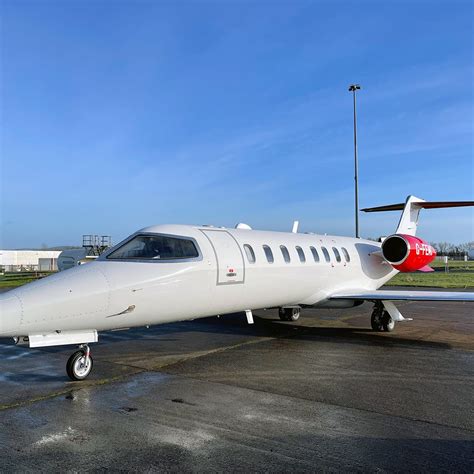
The Learjet 45XR can typically carry around eight passengers and has a range of approximately 1,690 nautical miles. Its cruising speed is around 460 knots, while its published ceiling reaches 51,000 feet. Its smaller size and shorter range made it useful for the same basic mission, although the newer Challenger 3500 provides substantially greater range and modern capability.
The aircraft also stand apart visually and operationally from Ryanair’s passenger fleet. Their Isle of Man registrations and business-jet configurations make them easy to distinguish from the airline’s standard Boeing 737s. Their presence demonstrates that Ryanair’s low-cost model extends far beyond what passengers see during a normal flight.
Why Point-to-Point Operations Make Them Valuable
Ryanair’s network structure is one of the most important reasons this strategy works.
A traditional hub-and-spoke airline can often concentrate engineering resources, spare parts, and replacement crews around major hubs. Ryanair’s extensive point-to-point operation distributes those resources more widely. That creates flexibility for passengers but also increases the importance of rapid positioning.
A mechanic might need to travel from one European airport to another without a convenient commercial connection. A replacement component might need to reach an aircraft before the next scheduled departure. A flight crew could require urgent repositioning after an unexpected disruption.
A private jet provides a direct solution to all three problems.
The Challenger 3500’s cabin can carry personnel while its operational flexibility allows Ryanair to schedule movements according to its own requirements rather than the published timetable of another airline. The result is not glamorous aviation. It is high-speed logistics designed to protect the reliability of a low-cost airline.
Ryanair Is Even Hiring Challenger 3500 Pilots
The importance of the aircraft to the engineering operation is further illustrated by Ryanair’s recruitment activity.
The airline has sought expressions of interest for a Challenger 3500 captain supporting its engineering operation in Bergamo, Italy. The supplied material says the position can pay up to approximately €133,400, with pilots potentially flying to as many as 240 destinations.
The requirements are considerably different from those associated with a conventional entry-level airline pilot. Candidates need at least 3,000 flight hours, including at least 1,000 hours of command experience in a multi-crew, multi-engine environment. Appropriate EASA or UK CAA licensing, strong English proficiency, and EU work authorization are also required.
The selection process includes simulator, technical, and personnel assessments. Pilots already holding a Challenger 3500 type rating receive preference, although other qualified pilots may be able to obtain the rating under a training-cost agreement.
This reinforces an important point: Ryanair is not casually maintaining a couple of private jets for occasional executive travel. The aircraft are part of a structured engineering support system.
These Jets Are Not Ryanair’s Secret Luxury Service
The word “private” can make these aircraft sound more mysterious than they really are.
Unlike Qatar Executive, the private aviation division of Qatar Airways, Ryanair does not operate these aircraft primarily as a premium charter product. Qatar Executive’s fleet is designed to carry customers seeking privacy, flexibility, and luxury, with aircraft including Gulfstream G700s, G650ERs, Global 5000s, and an Airbus A319CJ.
Ryanair’s business jets serve almost the opposite purpose. They are essentially flying maintenance tools.
That difference explains why many passengers may never notice them. A traveler checking into a Ryanair flight is unlikely to be told that a private jet helped deliver the engineer or component that allowed their Boeing 737 to operate. Yet behind the scenes, that small aircraft could be the reason the larger aircraft remains on schedule.
A Private Jet Strategy Built Around Cost Control
Ryanair’s private-jet operation ultimately reveals something fundamental about the economics of ultra-low-cost aviation. Keeping fares low does not mean eliminating expensive assets. It means spending money where it can protect the efficiency of the wider system.
A Challenger 3500 may cost tens of millions of dollars, but a single aircraft can support hundreds of millions of dollars worth of commercial aviation activity indirectly. Its value is measured not by how many passengers it carries, but by how many disruptions it can help prevent.
That makes Ryanair’s unusual private-jet fleet less of a contradiction than it first appears. The airline is not secretly becoming a luxury carrier. Instead, it has adopted an expensive-looking tool for a distinctly low-cost objective: keeping its commercial aircraft flying.
The next time one of Ryanair’s anonymous-looking Boeing 737s pushes back on time, there may be an invisible chain of logistics behind that departure. Somewhere else in Europe, a Challenger 3500 could be waiting with an engineer, a spare component, or a replacement crew member. It may carry only a handful of people, but its mission can protect an entire aircraft rotation.
That is the real secret behind Ryanair’s private jets. They are not a perk for passengers. They are a strategic weapon against downtime.