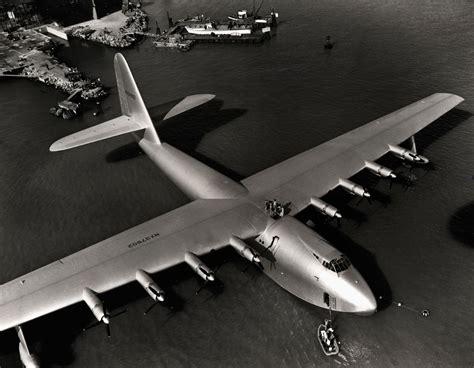
The genesis of the H-4 can be traced to a 1942 U.S. War Department requirement for a non-metal, high-capacity transport aircraft. The goal was ambitious: move 150,000 pounds of cargo or 750 fully equipped troops—and later, even two 30-ton M4 Sherman tanks—across enemy-infested waters without the need for escorts. With aluminum reserved for fighters and bombers, the design had to utilize alternative materials. Enter the Duramold laminated-wood process, which yielded a birch composite structure strong enough to handle the stresses of heavy lift.
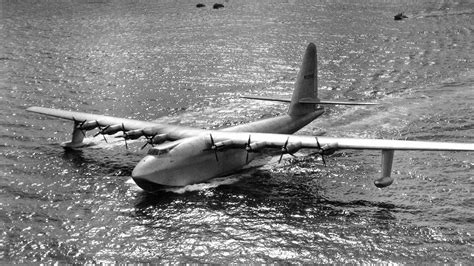
Howard Hughes and industrialist Henry J. Kaiser joined forces, forming the original HK-1 project. Seven conceptual layouts were studied—ranging from twin-hull to single-hull configurations with four, six, or eight wing-mounted engines—before settling on a single-hull, eight‑engine behemoth. By late 1943, Glenn Odekirk and Hughes had finalized the plans for what would become the largest flying boat ever built, with a wingspan that remains unmatched until 2019’s Stratolaunch aircraft.
Design Requirements and Conceptual Evolution
In 1942, Allied shipping losses in the Atlantic were unsustainable. German U-boats wreaked havoc on troop transports and supply convoys, threatening the flow of men and materiel to the European theater. The War Department’s directive called for a strategic airlift capable of carrying unprecedented loads. Researchers quickly realized that traditional aluminum construction was off-limits due to wartime priorities. The Duramold process—laminating thin sheets of birch veneer with resin under heat and pressure—emerged as the solution, offering a composite material lighter than steel yet robust enough for airframe construction.
Henry J. Kaiser, best known for Liberty ships, lacked aeronautical experience but had the vision to leverage his shipbuilding expertise. He enlisted Howard Hughes, whose reputation for pushing technological envelopes aligned perfectly with the mission. The initial HK-1 contract, issued in mid-1942, called for three aircraft built within two years. However, procurement restrictions on strategic materials, plus Hughes’s relentless demand for perfection, introduced significant delays.
By early 1944, only one airframe was under construction. Kaiser, frustrated by missed milestones, withdrew from the project. Hughes renegotiated the contract, narrowing the scope to a single prototype, now designated the H-4 Hercules. Despite the reduced scope, Hughes remained committed to realizing a full-scale flying fortress, directing construction at Hughes Airport in Playa Vista, California. The project enlisted Roddis Manufacturing in Wisconsin to produce specialized birch veneers, which were shipped cross-country for assembly.
Engineering Marvel: Duramold Construction
The Duramold process represented cutting-edge composite technology during the 1940s. Thin birch veneers—no thicker than a few millimeters—were impregnated with phenolic resin and laid up in molds conforming to fuselage, wing, and control-surface contours. Layers were stacked and cured under heat and pressure, forming rigid panels. These panels were then riveted and bonded to form the H-4’s vast airframe. Control surfaces such as elevators and rudder were fabric-covered to further reduce weight.
This labor-intensive approach required meticulous craftsmanship. Teams of young women at Roddis Manufacturing ironed and laminated veneer sheets before shipping them to California. At Hughes Airport, skilled craftsmen assembled the airframe in three giant sections: the fuselage, each wing, and a final shipment containing the tail assembly. A bespoke hangar with a slipway was erected at Long Beach to facilitate water trials.
The result was staggering: a 218‑foot‑8‑inch length, a 319‑foot‑11‑inch wingspan—the largest ever at the time—and an empty weight of 250,000 pounds. Eight Pratt & Whitney R-4360 Wasp Major radial engines, each producing 3,000 horsepower, drove four-bladed Hamilton Standard propellers measuring 17 feet 2 inches in diameter.
Maiden Flight and Operational Legacy
By mid-1947, the H-4 was structurally complete but obsolete for wartime needs. Howard Hughes faced intense scrutiny over the $23 million cost (equivalent to approximately $246 million in 2023 dollars). On August 6, 1947, he testified before the Senate War Investigating Committee, defending the project as a necessary technological leap.
On November 2, 1947, taxi tests began in the Long Beach harbor. Hughes personally piloted the craft, accompanied by co-pilot Dave Grant, two flight engineers, sixteen mechanics, and fourteen invited industry and press guests—36 souls aboard in total. After several high-speed runs, the H-4 lifted off the water, clearing 70 feet of spray and remaining airborne for 26 seconds, covering roughly one mile at 135 mph. At that altitude, it relied on ground‑effect cushion rather than true aerodynamic lift.
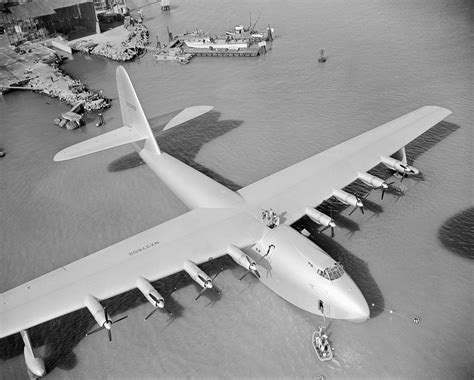
These few seconds proved the aircraft’s flightworthiness and justified the investment in Hughes’s eyes—but the H-4 never flew again. The program’s focus shifted to preserving the prototype rather than pursuing operational testing. A dedicated crew maintained the aircraft in climate‑controlled conditions until Hughes’s death in 1976, when maintenance staff was reduced and eventually disbanded.
Display, Ownership Battles, and Restoration
Ownership disputes between the U.S. government and Hughes’s Summa Corporation lingered until the mid-1970s, when a settlement awarded the H-4 to Summa for $700,000, with the Smithsonian receiving a section of wing and the H-1 Racer. Protected from commercial exploitation, the aircraft found its first public home in 1980 under a geodesic dome next to the RMS Queen Mary in Long Beach, California. Dubbed the Spruce Goose Dome, the venue hosted conventions, dinners, and nightly concerts beneath the aircraft’s towering wings.
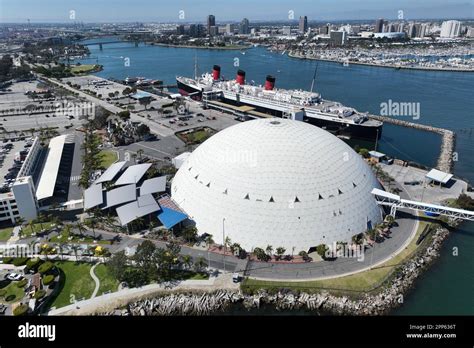
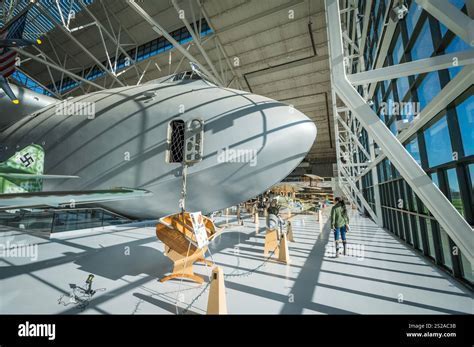
In 1986, the Time Voyager simulator attraction was added at a cost of $2.5 million. Two years later, The Walt Disney Company acquired the complex but abandoned display of the H-4 following the cancellation of its Port Disney project. A new host was sought, and in 1993, the Hercules embarked on a 1,055‑mile, 138‑day journey by barge, train, and truck to the Evergreen Aviation & Space Museum in McMinnville, Oregon.
Arriving on February 27, 1993, the aircraft was reassembled by Contractors Cargo Company and placed on permanent display. The former hangar at Playa Vista was repurposed into film sound stages—hosting productions such as Titanic and End of Days—and now serves as Google’s office and event space, underscoring the enduring legacy of Hughes’s once-secret factory.
Technical Specifications and Performance
The H-4 Hercules’s projected performance figures were as impressive as its dimensions:
- Crew: 3 (pilot, co-pilot, flight engineer)
- Length: 218 ft 8 in (66.65 m)
- Wingspan: 319 ft 11 in (97.51 m)
- Height: 79 ft 4 in (24.18 m)
- Empty Weight: 250,000 lb (113,398 kg)
- Powerplant: 8 × Pratt & Whitney R-4360 Wasp Major, 3,000 hp each
- Propellers: 4-bladed Hamilton Standard, 17 ft 2 in diameter
- Cruise Speed: 250 mph (400 km/h)
- Range: 3,000 mi (4,800 km)
- Service Ceiling: 20,900 ft (6,400 m)
While these numbers were never fully validated in flight—aside from the brief ground‑effect hop—the design remains a testament to engineering ambition.
Cultural Impact and Enduring Fascination
The Evergreen Aviation & Space Museum’s preservation ensures that new generations can appreciate the scale and audacity of Hughes’s vision. Annual attendance figures attest to the aircraft’s draw: hundreds of thousands traverse the museum’s halls to stand beneath the wing that once rivaled a football field in span.
Conclusion: Legacy of Ambition
More than seventy years after Howard Hughes rolled his life’s work into that custom-built hangar, the Spruce Goose endures—not as a successful transport solution, but as a symbol of what happens when determination meets imagination on an unprecedented scale.