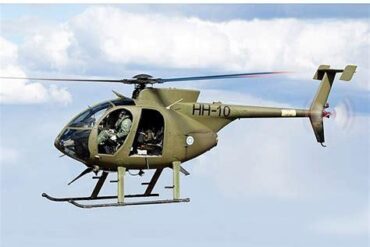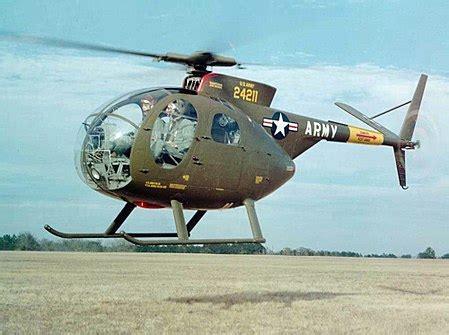
The Hughes OH-6 Cayuse, a light observation and utility helicopter, holds a distinguished place in aviation history. Conceived in response to the U.S. Army’s need for a nimble and reliable scout aircraft, this single-engine helicopter quickly earned a reputation for its agility, survivability, and operational versatility. First introduced in 1966, the OH-6 Cayuse was produced by Hughes Helicopters (now part of MD Helicopters), with an impressive 1,420 airframes constructed specifically for the U.S. Army.
Development Driven by Military Innovation
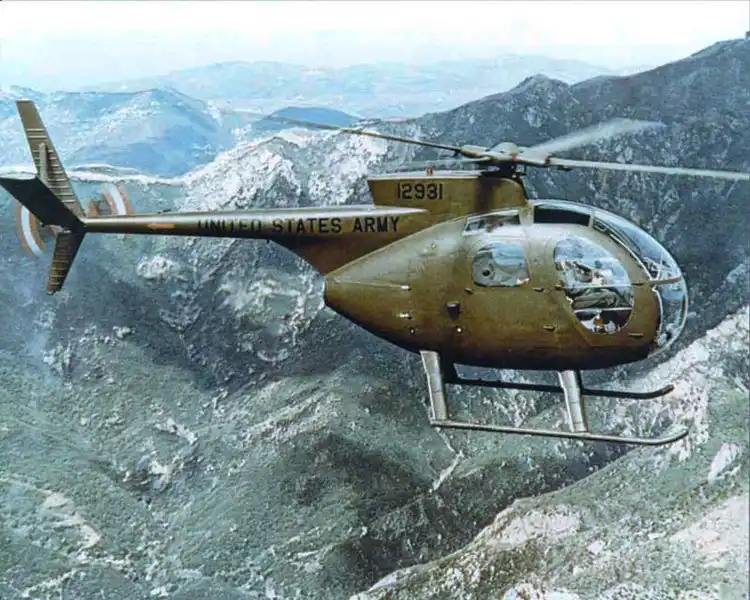
The OH-6 Cayuse was born from U.S. Army Technical Specification 153, issued in 1960 to find a replacement for the aging Bell H-13 Sioux. Hughes submitted its innovative Model 369, which faced stiff competition from Fairchild-Hiller and Bell. The helicopter’s maiden flight took place on 27 February 1963, showcasing its teardrop-shaped fuselage, a design that provided both superior aerodynamics and crashworthiness. Key design elements included a large plexiglass windscreen, self-sealing fuel tanks, and a four-bladed fully articulated rotor, all tailored to maximize agility and visibility in combat and reconnaissance missions.
Powered by an Allison T63-A-5A turboshaft engine producing 252 shp, five prototypes competed at Fort Rucker, Alabama. Hughes secured the production contract in May 1965, initially for 714 helicopters, later expanded to 1,300 units due to operational demand. This decision established Hughes as a leader in rotary-wing aircraft design, a legacy that continues to resonate today.
Frontline Service in Vietnam: A True Battlefield Workhorse
Entering service in 1966, the OH-6 Cayuse was rapidly deployed to Vietnam, where it became a linchpin in U.S. Army aviation tactics. The Cayuse excelled in “hunter-killer” missions, often paired with the formidable Bell AH-1 Cobra. In this tandem role, the OH-6 would sweep low and fast to locate enemy positions, sometimes deliberately drawing fire to reveal hidden adversaries. Once identified, it marked targets with smoke grenades, allowing the AH-1 to engage with devastating firepower. This high-risk, high-reward tactic highlighted the OH-6’s agility and resilience under fire.
One of the most audacious uses of the Cayuse came in 1972, when the CIA modified two OH-6As into the 500P variant for a covert wiretap operation in North Vietnam. These helicopters provided crucial intelligence that informed both Operation Linebacker II and the Paris Peace Talks, underscoring the platform’s adaptability in unconventional warfare.
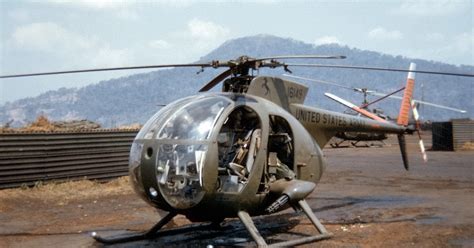
The Vietnam War, however, took a heavy toll on the fleet. Of the 1,422 OH-6As deployed, approximately 964 were lost, primarily to ground fire. Despite these losses, the Cayuse’s effectiveness on the battlefield cemented its reputation as one of the toughest and most reliable light helicopters ever built.
Evolution and Variants: A Lasting Legacy
The rising costs of the OH-6 program prompted the U.S. Army to reopen the competition in 1967, eventually awarding the contract to Bell’s Model 206, which became the OH-58 Kiowa. Nevertheless, the Model 369 lived on, evolving into the MD 500 series, which remains in production and operational service across the globe.
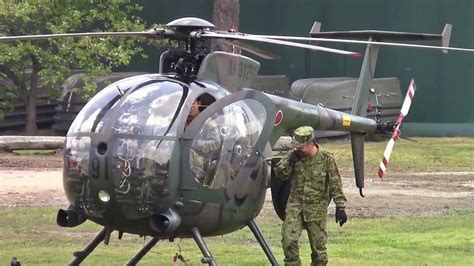
Japan played a pivotal role in extending the Cayuse’s operational lifespan. Under license, Kawasaki Heavy Industries built 387 OH-6/369 airframes for the Japan Ground Self-Defense Force (JGSDF), Maritime Self-Defense Force (JMSDF), and the Japan Coast Guard, as well as various civilian roles like EMS, law enforcement, and agriculture. In 2001, Kawasaki’s development of the OH-1 added further capability to Japan’s light helicopter fleet.
Record-Breaking Achievements in Aviation History
The OH-6 Cayuse is not only remembered for its battlefield prowess but also for its place in aviation record books. In 1966, the helicopter set a staggering 23 world records in categories such as speed, endurance, and altitude. Two notable feats stand out: on 26 March 1966, pilot Jack Schwiebold completed a 1,739.96-mile closed-circuit flight, while on 6 April 1966, Robert Ferry flew 1,923 nautical miles nonstop, carrying a massive fuel load. These records remain unbeaten as of 2021, a testament to the platform’s exceptional design and performance.
Special Operations: The Birth of the Little Bird
The 1980 failure of Operation Eagle Claw led to a comprehensive overhaul of U.S. special operations aviation. Task Force 158, which later became the 160th Special Operations Aviation Regiment (SOAR), adopted the OH-6A for its light assault and reconnaissance missions. Designated the MH-6 Little Bird for transport and AH-6 for armed attack, these helicopters were tailored for fast insertion and extraction of Special Forces, as well as precision strike missions. Their compact size and agility allowed them to be rapidly deployed via C-130 or C-5 aircraft, enhancing U.S. rapid response capabilities worldwide.
Global Operators and Enduring Service
Beyond the U.S. Army and 160th SOAR, the OH-6 Cayuse found a home with numerous military and law enforcement agencies worldwide. Operators have included the Japanese Self-Defense Forces, Spanish Navy, Denmark, Dominican Republic, Malta, Nicaragua, Taiwan, and various U.S. law enforcement units, including the U.S. Border Patrol. Its civilian counterpart, the MD 500, continues to serve in roles ranging from law enforcement to medical evacuation.
Technical Specifications: Hughes OH-6A Cayuse
- Crew: 2 (plus up to 4 passengers or 1,000 lb cargo)
- Length: 30 ft 3¾ in
- Rotor Diameter: 26 ft 4 in
- Empty Weight: 1,229 lb
- Maximum Takeoff Weight: 2,700 lb
- Powerplant: 1 × Allison T63-A-5A turboshaft engine, 317 shp (derated to 252.5 shp for take-off)
- Performance:
- Cruise Speed: 116 knots (sea level)
- Range: 330 nautical miles (ferry range 1,354 nmi)
- Service Ceiling: 15,800 ft
- Climb Rate: 2,067 ft/min
- Armament: provisions for XM-27 machine gun or XM-75 grenade launcher on the port side
Conclusion: A Timeless Symbol of Helicopter Excellence
The Hughes OH-6 Cayuse remains an enduring icon of rotary-wing aviation. Its unmatched agility, ruggedness, and operational flexibility have not only shaped modern reconnaissance and special operations tactics but also influenced the design of subsequent light helicopters. Whether dodging ground fire in Vietnam, setting world records, or executing precision assaults with Special Forces, the OH-6 has proven its mettle time and again. Today, as both military and civilian variants continue to fly, the Cayuse’s legacy stands as a beacon of engineering excellence and combat-tested reliability.